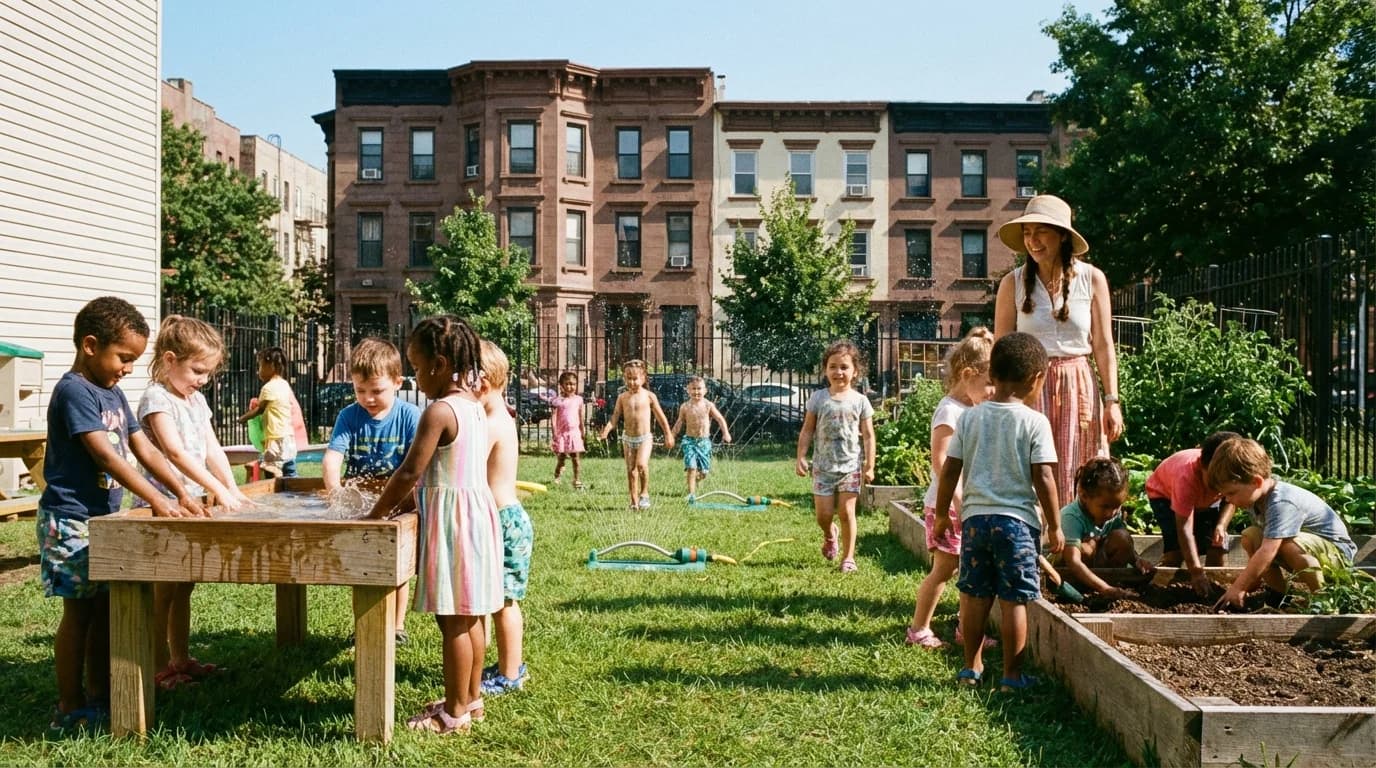
As the weather warms up and the school year winds down, Flatbush parents face a question that deserves more thought than it usually gets: what will your child do all summer? If your little one is in daycare or preschool, the answer might seem obvious. But the quality and structure of a summer program can vary enormously from one center to the next, and those differences matter more than most families realize.
For children between infancy and age five, summer is not a break from learning. Their brains are developing at a pace they will never match again. The connections being formed right now, through language, play, movement, and social interaction, are laying the groundwork for everything that comes after. A thoughtful summer daycare program builds on that momentum. A careless one lets it stall.
Here is what Flatbush families in the 11226 area and surrounding neighborhoods should look for when evaluating summer daycare options in Brooklyn.
Why Summer Daycare Matters More Than You Think
You have probably heard of the "summer slide," the well-documented phenomenon where school-age children lose academic ground over the summer months. Research from the National Summer Learning Association shows that students can lose up to two months of reading achievement during summer break. But here is what gets less attention: the foundations for that summer slide start being laid in the earliest years.
The American Academy of Pediatrics (AAP) emphasizes that consistent, quality early learning experiences between birth and age five are critical for brain architecture. When children experience long stretches without structured stimulation, whether that means language-rich conversations, problem-solving activities, or guided social interactions, the developmental momentum slows. This does not mean toddlers need worksheets in July. It means they need the same kind of intentional, play-based learning environment they thrive in during the rest of the year.
A strong summer daycare program maintains the routines and learning frameworks your child is already accustomed to while layering in the seasonal activities that make summer special. If your child's current program follows a research-backed curriculum like Creative Curriculum, look for a summer program that continues that approach rather than switching to a purely recreational model.
Year-Round Programs vs. Seasonal Summer Camps
One of the first decisions Flatbush parents face is whether to keep their child in a year-round daycare that adjusts its programming for summer, or to enroll in a standalone summer camp. Both have their place, but for children under five, there are compelling reasons to lean toward year-round programs.
Year-round daycares offer continuity. Your child stays with the same teachers, in the same environment, with the same peers. For infants and toddlers especially, this consistency is not a luxury. It is a developmental necessity. Research from Zero to Three shows that secure relationships with consistent caregivers are foundational to healthy social-emotional development. Disrupting those relationships every June and September creates unnecessary stress for young children.
Seasonal summer camps, on the other hand, can be excellent for older preschoolers who are ready for new social experiences and environments. The challenge is finding one with appropriate ratios, qualified staff, and meaningful programming rather than just babysitting with a theme.
At Einstein Daycare, we operate year-round with a curriculum that adapts to the season. Our infant, toddler, and preschool programs maintain the Creative Curriculum framework through the summer while incorporating warm-weather activities that get children outside and moving. The structure stays. The energy shifts.
Outdoor Play and Physical Activity
Summer in Brooklyn is made for being outside. Flatbush families know this instinctively. The playgrounds at Prospect Park fill up by mid-morning, the sprinklers along the B44 corridor are running by late June, and community gardens across the neighborhood are bursting with activity. A summer daycare program should mirror that energy.
The CDC recommends that children ages three to five get at least three hours of physical activity throughout the day, including both structured and unstructured movement. During summer months, quality programs shift more of that activity outdoors. Look for a daycare that offers:
- Daily outdoor time: Not just a quick trip to the playground, but extended periods where children can run, climb, dig, and explore. Morning hours before the peak heat are ideal.
- Water play: Sprinklers, water tables, splash pads, and supervised water activities are staples of good summer programming. They are also excellent for sensory development. Our guide to sensory play benefits in early childhood explains why these experiences matter beyond just cooling off.
- Nature exploration: Even in an urban setting like Flatbush, there are opportunities to observe insects, grow plants, collect leaves, and learn about the natural world. Some programs take walking trips to nearby parks or community gardens.
- Gross motor challenges: Obstacle courses, relay games, parachute play, and age-appropriate sports activities help children develop coordination, balance, and body awareness.
Ask any prospective summer program how much time children spend outdoors on a typical day. If the answer is less than an hour, or if outdoor time only happens "when the weather is nice," that is a program designed around adult convenience, not children's needs.
Sun Safety and Hydration Policies
Brooklyn summers are hot. The average July temperature in Flatbush regularly pushes into the high 80s and low 90s, and the heat island effect in densely built neighborhoods can add several degrees on top of that. A daycare that takes children outside in summer needs clear, written policies for heat safety.
Here is what to ask about:
- Sunscreen policy: Does the center apply sunscreen before outdoor play? Do they use a broad-spectrum SPF 30 or higher? The AAP recommends sunscreen for children over six months and shade or protective clothing for younger infants. You should know whether the center supplies sunscreen or asks parents to provide it, and whether you need to sign a permission form for application.
- Shade availability: Are there shaded areas in the outdoor play space? Canopies, trees, or covered structures make a significant difference during peak sun hours between 10:00 AM and 2:00 PM.
- Heat advisories: What is the center's protocol when the city issues a heat advisory? Quality programs have a specific threshold, often a heat index above 95 degrees, at which they move activities indoors or limit outdoor time to short, shaded periods.
- Hydration: How frequently are children offered water during summer months? The answer should be "constantly." Water should be available and encouraged throughout the day, not just at mealtimes. Watch for centers that use water stations in classrooms and carry water outdoors.
- Appropriate clothing guidance: Good programs communicate with parents about dressing children in lightweight, breathable clothing and closed-toe shoes suitable for active outdoor play. Sending your child in sandals to a program with a climbing structure is a recipe for a stubbed toe.
These details might sound minor, but they reflect a program's overall approach to health and safety. A center that has thought carefully about sunscreen logistics has probably thought carefully about everything else, too. For a broader look at what health and safety standards to expect, see our guide to daycare health and safety standards in Flatbush.
Summer Field Trips and Community Connections
For preschool-age children, summer field trips can be some of the most memorable and educational experiences of the year. Brooklyn offers an extraordinary range of accessible destinations for young learners, and a strong summer program takes advantage of them.
Prospect Park alone provides enough material for an entire summer curriculum. The Prospect Park Zoo, the Audubon Center, the nature trails, the LeFrak Center, and the playgrounds each offer different learning opportunities. The Brooklyn Botanic Garden, just a short trip up Flatbush Avenue, connects beautifully to science and nature studies. The Brooklyn Children's Museum in Crown Heights is one of the oldest children's museums in the world and offers programming specifically designed for the under-five set.
Closer to home, Flatbush has its own assets. The community gardens along Church Avenue and Nostrand Avenue are living classrooms for children learning about plants, insects, and food. The local branch of the Brooklyn Public Library at Flatbush Avenue offers summer reading programs that complement what children are learning at daycare.
When evaluating a summer program's field trip offerings, ask practical questions: How are children transported? What is the ratio of adults to children during outings? Are parents notified in advance? Is there a permission process? For younger children, especially infants and toddlers, the immediate neighborhood and the center's outdoor space may be more appropriate than longer excursions. Walking trips around the block can be just as enriching for a two-year-old as a museum visit is for a four-year-old.
Maintaining Routines Through Summer
One of the most important things a summer daycare program does is something parents might not even notice: it maintains routine. Children thrive on predictability. They feel safer, more confident, and more willing to explore when they know what comes next. Nap time follows lunch. Outdoor play follows morning circle. Art comes after snack. The specifics matter less than the consistency.
During summer, it is tempting for programs to loosen the structure. More free play, fewer planned activities, a "let them just be kids" mentality. There is nothing wrong with flexibility, and summer should absolutely feel different from the rest of the year. But the underlying framework should remain intact.
This is especially important for children who will be transitioning to pre-K or kindergarten in the fall. The summer before that transition is a critical window for reinforcing the self-regulation skills, social competencies, and attention stamina that school will demand. A summer program that lets everything go unstructured from June through August can make the September adjustment significantly harder. For more on how daily routines support development, our post on toddler daily routines at daycare breaks down what a structured day actually looks like.
At Einstein Daycare, our summer schedule adjusts the timing and emphasis of activities, more outdoor play, more water and sensory exploration, more movement-based learning, but the Creative Curriculum framework and daily rhythm remain consistent. Children still engage with all of their learning centers. Teachers still observe and document developmental progress using Teaching Strategies GOLD assessments. The continuity gives children the security to enjoy everything summer has to offer without losing the structure they depend on.
Enrichment Programming in Summer
Summer is an ideal time for daycare programs to lean into enrichment activities. The longer daylight hours and warmer weather open up possibilities that are harder to access in January.
Look for programs that incorporate:
- Music and movement: Outdoor music sessions, rhythm activities, dancing, and singing games. These are not just fun. They support language development, pattern recognition, and social-emotional skills. Our post on why movement and music matter in preschool covers the research behind this.
- Yoga and mindfulness: Summer heat can make children irritable and restless. Yoga provides tools for self-regulation, body awareness, and calm. At Einstein Daycare, yoga is part of our regular programming year-round, and it becomes especially valuable during the high-energy summer months.
- Gardening and nature science: Summer is growing season. Programs that involve children in planting, watering, observing, and even harvesting teach patience, responsibility, and basic scientific concepts.
- Art exploration: Outdoor art projects, messy play, large-scale collaborative murals, and process-based art activities thrive in summer when cleanup is easier and space is more open.
- Cooking and food activities: Simple, no-cook recipes like fruit salads, smoothies, or trail mix teach math concepts (measuring, counting), fine motor skills, and nutrition awareness.
The best summer enrichment does not feel like "extras" bolted onto a basic program. It feels integrated into the day, connected to what children are already learning, and responsive to their interests.
What to Ask When Touring a Summer Program
If you are evaluating summer daycare options in Flatbush or the surrounding Brooklyn neighborhoods, here are the questions that will tell you the most about a program's quality:
- How does your summer programming differ from the rest of the year?
- What is the daily schedule during summer months?
- How much outdoor time do children get on a typical summer day?
- What is your sun safety and heat advisory policy?
- Do you offer water play activities?
- Are enrichment programs like music, art, or yoga included in summer?
- Do you take any field trips? If so, where and how are children supervised?
- Are the same teachers working through summer, or do you use different staff?
- What is the teacher-to-child ratio during summer?
- Is the summer program full-day, and does it run the same hours as the regular program?
The answers to these questions will quickly separate programs that have genuinely thought about summer from those that treat it as an afterthought. Whether you are near Flatbush Junction, the Church Avenue corridor, or anywhere accessible by the B41 or 2/5 line, the standard for what your child deserves does not change when the temperature rises.