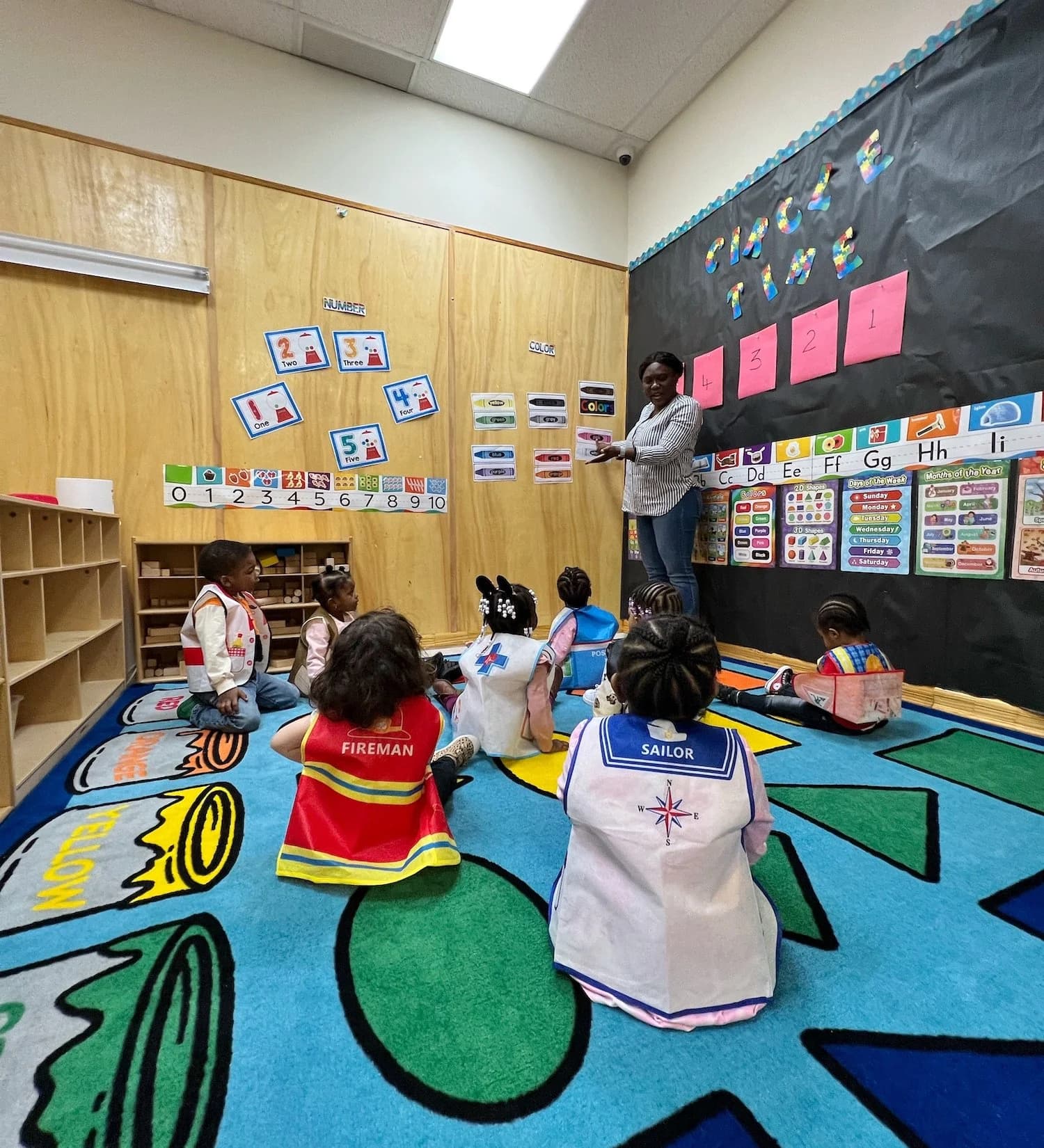
Your toddler wakes up at 6:45 every morning, eats the same breakfast in the same bowl, watches the same four minutes of the same show while you get dressed, and screams if you try to put the left shoe on before the right. You might call this stubbornness. Developmental scientists call it something else: your child's brain building the predictive models it needs to feel safe enough to learn. That same need for daily routine is what makes the transition to daycare work for toddlers across Crown Heights and East Flatbush.
Routines are not a parenting preference or a daycare scheduling convenience. They are a biological requirement for how toddlers process the world. A 2024 systematic review analyzing 170 studies found that family routines were associated with positive outcomes across cognitive, self-regulation, social-emotional, academic, and physical health domains.
Sixteen out of 18 studies in that review found a direct positive link between routines and executive function. That is not a trend. That is near-unanimity in a field where researchers rarely agree on anything.
For families in Crown Heights, Prospect Lefferts Gardens, and East Flatbush who are sending a toddler to daycare for the first time, understanding how routines work is the single most useful thing you can do before that first Monday drop-off.
What Routines Actually Do Inside a Toddler's Brain
Between ages one and three, a child's brain is forming roughly one million new neural connections every second. That sounds impressive until you consider the flip side: toddlers are constantly overwhelmed by incoming sensory information they have no framework for organizing. Routines provide the framework.
When your toddler knows that breakfast comes after waking up, that shoes come after socks, and that you always say the same goodbye phrase at drop-off, each of those predictable sequences frees up cognitive resources. The brain does not have to spend energy figuring out what happens next. It can spend that energy on the new puzzle, the unfamiliar word, or the complicated social interaction happening in the block area.
Research on cortisol levels in toddlers starting daycare shows a clear pattern. Children show rising cortisol, the primary stress hormone, during their initial weeks in group care. This is expected and not harmful in itself.
But the trajectory matters: in programs with predictable daily schedules, cortisol levels stabilize after approximately four months. The routine itself becomes the regulating mechanism. The child's body learns that this environment is safe because the sequence of events is reliable.
This is why a toddler who has attended daycare for six months handles disruptions better than one who started last week. It is not just familiarity with the teachers or the room. It is the accumulated neurological effect of thousands of repeated, predictable sequences telling the stress-response system that everything is under control.
The Five Core Routines in a Toddler Daycare Day
The Creative Curriculum for Infants, Toddlers & Twos identifies five core daily routines that serve as the backbone of a toddler's experience in group care: hellos and goodbyes, diapering and toileting, eating and mealtimes, sleeping, plus dressing. These are not administrative tasks that happen between the "real" learning. They are the learning.
- Hellos and goodbyes teach children about separation and reunion, reinforcing the reliability of relationships. A consistent drop-off ritual tells your child that goodbyes have a pattern and that the pattern always ends with you coming back. We go deeper into this in our post on separation anxiety at daycare drop-off.
- Diapering and toileting are one-on-one interactions between a teacher and child. In a well-run program, diaper changes are not rushed. The teacher narrates what is happening, makes eye contact, and uses the time to build the individual relationship that makes group care feel personal.
- Eating involves self-help skills (using a spoon, drinking from a cup), social learning (sitting at a table with peers), and language development (naming foods, making requests). A toddler who eats lunch at the same time, at the same table, with the same sequence of handwashing, sitting down, eating, then cleaning up is practicing executive function at every meal.
- Sleeping is where memory consolidation happens. Research from UMass Amherst found that preschoolers who napped recalled approximately 10% more on memory tasks than when they stayed awake during the rest period. The American Academy of Pediatrics recommends 12 to 14 hours of total sleep for toddlers, and a midday nap at daycare is part of hitting that target.
- Dressing builds independence, fine motor skills, and body awareness. Putting on shoes, pulling up pants, zipping a jacket: these are real accomplishments for a two-year-old, and they happen within the routine rather than as standalone lessons.
At Einstein Daycare, teachers use the Creative Curriculum framework to turn each of these routines into intentional learning moments. Teachers track developmental progress across 38 objectives in 10 domains using Teaching Strategies GOLD, which means that the routine of putting on a coat is documented as a self-help skill milestone, not treated as dead time before outdoor play.
Why "Routine" Does Not Mean "Rigid"
One of the most persistent misunderstandings parents have about structured daycare schedules is that routine means rigidity. It does not. The National Association for the Education of Young Children defines developmentally appropriate practice as including "predictable, consistent routines" while explicitly stating that these should not become rigid schedules.
The difference matters. A rigid schedule says: circle time is at 9:15 and lasts exactly 12 minutes, regardless of what is happening in the room. A consistent routine says: after breakfast cleanup, we gather on the rug for circle time, and today we will stay a few extra minutes because the children are deeply engaged in the story.
The sequence stays the same. The timing flexes. Your toddler knows what comes next without being rushed through the current moment.
This distinction is what allows routines to support creativity rather than stifle it. When children feel secure in the sequence, they take more risks during the open-ended parts of the day. A child who knows that outdoor play always follows choice time will dig deeper into a block structure because they are not anxious about missing their chance to go outside.
Zero to Three, the national research organization for infant and toddler development, puts it plainly: routines create a sense of safety that allows children to explore, take healthy risks, and engage more fully in learning. Security enables exploration. Not the other way around.
Aligning Home Routines with the Daycare Schedule
Here is where Crown Heights and East Flatbush families can make the biggest practical impact on their toddler's daycare experience. The closer your home routine mirrors the daycare routine, the smoother everything gets.
This does not mean your home needs to operate like a classroom. It means paying attention to the anchor points: wake-up time, meals, nap, and bedtime. If your child eats lunch at daycare at 11:30, eating lunch at 1:30 on Saturday creates a mismatch that shows up as crankiness on Monday morning. If nap starts at 12:30 at daycare but your toddler naps at 3:00 on weekends, Monday's nap time becomes a battle instead of a rest.
Research from the University at Albany-SUNY found that the combination of consistent routines and home learning activities halved the cognitive score gaps tied to household income. Routines alone did not close the gap entirely. But routines created the conditions under which other learning could take hold.
Think of the schedule as the soil. The activities, the books, the conversations at dinner: those are the seeds. Without the soil, the seeds have nowhere to grow.
A few specific adjustments that East Flatbush, Brooklyn families report making the biggest difference:
- Match wake-up times on weekends. You do not need to be precise to the minute, but a child who wakes at 6:30 on weekdays and 9:00 on Saturdays is essentially jet-lagged every Monday. Keep weekend wake-ups within 30 minutes of the weekday time.
- Use the same mealtime language. If the daycare says "time to wash hands for lunch," use the same phrase at home. Consistent verbal cues reinforce the routine across both environments.
- Practice the goodbye ritual at home. Before drop-off is stressful, rehearse it when it is not. Say your goodbye phrase when you leave the room for two minutes. Your child learns the pattern without the emotional charge of an actual separation.
- Keep bedtime non-negotiable. Sleep-deprived toddlers do not adjust to routines. They fight them. A consistent 7:00 or 7:30 bedtime sets the foundation for everything else.
When Your Toddler Resists the Routine
Your 22-month-old refuses to put on shoes. Your two-and-a-half-year-old screams "NO" when you announce it is time to leave the playground. Your toddler throws the breakfast plate and demands crackers instead. You think: this routine thing is clearly not working.
It is working. Resistance is a feature of toddler development, not evidence that routines have failed. Between 18 and 36 months, children are developing autonomy.
The developmental psychologist Erik Erikson identified this stage as the central conflict between autonomy and shame or doubt. Your toddler is supposed to push back. That is the developmental task of this age.
What the routine provides is the container for that resistance. A child who fights putting on shoes within a predictable morning sequence is exercising autonomy in a safe context. They know what comes next. They know the boundary.
They are testing whether the boundary holds. When it does, paradoxically, they feel more secure.
The same applies at daycare. A toddler who protests cleanup time in a classroom with consistent routines is not struggling because of the routine. They are struggling with the transition, which is a different skill that the routine is helping them practice. Over weeks and months, the protests shorten. The child learns that cleanup time is followed by outdoor play, and that knowledge makes the transition tolerable.
If your child's resistance is making mornings feel impossible, the answer is usually to simplify the routine rather than abandon it. Reduce the number of steps. Offer one choice within the sequence ("red shoes or blue shoes?") to satisfy the need for autonomy. Keep the order the same even when the details change.
The Sneaky Goodbye Problem
Parents discover quickly that one of the hardest moments in any daycare routine is the goodbye. And plenty of well-meaning advice suggests that the easiest approach is to slip out while your child is distracted. Do not do this.
A sneaky goodbye solves the problem for you in the moment, but it creates a bigger problem for your child over time. When a parent disappears without warning, the child learns that any moment of distraction could mean the parent is gone. This makes the child more clingy, more vigilant, and less able to engage in play because they are constantly scanning for whether you are still there.
NAEYC research on goodbye routines supports what experienced teachers already know: a predictable, brief goodbye ritual produces less distress over time than an unpredictable one, even when the predictable version involves tears on Day One. Your child needs to learn that goodbyes are real, that they follow a pattern, and that the pattern always ends with reunion.
At Einstein Daycare, teachers work with each family to develop a goodbye routine that fits their child. Some children do well with a wave at the window. Others need to walk their parent to the door and close it themselves.
The specific ritual matters less than the consistency of it. Whatever you do on Tuesday, do it again on Wednesday. And Thursday. And every day after that until it becomes as automatic as brushing teeth.
What the Research Says About Long-Term Outcomes
The case for routines is not just about surviving the toddler years. The effects compound over time. Children who experience consistent daily routines in early childhood show better school readiness, stronger self-regulation, and higher academic achievement in elementary school. The 2024 systematic review mentioned earlier found that routines predicted outcomes across virtually every developmental domain the researchers measured.
The mechanism is straightforward. Routines build executive function: the ability to plan, focus attention, remember instructions, and manage impulses. Executive function at age three is a stronger predictor of school readiness than IQ. A child who has spent two years in a daycare program with consistent, well-implemented routines arrives at kindergarten with two years of executive function training that no worksheet or flashcard app can replicate.
NYC DOHMH requires licensed daycare programs under Article 47 to maintain structured daily programming, which means any licensed center in the 11213 zip code should have a documented schedule. But having a schedule posted on the wall is different from implementing it with intention. When you tour a daycare, watch how teachers manage transitions. Do children know what comes next? Do they move through the sequence with some confidence, or does every transition require a battle? The answers tell you how well the routine is actually working.
For families commuting along Nostrand Avenue on the B44 or walking from the neighborhoods around Wingate Park on Winthrop Street, the choice of daycare program shapes your child's daily experience for years. A program where routines are treated as the foundation of learning rather than the filler between activities will give your child a measurably different start.
Practical Steps for This Week
You do not need to overhaul your home life to support your toddler's adjustment to daycare. Start with three things.
First, ask your daycare for a copy of the daily schedule. Not the marketing version on the website. The actual schedule that teachers follow in your child's classroom. Compare it to your home routine and identify the biggest mismatches. Usually it is meal timing or nap timing, and either one can be adjusted gradually over a week.
Second, build a two-minute goodbye ritual and commit to it. Hug, kiss, one phrase, walk out. Practice it at home this weekend with low-stakes separations: leaving the room, stepping outside for a moment, going to the store. Your child learns the pattern when the emotional stakes are low, which makes the daycare version less frightening.
Third, protect bedtime above all else. Every routine problem in the morning has its roots in what happened the night before. A toddler running on insufficient sleep cannot regulate emotions, tolerate transitions, or learn effectively. The AAP's recommended 12 to 14 hours is not aspirational. It is the baseline your child's brain needs to do its job.
The families we work with at our East Flatbush location, at 900 Lenox Road near the corner of New York Avenue, often tell us the same thing after the first few months: the routine became invisible. Their child stopped resisting transitions. Mornings became predictable. Drop-off became a non-event.
That invisibility is the whole point. When the routine disappears into the background, your child is free to focus on everything happening in the foreground: the friendships, the discoveries, the daily accumulation of skills that will carry them into kindergarten and beyond. Read our guide to preparing for the first week of daycare for more on making the transition as smooth as possible.