If you have toured more than one daycare in East Flatbush, Brooklyn, you have probably heard the words "Creative Curriculum" at least once. Maybe a director mentioned it during a walk-through, or you spotted it on a website. But what does it actually mean for your child's day? And how do you tell the difference between a program that truly uses it and one that just puts the name on the wall?
Einstein Daycare uses Creative Curriculum across all of our classrooms, from the infant room through pre-K. We chose it for specific reasons, and we think parents should understand what those reasons are before deciding on any program in Flatbush, Crown Heights, or the surrounding area.
The Short Answer for Busy Parents
Creative Curriculum is a research-backed early childhood framework published by Teaching Strategies. It is the most widely used curriculum in the United States. Roughly 39% of Head Start programs use it, making it the single most common framework by a wide margin. NYC's Department of Education chose it as the required curriculum for all Pre-K for All and 3-K for All programs citywide.
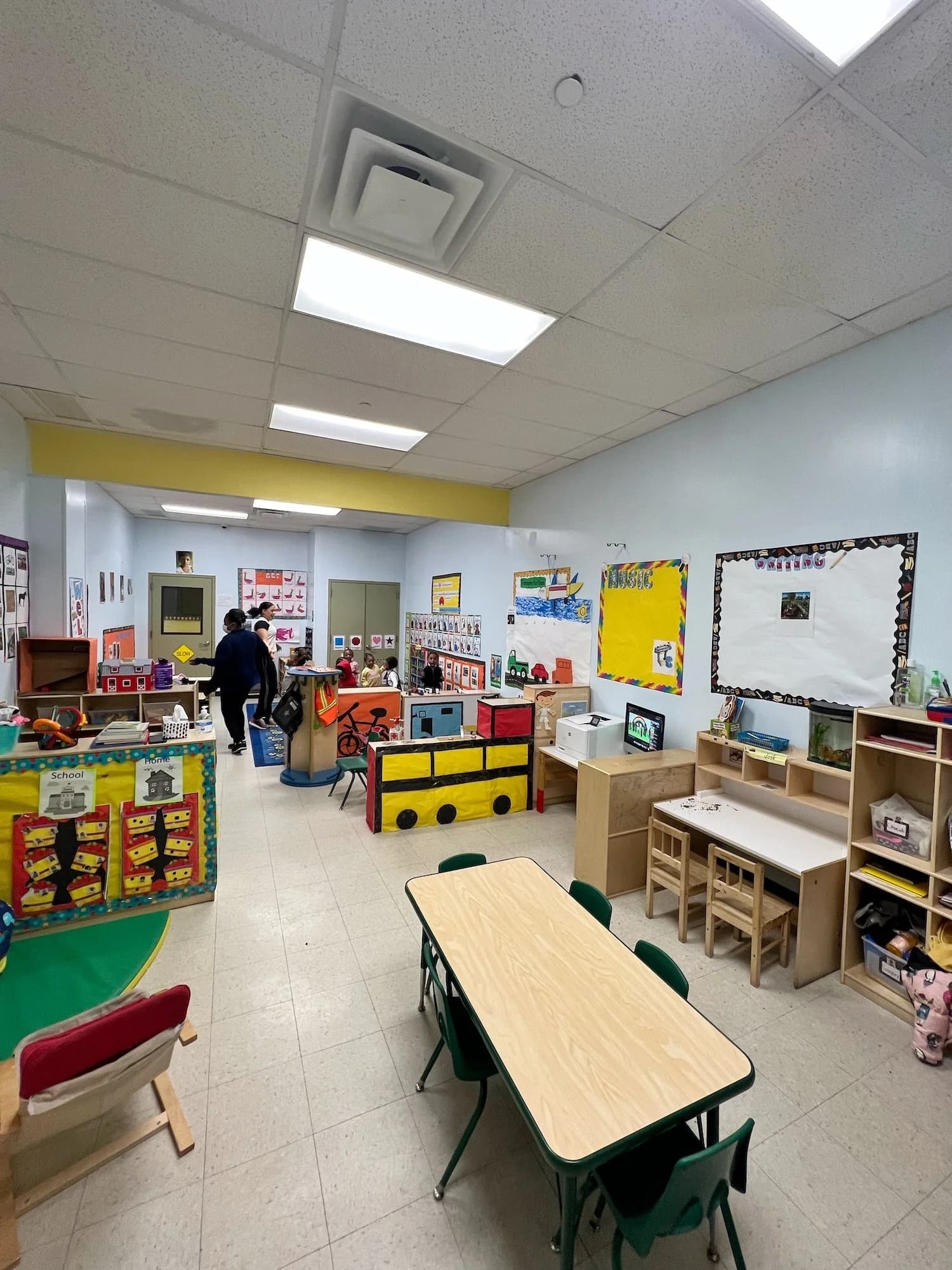
In practical terms, Creative Curriculum organizes a classroom into distinct learning areas, sometimes called "interest areas" or "centers." Each area is stocked with specific materials designed to develop particular skills. Children rotate through these areas during the day, choosing where they want to spend time. Teachers observe, guide, and extend learning based on what each child is doing. The approach combines child-initiated exploration with teacher-directed instruction.
How Interest Areas Work
A classroom using Creative Curriculum has clearly defined zones, each with a developmental purpose. Here is what you would see walking through a preschool classroom at our Lenox Road location.
- Blocks: Wooden unit blocks, cardboard blocks, and accessories like small vehicles and figures. Children build structures, test balance, and collaborate on designs. The learning here covers spatial reasoning and early math concepts like measurement and symmetry.
- Dramatic Play: A play kitchen, dress-up clothes, dolls, and props that change with the curriculum theme. When children pretend to run a restaurant or visit a doctor, they develop language and social-emotional understanding.
- Art: Open-ended materials like paint, clay, collage supplies, and drawing tools. The goal is process, not product. A child's painting does not need to "look like" anything. The value is in the fine motor development and creative expression.
- Library: Books organized at child height, a comfortable reading area, and materials for early writing. Teachers read aloud here daily, building vocabulary and print awareness.
- Discovery: Magnifying glasses, scales, natural objects, and simple science experiments. Children practice observation and cause-and-effect reasoning.
- Sand and Water: Sensory bins with scoops, funnels, and measuring tools. What looks like messy play is actually early math: children learn about volume and weight through hands-on manipulation.
The infant and toddler editions of Creative Curriculum work differently. For the youngest children, the focus is on responsive caregiving, sensory exploration, and building secure relationships with consistent caregivers. The interest areas are simpler but still intentional. Our infant and toddler programs use the age-appropriate version of the framework for each group.
The Balance Between Play and Structure
This is where most parent confusion lives. Some families hear "play-based" and assume it means kids play all day with no direction. Others hear "curriculum" and worry it means worksheets and testing for three-year-olds. Creative Curriculum is neither.
The National Association for the Education of Young Children defines best practice as a "strengths-based, play-based approach to joyful, engaged learning." That is not a contradiction. Play is how young children learn best. A structured curriculum makes sure that play is rich, purposeful, and connected to developmental goals rather than aimless.
In a Creative Curriculum classroom, a typical morning might include a teacher-led circle time with a read-aloud and group discussion, followed by a long "choice time" where children select their own interest areas. During choice time, teachers are not standing back watching. They are circulating, asking open-ended questions, introducing new vocabulary, and documenting what they observe. After choice time, there might be a small-group activity focused on a specific skill, like sorting objects by color or retelling a story in sequence.
The structure exists. You just cannot see it from the doorway, because it does not look like rows of desks and a chalkboard.
How Teachers Track Your Child's Growth
Teaching Strategies GOLD is the assessment system designed to work alongside Creative Curriculum. It tracks child development across 38 research-based objectives spanning social-emotional, cognitive, language, and physical domains. The word "assessment" makes some parents nervous, so let us be direct about what this is and what it is not.
GOLD is entirely observational. There are no tests, no timed tasks, no flashcard drills. Teachers document what they see during normal classroom activity. A child stacking blocks three high goes into the record. A child resolving a conflict over a toy with words instead of hands goes into the record. A child recognizing their own name on a cubby goes into the record. Over time, these observations build a detailed picture of each child's strengths and growth areas.
Parents receive regular reports showing progress across developmental domains. These reports are far more useful than a letter grade or a pass/fail score because they tell you specifically what your child is working on and what comes next. At Einstein Daycare's curriculum page, you can read more about how we use GOLD to individualize learning for each child.
How Creative Curriculum Compares to Other Approaches
If you have been visiting daycares, you have probably encountered Montessori, Reggio Emilia, or HighScope. Each is a legitimate early childhood framework. The differences are real, and knowing them helps you pick the right fit.
Montessori emphasizes self-directed activity with proprietary materials. Classrooms are typically mixed-age, and the teacher's role is primarily observational. Children choose their own work and move through a sequence of increasingly complex tasks at their own pace.
Reggio Emilia is a philosophy rather than a set curriculum. There is no fixed scope and sequence. Long-term projects emerge from children's interests, with teachers acting as co-researchers. Documentation of the learning process is central to the approach.
HighScope uses a "plan-do-review" cycle in which children state what they want to do, carry it out, and then reflect on it. It has strong longitudinal research support from the Perry Preschool Project.
Creative Curriculum provides an explicit scope and sequence aligned to Head Start standards and NYC DOE requirements, with integrated observational assessment through GOLD and extensive teacher support materials. Its strengths are coherence across age groups, strong institutional alignment, and a built-in feedback loop between observation and planning.
No single approach is objectively best. What matters is whether the program implements its chosen framework with fidelity, and whether the teachers understand and believe in what they are doing.
The NYC Connection Most Parents Miss
Here is something many families in the 11203 zip code do not realize. The NYC Department of Education required all Pre-K for All and 3-K for All contracted programs to adopt Creative Curriculum as their citywide standard. That mandate took full effect in the 2024-25 school year.
What this means for your family: a child who starts at Einstein Daycare as a toddler or two-year-old and moves into a NYC public 3-K or Pre-K program at age three or four will walk into a classroom that uses the same framework. The interest areas will look familiar. The daily routine will feel familiar. The vocabulary teachers use will be familiar. That continuity reduces the transition stress that many children experience when switching programs.
This is one of the reasons we chose Creative Curriculum at our East Flatbush location. It is not just an internal decision. It is an alignment with the system your child will enter next. Chalkbeat NYC reported on this citywide mandate and its implications for standardizing early childhood education across the boroughs.
What to Ask When You Visit
If you are touring daycares that claim to use Creative Curriculum, these questions will help you separate strong implementation from surface-level use.
- "Can I see your interest areas?" A program using Creative Curriculum should have clearly defined, well-stocked learning centers. If the classroom is one open room with no defined zones, the implementation may be shallow.
- "How do you use Teaching Strategies GOLD?" Ask how often teachers document observations and how reports are shared with families. If they cannot name the assessment tool, ask what they use instead.
- "How do you balance teacher-directed and child-initiated time?" The answer should describe a daily schedule that includes both. A program that is all free play or all teacher-led activities is not implementing Creative Curriculum as designed.
- "What edition do you use for my child's age group?" Creative Curriculum has separate editions for infants, toddlers, twos, and preschool. A program should be using the age-appropriate version, not a one-size-fits-all approach.
The federal What Works Clearinghouse reviewed Creative Curriculum and found evidence of positive effects across language, print knowledge, and math domains. The research supports that this framework, when implemented well, produces real results for young children.
If you are comparing options across East Flatbush and want to see what full implementation looks like, our photo gallery shows our classrooms and learning centers. Or read our post on why daily movement and music are part of the Creative Curriculum framework at Einstein.