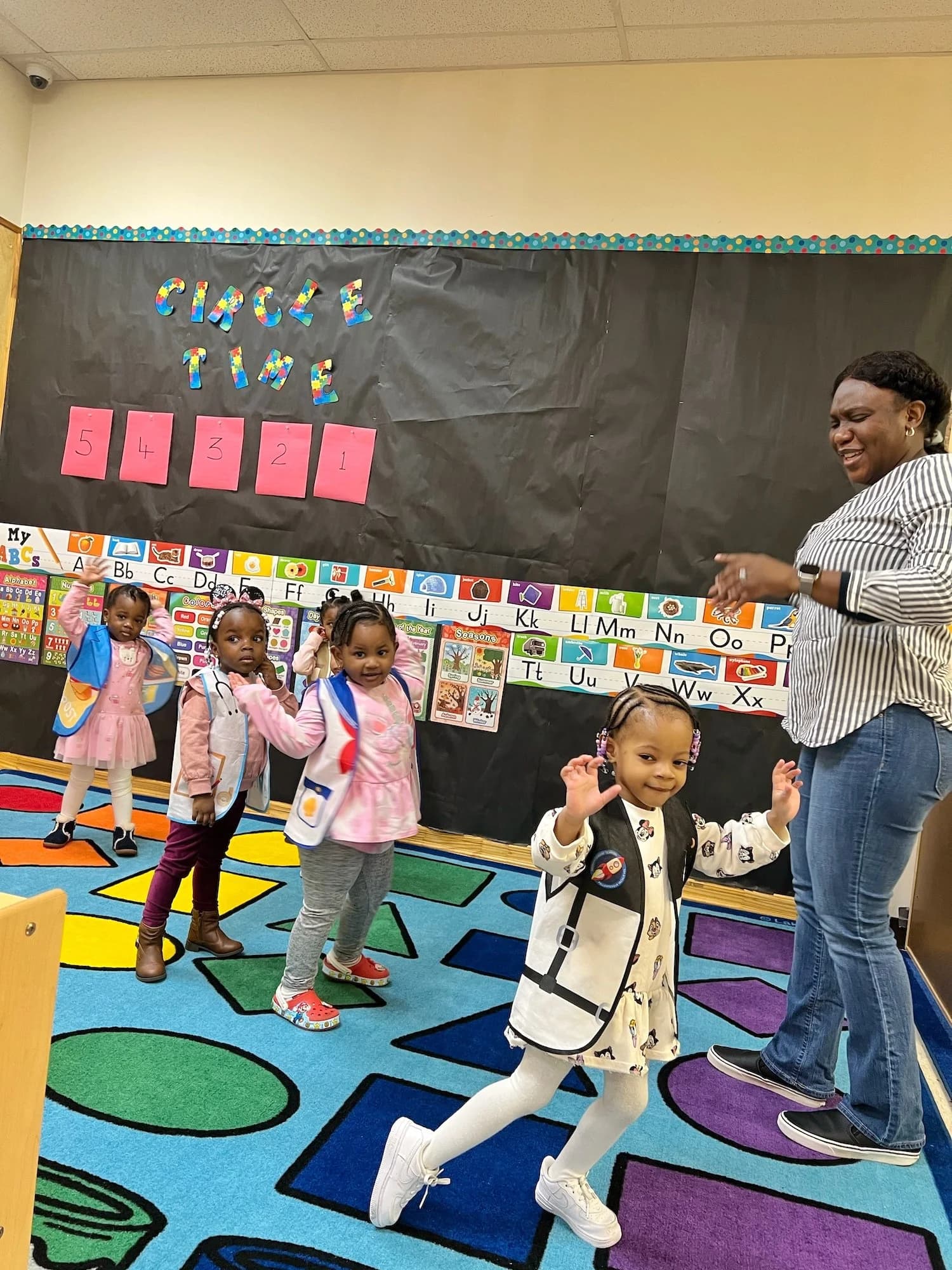
Walk into most daycare classrooms in East Flatbush, Brooklyn, and you will see kids sitting at tables with crayons, listening to a story, or building with blocks. All of that matters. But the programs that produce the strongest outcomes add something else: daily music and movement. Not as a reward for good behavior. As a core part of how children learn.
At Einstein Daycare on Lenox Road, yoga and music are built into every day for children from infancy through pre-K. The decision to prioritize music and movement at our preschool in East Flatbush was not a marketing choice. It was driven by the research, and the results we see in our classrooms confirm it.
Your Child's Brain on Movement
Physical activity does more than burn energy. When young children move, blood flow to the brain increases, oxygen delivery improves, and the brain releases neurotrophins that strengthen neural connections. The prefrontal cortex, which controls impulse regulation, planning, and attention, responds directly to movement-based stimulation. For toddlers and preschoolers whose brains are forming these circuits for the first time, structured movement is not a nice-to-have. It is foundational.
The CDC recommends that preschoolers ages 3 to 5 get at least three hours of active play per day, with 90 to 120 minutes of moderate-to-vigorous activity during an eight-hour care day. That is a high bar, and most programs do not hit it unless movement is intentionally scheduled into the routine.
A 2024 randomized controlled trial published in Child Development found that children in early childhood settings with structured physical activity showed measurable improvements in both executive function and language development. Movement and language may seem unrelated, but the same brain regions that coordinate physical sequences also support the sequencing required for speech and reading.
What the Research Says About Music and Young Children
Music is not background noise in a quality preschool. For young children, it is a direct pathway to language, math, and social connection. Zero to Three identifies music as having a powerful influence on all areas of development, from brain architecture to bonding with caregivers.
Rhythm, beat, and tempo require the brain to recognize patterns and proportions: the same cognitive operations that underlie early math. Children who receive regular music exposure in preschool consistently show stronger vocabulary and listening skills, with measurable gains in reading readiness.
Nearly 70% of preschool teachers report using music three or more times per day. That frequency is not coincidental. Music works as both a learning tool and a regulation strategy. A familiar song during transitions helps children shift between activities without the meltdowns that come from abrupt changes. Rhythm gives young brains a structure to follow when verbal instructions alone are not enough.
Yoga for Preschoolers Is Not What You Think
When parents hear "yoga for kids," many picture miniature adults holding poses on tiny mats. Preschool yoga looks nothing like that. It is a combination of simple poses and breathing exercises adapted for developing bodies and short attention spans.
A 2021 systematic review of yoga in preschool settings found that 83% of studies reported significant improvements in attention following yoga practice. A separate study of five-year-olds who practiced yoga twice per week showed improvements in behavior and cognitive performance, plus better visual-motor coordination, compared to children in standard PE classes.
The reason it works is straightforward. Each pose asks the child to focus on one sensation, one position, one breath. That single-point focus is exactly what a preschool-age brain needs to build the self-regulation skills that predict kindergarten success. NAEYC endorses yoga as a developmentally appropriate way to build motor skills and emotional awareness in young children.
Why Unstructured Play Alone Is Not Enough
Free play matters. But the assumption that young children are naturally active enough to meet their movement needs without guidance does not hold up under observation. Studies show that even in settings with outdoor access, children spend a surprisingly small proportion of their time in moderate-to-vigorous physical activity unless an adult structures the opportunity.
The Rhythm and Movement for Self-Regulation (RAMSR) research program studied 612 children across 26 kindergartens in three randomized controlled trials. Children receiving intentional rhythm and movement instruction showed steeper growth in self-regulation and executive function compared to children who only had unstructured play. Guided movement produced cognitive gains that free play alone did not.
This is not an argument against free play. It is an argument for both. Children at Einstein Daycare get daily outdoor time at our play area, with Wingate Park just down the road for larger outings, plus structured yoga and music led by teachers who understand the developmental purpose behind each activity.
What Music and Movement Look Like at an East Flatbush Preschool
In a toddler room, this might look like a teacher leading a call-and-response clapping game during circle time. The children are practicing rhythm and motor coordination while learning to take turns. They do not know they are learning anything. They just know the song is fun.
The preschool classroom takes it further. Children might follow a sequence of yoga poses that tells a story. A "journey through the jungle" involves balancing like a flamingo, stretching tall like a giraffe, crouching like a frog, and leaping like a monkey. Each pose builds body awareness and spatial reasoning. The narrative thread develops language skills and sequencing ability.
Music for preschoolers includes singing with hand motions and playing simple percussion instruments. Children also move to different tempos: marching slowly, then quickly. When a teacher varies the speed, she is teaching tempo and self-regulation at the same time. When children take turns on a drum, they practice patience and social awareness.
These are not breaks from learning. They are some of the most productive minutes in the school day.
The Connection to School Readiness
Executive function develops most rapidly between ages three and five. Research shows it is more predictive of kindergarten readiness than IQ. Two of its core components, working memory and self-control, are precisely what structured movement and music activities build.
For families in the 11203 zip code and across Flatbush, this has a practical implication. Children who attend a preschool with daily movement and music arrive at kindergarten with stronger self-regulation and attention spans than children whose preschool experience was primarily table-based. The academic skills follow, but the regulatory foundation has to come first.
Head Start recognizes music as a core element of child development, citing its role in language acquisition and cultural identity. That second point resonates in a community where families bring rich musical traditions from across the Caribbean and beyond. Music in the classroom can serve as a bridge between home culture and school learning.
Finding a Program That Puts This Into Practice
If you are comparing daycares or preschools for your family, ask specifically about movement and music. Not just whether the program "has" it, but how often it happens and what the goals are. A few questions that separate strong programs from average ones.
- How many minutes of structured movement happen each day? Look for at least 30 minutes of guided physical activity beyond outdoor free play.
- Is music part of the daily routine or an occasional special event? Programs that use music for transitions, circle time, and learning activities get more developmental value from it.
- What training do teachers have in movement-based instruction? A yoga session led by a trained teacher looks different from one led by someone following a YouTube video.
- How does physical activity connect to the overall curriculum? In a program using Creative Curriculum, movement and music integrate into the learning framework rather than sitting outside it.
At Einstein Daycare, our programs for infants through preschoolers include daily yoga, music, and outdoor play as part of the Creative Curriculum framework. You can see what our classrooms look like by browsing the gallery or visiting in person.