There is a persistent myth among well-meaning parents that the earlier a child learns to read, the better. You see it in the marketing for flashcard apps, phonics workbooks for two-year-olds, and "Your Baby Can Read" programs that promise to turn infants into early readers. The anxiety is understandable, especially for Brooklyn families who know how competitive kindergarten entry and school placement can feel in New York City.
But here is what the research consistently shows: pushing formal reading instruction on children before they are developmentally ready does not create better readers. What does create better readers is building the foundation of skills, knowledge, and love of language that makes reading possible when the time is right. This foundation is called early literacy, and it starts in infancy.
For Canarsie families in the 11236 area and across Brooklyn, understanding what early literacy looks like at daycare can help you choose a program that genuinely prepares your child for reading success, and help you recognize the remarkable language work that is already happening every time your toddler babbles, sings, or asks you to read "Goodnight Moon" for the fourteenth time today.
What Early Literacy Actually Means
Early literacy is not reading. It is the collection of skills, knowledge, and attitudes that children develop before they can read independently. Think of it as building the infrastructure that reading will eventually run on. Without that infrastructure, even the best reading instruction will struggle to stick.
The National Institute for Literacy and the National Early Literacy Panel have identified several key components of early literacy that are strongly predictive of later reading success:
- Phonological awareness: The ability to hear and manipulate the sounds in language. This includes recognizing rhymes, clapping out syllables, and eventually identifying individual sounds (phonemes) in words.
- Print awareness: Understanding that print carries meaning, that we read from left to right and top to bottom, that words are separated by spaces, and that the squiggles on the page represent spoken language.
- Vocabulary: The number and depth of words a child understands. Research shows that vocabulary at age three is one of the strongest predictors of reading comprehension in third grade.
- Oral language: The ability to understand and produce spoken language, including grammar, sentence structure, and narrative skills.
- Letter knowledge: Familiarity with the names and shapes of letters, though this typically develops later in the preschool years and should not be forced on toddlers.
- Print motivation: Perhaps most importantly, the child's interest in and enjoyment of books and reading. A child who loves being read to is a child who will want to learn to read.
A quality daycare program builds all of these components simultaneously, not through worksheets and drills, but through the rich, language-saturated environment that young children naturally thrive in.
The Five Pillars of Reading Readiness
The National Reading Panel, whose work has shaped reading instruction policy across the United States, identified five essential pillars of reading: phonemic awareness, phonics, fluency, vocabulary, and comprehension. While formal instruction in phonics and fluency typically begins in kindergarten or first grade, the groundwork for all five pillars can and should be laid during the daycare years.
Phonemic awareness starts with exposure to language play. When toddlers sing nursery rhymes, they are hearing rhyming patterns. When a teacher plays a game where children clap the syllables in their names ("Ma-ri-a, three claps!"), they are segmenting words into smaller units. When preschoolers play "I Spy" with beginning sounds ("I spy something that starts with /b/"), they are isolating phonemes. None of this requires sitting at a desk. All of it is building the auditory discrimination skills that phonics instruction will depend on.
Vocabulary grows through conversation, read-alouds, and exposure to a rich variety of words in meaningful contexts. The famous Hart and Risley study found that the sheer volume of words children hear in their early years, and crucially, the quality and variety of those words, has a lasting impact on language development and academic outcomes. A daycare where teachers narrate activities, ask open-ended questions, and introduce new words in context is a daycare that is actively building vocabulary.
Comprehension begins with understanding stories. When a teacher pauses during a read-aloud and asks, "What do you think will happen next?" they are teaching prediction, a comprehension strategy. When children retell a story in their own words during dramatic play, they are practicing narrative structure. When they connect a book about rain to the rainy day they can see through the window, they are making text-to-world connections. These are the same comprehension strategies that will be explicitly taught in elementary school, but they start here, in a daycare classroom, with a picture book and a teacher who knows how to use it.
How Creative Curriculum's Library and Literacy Center Works
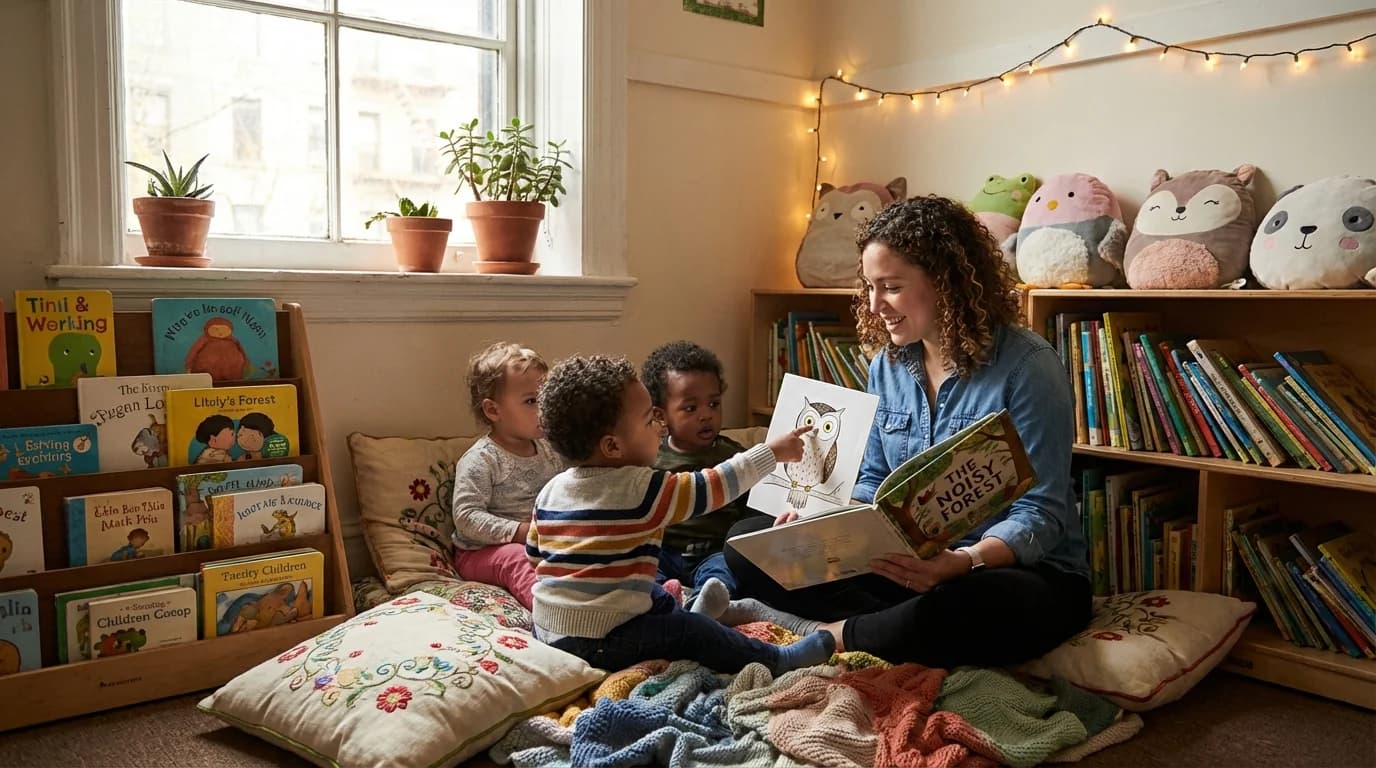
In a Creative Curriculum classroom, literacy is not confined to a single lesson or time block. It is embedded in every interest area and every part of the day. However, the library center serves as the dedicated space where children can develop their relationship with books and print.
A well-designed library center in a Creative Curriculum classroom includes:
- A comfortable, inviting space: Soft seating, good lighting, and a quiet location away from the noisier interest areas. Children should want to go there.
- A diverse, rotating book collection: Board books for younger children, picture books for preschoolers, nonfiction books with real photographs, books in multiple languages reflecting the families in the classroom, and books that represent a wide range of characters, families, and experiences.
- Books displayed face-out: Young children choose books by their covers, not their spines. Displaying books face-out at child height encourages independent browsing.
- Writing materials: Paper, crayons, markers, alphabet stamps, and magnetic letters. The library center often overlaps with a writing center where children can experiment with making their own marks and "writing" their own stories.
- Listening materials: Audiobooks with corresponding physical books, or a simple recording of the teacher reading a favorite story, allow children to experience books independently.
- Props for retelling: Felt board characters, puppets, or small figures that correspond to popular classroom books let children act out and retell stories, reinforcing comprehension and narrative skills.
At Einstein Daycare, our library centers are curated intentionally. We rotate books to connect with classroom studies, seasonal themes, and children's expressed interests. If a group of preschoolers becomes fascinated with trucks, the library center will feature books about trucks, construction, transportation, and how things are built. This is how Creative Curriculum works: teachers observe children's interests and use those interests as doorways into deeper learning, including literacy.
Read-Alouds and Dialogic Reading
If there is one single practice that has the most impact on early literacy development, it is being read to. The American Academy of Pediatrics (AAP) recommends reading aloud to children from birth, and the research supporting this recommendation is overwhelming. Children who are read to frequently develop larger vocabularies, stronger listening comprehension, greater print awareness, and a more positive attitude toward books and reading.
But not all read-alouds are created equal. The most effective approach is called dialogic reading, a technique developed by researcher Grover Whitehurst in which the adult engages the child as an active participant in the story rather than a passive listener.
In a traditional read-aloud, the adult reads and the child listens. In dialogic reading, the adult uses strategies to draw the child into conversation about the book:
- Ask open-ended questions: "What is happening on this page?" rather than "What color is the ball?"
- Follow the child's lead: If the child points to something on the page, talk about it, even if it means departing from the text.
- Expand on the child's responses: If the child says "doggy," the adult might respond, "Yes, that's a big brown dog. He looks like he's running fast. Where do you think he's going?"
- Connect to the child's experience: "This girl is going to the park. We went to the park yesterday. Do you remember what we did there?"
- Repeat favorite books: Children learn through repetition. Rereading the same book multiple times allows children to internalize vocabulary, anticipate what comes next, and eventually "read" the book themselves from memory.
In a quality daycare, read-alouds happen multiple times throughout the day, not just at story time. Teachers read during transitions, during small-group activities, one-on-one with individual children, and in response to spontaneous moments. A child who picks a book up off the shelf and brings it to a teacher should always find a willing reader. This matters as much as any formal lesson. For more on how a structured day incorporates these moments, see our post on a typical day at daycare in Brooklyn.
Environmental Print: Literacy Is Everywhere
Long before children can read books, they can read the world around them. The golden arches mean McDonald's. The red hexagon means stop. The letters on their cubby mean that is where their coat goes. This is environmental print, and it is one of the earliest and most natural forms of literacy development.
Quality daycare programs are intentional about creating a print-rich environment. This means:
- Labeling: Shelves, bins, interest areas, and common objects are labeled with both words and pictures, so children begin to associate written words with the things they represent.
- Name recognition: Children's names appear on cubbies, art displays, attendance charts, and job boards. Their own name is typically the first word a child learns to recognize, and it opens the door to letter knowledge.
- Classroom print: Daily schedules with pictures and words, weather charts, sign-in sheets, and message boards model the functional uses of print.
- Writing opportunities: A sign-up sheet for turns on a popular toy, a restaurant menu in the dramatic play area, or a "mail center" where children can write and deliver letters to classmates all demonstrate that writing has real purposes.
Walking through Canarsie or any Brooklyn neighborhood, you can extend this awareness naturally. Point out street signs, store names, bus route numbers, and menu boards. Ask your child if they see any letters they know. Literacy learning does not stop at the daycare door. The B42 bus, the signs along Rockaway Parkway, the labels at the grocery store on Avenue L are all part of your child's literacy landscape.
Oral Language: The Engine of Literacy
Oral language, the ability to understand and use spoken words, is the engine that drives all other literacy skills. A child who has a strong spoken vocabulary will find it far easier to decode written words, because they already know what those words mean. A child who can tell a coherent story verbally is building the narrative skills that will eventually transfer to written composition.
The research is clear on this point. A landmark study published in Child Development found that the quality of language interactions between caregivers and children in the first three years of life was the single strongest predictor of language skills at age three, which in turn predicted reading performance in third grade. Quality, in this context, means back-and-forth conversation, not just talking at children, but talking with them.
In a daycare setting, oral language development happens through:
- Conversation: Teachers who engage children in genuine, extended conversations during meals, transitions, and play are building oral language. "What did you build?" followed by "Tell me more about that" followed by "What would happen if you added another block on top?" is a conversation that stretches a child's language capacity.
- Singing and rhyming: Songs, chants, fingerplays, and nursery rhymes expose children to the rhythmic and phonological patterns of language. They also build vocabulary in a memorable, engaging way. Our music and movement program is deeply connected to our literacy goals for this reason.
- Storytelling: Encouraging children to tell their own stories, whether about their weekend, their drawing, or an imaginary adventure, develops narrative structure, vocabulary, and the confidence to use language expressively.
- Dramatic play: When children play "restaurant," "doctor," or "family" in the dramatic play center, they are using language in role-play situations that require them to adopt different vocabularies, tones, and conversational styles. A child pretending to be a doctor says things they would never say as themselves, stretching their linguistic range.
For families raising bilingual or multilingual children, oral language development at daycare is especially important. Research from the National Academies of Sciences confirms that strong oral language skills in any language support literacy development across languages. A child who has rich oral language in Haitian Creole or Spanish at home and is building English at daycare is not confused. They are developing a cognitive advantage.
How Einstein Daycare Integrates Literacy Throughout the Day
At Einstein Daycare, literacy is not a subject. It is woven into everything we do. Here is what that looks like on a typical day:
Morning arrival: Children sign in by finding their name card, an early print recognition activity. Teachers greet each child by name and engage them in brief conversation about their morning.
Circle time: The group reads a morning message together. The teacher points to words as she reads them, modeling directionality and one-to-one word correspondence. The group sings a good morning song, reinforcing phonological awareness through rhythm and rhyme.
Free-choice time: Children choose from interest areas including the library center, where books related to the current classroom study are displayed. A child at the writing center practices making letters with markers. In dramatic play, two children are "writing" a grocery list before going "shopping." At the art center, a child dictates a sentence about her painting, and the teacher writes it on the page, modeling the connection between spoken and written language.
Small-group activities: The teacher works with four children on a phonological awareness game, sorting picture cards by beginning sound. Another group is sequencing story cards from a book they read yesterday, reinforcing narrative comprehension.
Read-alouds: The teacher reads aloud at least three times during the day: during morning meeting, before rest time, and during a small-group session. Each read-aloud uses dialogic reading techniques, asking questions, expanding on children's responses, and connecting the story to classroom experiences.
Outdoor time: Even outside, literacy is present. Children find letters chalked on the sidewalk. The teacher reads a book in the shade. Two children "write" with sticks in the sand. For more on how outdoor play connects to kindergarten readiness, including literacy, see our dedicated post.
Meals and transitions: Teachers use rich, descriptive language during meals ("This applesauce is smooth and cold. The crackers are crunchy and salty.") and sing transition songs that reinforce rhyming and syllable awareness.
Our teachers use Teaching Strategies GOLD assessments to track each child's literacy development across multiple dimensions, from phonological awareness to print concepts to comprehension. This allows us to individualize our approach, providing more challenge for children who are ready and more support for those who need it, rather than treating every child the same.
What Parents Can Do: Brooklyn Resources and Home Practices
The literacy work that happens at daycare is powerful, but what happens at home matters just as much. The good news is that the most effective home literacy practices are simple and free.
Read aloud every day. The AAP recommends reading to your child from birth. Even infants benefit from hearing the rhythm and melody of spoken language. Aim for at least 15 to 20 minutes of reading per day, though more is always welcome. Let your child choose the books. Repeat favorites as often as they want. The repetition is not boring to them. It is how they learn.
Talk to your child constantly. Narrate your day. Describe what you see on walks through the neighborhood. Ask questions and wait for answers, even from toddlers whose answers are mostly babble. The back-and-forth of conversation is where vocabulary grows.
Visit the library. The Brooklyn Public Library system is one of the best in the country, and it is free. The Canarsie branch on Rockaway Parkway and the Flatbush branch on Linden Boulevard both offer story time programs for young children, summer reading challenges, and access to thousands of picture books. Getting a library card for your child and making library visits a regular habit teaches them that books are valuable and accessible.
Sing together. Nursery rhymes, lullabies, and silly songs are literacy tools. They teach rhyme, rhythm, repetition, and vocabulary. You do not need to be a good singer. Your child does not care about your pitch. They care that you are singing with them.
Point out print in the environment. Read signs, cereal boxes, street names, and subway maps together. When your child notices that the sign says "STOP" or recognizes the first letter of their name on a store sign, celebrate it. They are reading their world.
Limit passive screen time. The AAP recommends avoiding screen media for children under 18 months (except video calling) and limiting it to one hour per day of high-quality programming for children ages two to five. Interactive, language-rich activities, whether reading, talking, singing, or playing, build literacy skills in ways that passive screen watching does not.
Brooklyn families have an advantage when it comes to building literate children. We live in a city saturated with print, language, stories, and cultural richness. Every bodega sign, every subway announcement, every conversation overheard on the B42 is part of the language environment your child is absorbing. Pair that immersion with a daycare program that knows how to nurture early literacy, and you are giving your child everything they need to become a confident, capable reader.