For families in Canarsie, East Flatbush, and the 11236 zip code, the daily commute to daycare is part of the routine before the routine even starts. You buckle your toddler into the car seat or stroller, navigate traffic on Flatbush Avenue or Rockaway Parkway, and hand off a slightly cranky, half-awake child to a teacher at the door. Then you wonder, for the next eight hours, what actually happens in there.
This is one of the most common questions first-time daycare parents ask. What does my child do all day? Is it structured or is it just free play? When do they eat? Will they nap? What are they learning? The answer depends on the program, but at a licensed daycare in East Flatbush, Brooklyn, using a research-backed curriculum, every hour of the day has a purpose.
Morning Arrival and the Daily Health Check
NYC DOHMH requires every licensed daycare to conduct a daily health inspection of each child at arrival. Under Article 47 of the NYC Health Code, this check must be performed by staff who are trained to recognize signs of illness and who are familiar with the child. It is not a formality. Teachers look for fever, rashes, runny noses, pink eye, and any behavioral changes that might signal a child is unwell.
At Einstein Daycare on Lenox Road, the health check is also the first transition of the day. Children store their belongings in their cubbies, wash their hands, and settle into a quiet activity like looking at books or drawing while classmates arrive. This soft start matters. It gives each child time to shift from home mode to school mode without being rushed into a group activity the moment they walk in.
Drop-off can be the hardest part of the day for parents and children alike. If your child cries when you leave, know that this is developmentally normal, especially between 10 and 18 months. Most children settle within minutes. Teachers use consistent greeting routines and transition objects to help, and they will tell you honestly how long the tears lasted if you ask at pickup.
Circle Time and the Start of the Learning Day
Once most children have arrived, the morning begins with circle time or morning meeting. In a Creative Curriculum classroom, this is a structured 15-to-20-minute gathering that sets the tone for the day.
Circle time typically includes a welcome song, an attendance check, a discussion of the day's schedule, and a read-aloud connected to the current study topic. Teachers might introduce new vocabulary, lead a fingerplay, or ask a "question of the day" that children discuss together. For preschoolers, this builds listening skills, turn-taking, and the ability to participate in a group conversation.
For toddlers, circle time is shorter and more sensory. Songs with hand motions, rhythm instruments, and movement activities keep younger children engaged. The goal is the same: building routine, building language, and building the social skills required to function in a group.
Learning Centers: What Children Actually Do
This is the core of the day, and it is where the line between "playing" and "learning" disappears entirely. In a Creative Curriculum classroom, choice time lasts 60 to 70 minutes or longer. Children select from clearly defined interest areas, each stocked with materials designed to develop specific skills.
- Blocks: Wooden unit blocks, cardboard blocks, vehicles, and figures. Children build structures, test balance, and negotiate building plans with peers. The learning here covers spatial reasoning, early math, and cooperative problem-solving.
- Dramatic play: A play kitchen, dress-up clothes, dolls, and props that change with the curriculum theme. When children pretend to run a restaurant or visit a doctor, they develop language, narrative thinking, and social understanding.
- Art: Open-ended materials like paint, clay, collage supplies, and drawing tools. The focus is on process, not product. A child's painting does not need to look like anything. The value is in fine motor development and creative expression.
- Library: Books at child height, a reading area, and early writing materials. Teachers read aloud here daily, building vocabulary and print awareness.
- Discovery: Magnifying glasses, scales, natural objects, and simple experiments. Children practice observation and cause-and-effect reasoning.
- Sand and water: Sensory bins with scoops, funnels, and measuring tools. What looks like messy play is early math: volume, weight, and measurement through hands-on exploration.
During choice time, teachers do not stand on the sidelines. They circulate, asking open-ended questions, introducing new vocabulary, and documenting what they observe for each child's Teaching Strategies GOLD assessment. Every interaction has a purpose, even when it looks casual from the doorway.
Outdoor Play and Gross Motor Time
The CDC recommends that preschoolers ages three to five get at least three hours of physical activity per day, including moderate-to-vigorous activity. For toddlers in care settings, the CDC targets 60 to 90 minutes of moderate-to-vigorous activity per eight-hour day. Those numbers are hard to hit unless outdoor time is built into the schedule deliberately.
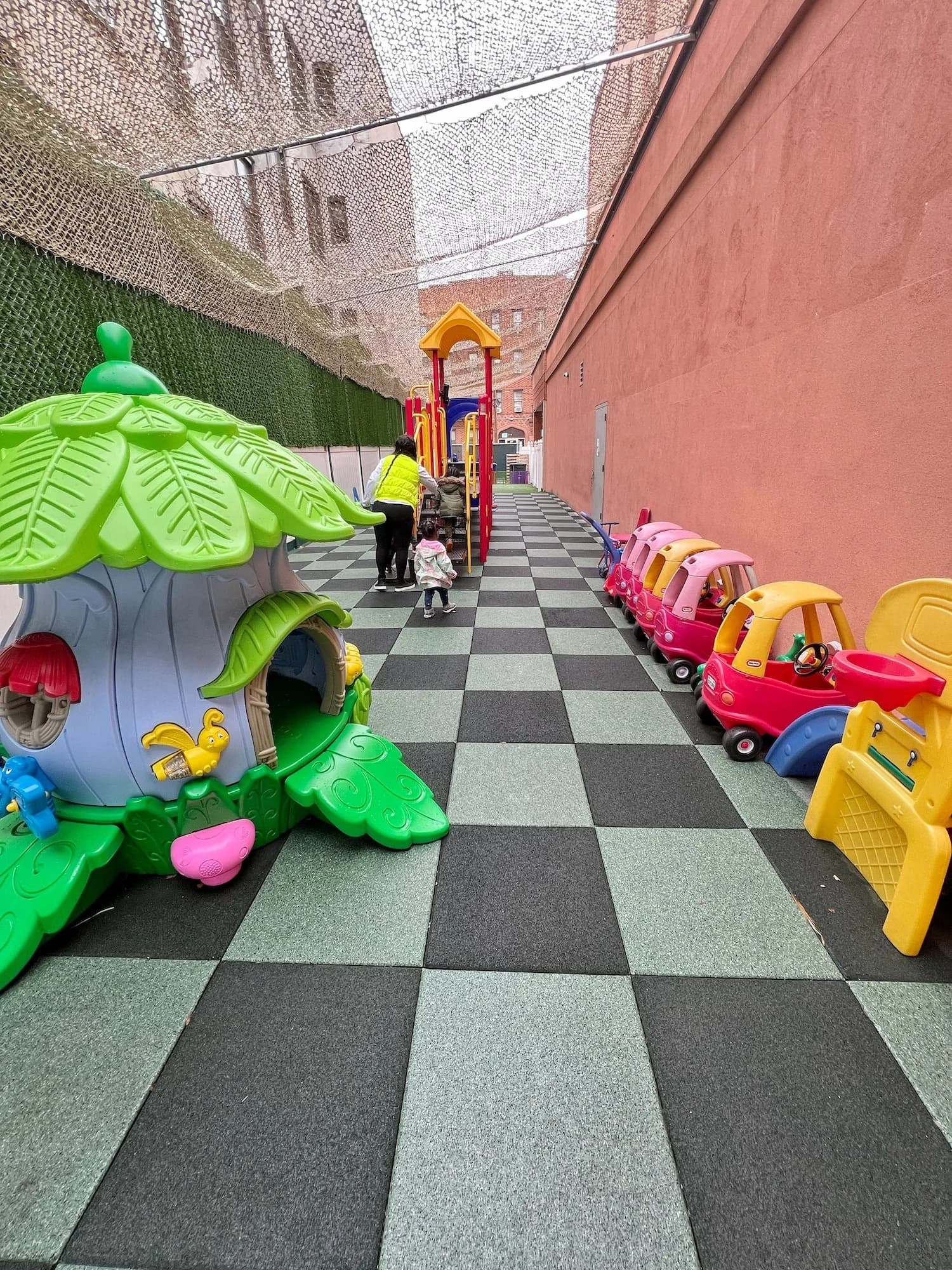
NYC DOHMH requires a written daily schedule that includes outdoor activities, and the city's cold weather policy states that low temperatures alone should not prevent outdoor play as long as children are dressed appropriately. At our East Flatbush location, children use the outdoor play area daily for running, climbing, ball games, and unstructured exploration. Wingate Park, just down the road, provides additional space for larger outings.
Outdoor time is not a break from learning. It is where gross motor development happens: running builds cardiovascular health, climbing builds strength and coordination, and group games build cooperation and turn-taking. For children who struggle with self-regulation indoors, physical activity often improves their ability to focus during the next indoor period. The research on this is consistent: movement and cognition are connected, not competing.
Meals, Snacks, and the Lunch Routine
Mealtimes at daycare serve two purposes: nutrition and social learning. Programs participating in the Child and Adult Care Food Program serve meals that meet federal nutrition guidelines. A typical lunch includes fluid milk, a protein, two servings of fruits or vegetables, and a grain. Breakfast and snacks follow similar component requirements.
What parents often do not realize is how much learning happens at the lunch table. Children practice self-help skills by serving themselves and using utensils. They engage in conversation with peers and teachers. They try foods they might refuse at home because they see other children eating them. Peer modeling is one of the most effective strategies for expanding a picky eater's range.
For families where mealtimes at home include foods from the Caribbean, West African, or other cultural traditions common in the Flatbush and Canarsie communities, daycare meals introduce variety while maintaining nutritional standards. If your child has dietary restrictions or allergies, licensed programs are required to accommodate them. Communicate these needs in writing during enrollment and confirm them with the director.
Nap Time and Rest Periods
Article 47 requires that every child in full-time care have a quiet, relaxed period of approximately one hour per day. Children who cannot sleep must not be confined to a sleeping surface. They are offered supervised quiet play instead. Staff must be awake at all times during nap periods.
That one-hour rest is not just about recharging energy. A landmark study from UMass Amherst published in the Proceedings of the National Academy of Sciences found that preschoolers who napped recalled 10% more on a memory test compared to when they stayed awake. The average nap in the study was 77 minutes. The memory benefits persisted 24 hours later, meaning naps did not just delay forgetting. They actively consolidated what children had learned that morning.
The American Academy of Pediatrics endorses sleep guidelines developed after a review of 864 scientific articles. Toddlers aged one to two need 11 to 14 hours per 24-hour period, including naps. Preschoolers aged three to five need 10 to 13 hours. Getting the recommended sleep is associated with improved attention, behavior, learning, memory, and emotional regulation.
If your child resists napping at daycare, it does not mean the program is doing something wrong. Nap resistance is common, especially when home routines differ. The regulatory requirement that non-sleeping children be allowed up for quiet activity rather than forced to lie still protects your child's experience while respecting the rest needs of the group.
Afternoon Activities and Pickup
After rest, the afternoon typically includes a snack, a second round of choice time or small-group activities, and additional outdoor play if weather allows. Teachers often use the afternoon for activities that complement the morning's focus. If the morning small group worked on a math concept like sorting, the afternoon might involve an art project that reinforces the same idea through a different medium.
Pickup mirrors the structure of drop-off. Teachers share highlights of the day, mention anything notable about behavior or health, and help the child transition back to their parent. For infants and toddlers, programs maintain daily logs that record feeding times, diaper changes, nap duration, and activities. Preschool families may receive updates less frequently but should expect regular communication about developmental progress through parent conferences and GOLD reports.
The B44 bus runs along Nostrand Avenue, and families taking the 2 or 5 train to Saratoga Avenue or Nostrand Avenue station are a short walk from our location. For parents driving from the 11236 zip code, Lenox Road is accessible from both Utica Avenue and Flatbush Avenue.
One thing parents notice after the first few weeks: the routine transforms their child. Children who screamed at drop-off start walking in confidently. Children who refused to nap anywhere but their own crib start falling asleep on a daycare cot within minutes. Children who only played alone begin seeking out friends. The predictability of the daily schedule is what makes this growth possible. When children know what comes next, they can focus on learning instead of worrying.
If you have been wondering what your child would actually do at daycare for eight hours, the answer is this: arrive, get checked, settle in, sing, choose, build, paint, read, run, eat, rest, play some more, and go home a little more capable than they were that morning. Every piece of the day has been thought through by people who understand how young children develop. The best way to see it is to visit during active hours and watch for yourself. Read our guide to health and safety standards for more on what NYC requires of licensed programs.