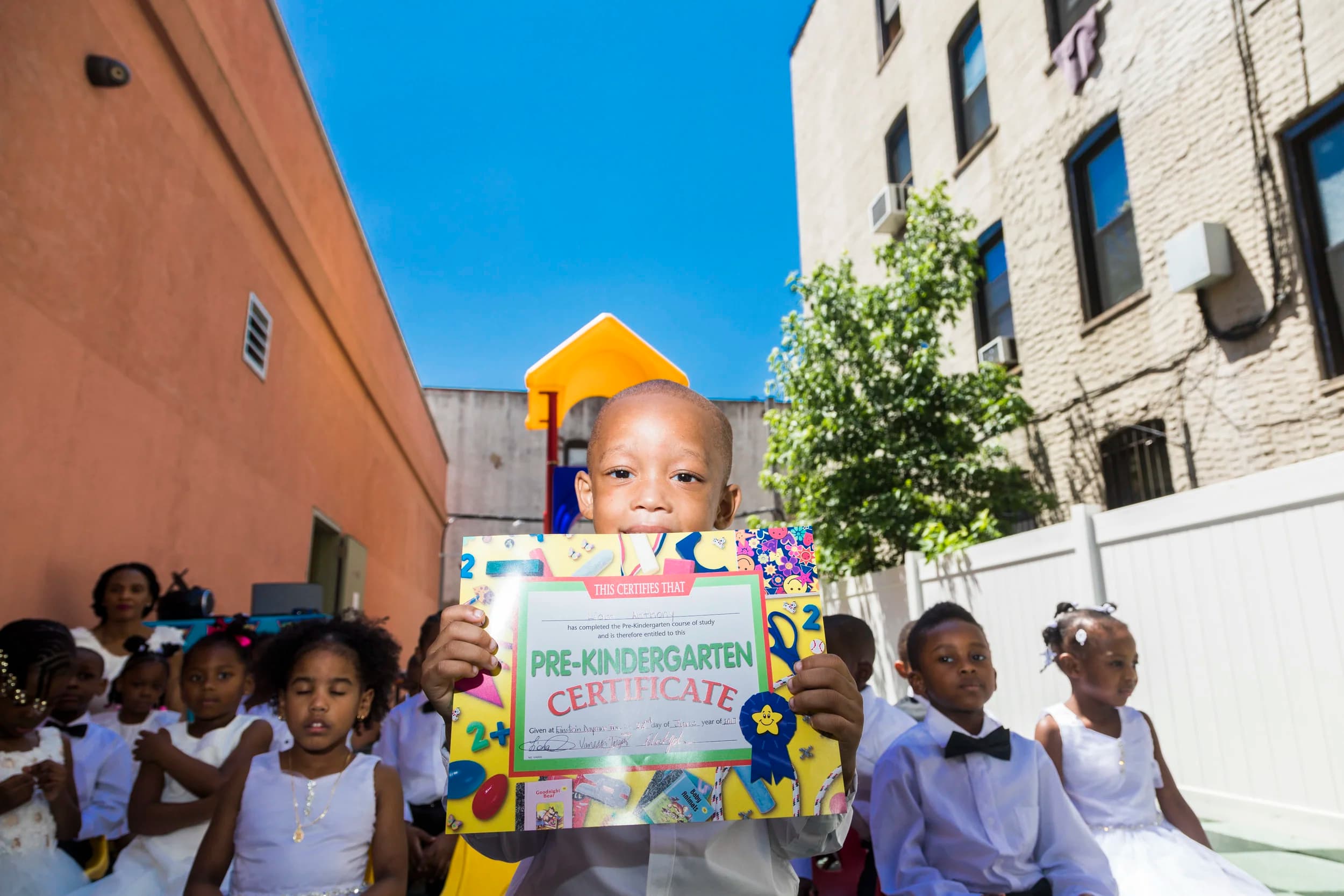
Parents in Flatbush and Midwood ask us some version of this question every week: "Is my child going to be ready for kindergarten?" It usually comes with a follow-up about letters, numbers, or whether their three-year-old should be reading by now. The concern is real. So is the misconception behind it.
Kindergarten readiness in the 11210 zip code and across East Flatbush, Brooklyn, does not hinge on how high your child can count. The research on what actually predicts school success points in a different direction, and it starts with how children play.
What Kindergarten Teachers Actually Want Your Child to Know
In a national survey of 1,339 kindergarten teachers conducted by the National Center for Education Statistics, the skills rated most important for school readiness were not academic. Teachers overwhelmingly ranked the ability to communicate needs, follow directions, pay attention, avoid being disruptive, and show sensitivity to other children's feelings as the top indicators. Very few endorsed counting to 20 or knowing the alphabet as critical entry requirements.
That survey was conducted in 1993, and the finding has held up in every subsequent study. A developmental psychobiology review published by the NIH confirmed that self-regulation at school entry predicts behavioral self-control, cognitive flexibility, and work habits through at least second grade. Children who entered kindergarten with low self-regulation fell further behind their peers over time rather than catching up.
Michigan State University researchers went further: social and emotional skills are a greater predictor of first-grade academic performance than either cognitive ability or family background. The reading and math follow once a child can sit, listen, take turns, and manage frustration.
Why Play Builds the Skills That Matter
The American Academy of Pediatrics published a clinical report titled "The Power of Play" in 2018, reaffirmed in January 2025. It describes developmentally appropriate play as "a singular opportunity to promote the social-emotional, cognitive, language, and self-regulation skills that build executive function and a prosocial brain." That is the AAP calling play essential, not optional.
NAEYC defines best practice in early childhood education as "a strengths-based, play-based approach to joyful, engaged learning." Their position statement identifies play specifically as "an important vehicle for developing self-regulation as well as for promoting language, cognition, and social competence."
What does this look like in a classroom? When a four-year-old negotiates with a peer over who gets to be the doctor in the dramatic play area, she is practicing conflict resolution, perspective-taking, and verbal communication. When a three-year-old stacks blocks, counts them, knocks them down, and starts again, he is working through early math concepts, spatial reasoning, and frustration tolerance. None of this looks like school. All of it prepares children for school.
Self-Regulation: The Skill Kindergarten Teachers Care About Most
Self-regulation is the ability to manage your own emotions, attention, and behavior in response to the situation you are in. For a five-year-old, that means waiting your turn during circle time, not grabbing a toy from another child, staying focused during a read-aloud, and recovering from disappointment when the block tower falls.
This skill develops most rapidly between ages three and five. Research shows it is more predictive of kindergarten success than IQ. A cross-case study published in PMC followed children entering kindergarten after three or more years of play-based early childhood education and found that the approach "prepared children for successful kindergarten experiences and was a viable early childhood education pedagogy fostering school readiness."
Play builds self-regulation because it requires children to follow rules, wait, take turns, and manage their impulses in real time. A child playing a board game cannot flip the board when losing. A child in a pretend restaurant cannot serve everyone at once. These are practice reps for the self-control that kindergarten demands, delivered in a context that children are motivated to sustain.
What Creative Curriculum Does to Prepare Children
Creative Curriculum, the framework used at Einstein Daycare and now mandated by the NYC Department of Education across all Pre-K for All and 3-K for All classrooms citywide, is built on this research. Classrooms are organized into interest areas: blocks, dramatic play, art, library, discovery, sand and water. Children choose where to spend time. Teachers observe, ask open-ended questions, introduce vocabulary, and extend learning based on what each child is doing.
The balance matters. A morning might start with a teacher-led circle time including a read-aloud and group discussion, then shift to an extended choice period where children direct their own learning across the interest areas. Teachers circulate, not passively watching, but actively scaffolding. After choice time, a small-group activity might focus on a specific skill like sorting objects by attribute or sequencing a story.
For families near Flatbush Avenue or along the B41 bus route, this has a practical advantage. A child who starts at a daycare using Creative Curriculum before age three and then enters a NYC public 3-K or Pre-K seat will walk into a classroom using the same framework. The interest areas, daily routines, and teacher language will all feel familiar. That continuity reduces transition stress and lets children hit the ground running.
How Teaching Strategies GOLD Tracks Readiness
Teaching Strategies GOLD is the assessment system paired with Creative Curriculum. It tracks child development across 38 research-based objectives spanning 10 domains: social-emotional, physical, language, cognitive, literacy, mathematics, science and technology, social studies, the arts, and English language acquisition.
The assessment is entirely observational. No tests, no worksheets, no timed drills. Teachers document what they see during normal classroom activity and rate each child's progress along a developmental continuum three times per year. A child who resolves a conflict with words instead of hitting gets documented. A child who recognizes their name on a cubby gets documented. Over months, these observations build a detailed picture of where each child stands across every readiness domain.
Parents receive reports showing progress in concrete terms. Instead of a letter grade, you see exactly which skills your child is developing and what comes next. The GOLD system has been shown to strongly differentiate children's likelihood of later proficiency in both academic areas based on their language, cognitive, and social competence scores.
Pre-K for All and 3-K for All in Flatbush and Midwood
NYC offers free, full-day Pre-K for all four-year-olds and expanding 3-K for three-year-olds. Families in the 11210 and 11203 zip codes have access to seats through NYC Public Schools, community-based organizations, and Pre-K Centers. Children born in 2022 are eligible for pre-K starting fall 2026.
The local elementary schools that children in this area feed into include PS 152 (School of Science and Technology) in District 22, PS 135 (Sheldon A. Brookner) in District 18, and PS 241 in District 17. Each of these schools receives children from Pre-K programs using Creative Curriculum, which means the learning framework carries through from daycare to elementary school without disruption.
Children who arrive at 3-K or Pre-K with prior experience in a quality play-based program have already practiced separating from a parent, following classroom routines, eating in a group, and interacting with peers daily. Research from the Brookings Institution found that children who start kindergarten ready have an 82% chance of mastering basic skills by age 11, compared with 45% for children who are not ready. The gap is real, and the preparation that closes it starts years before the first day of kindergarten.
Questions to Ask Your Daycare About School Readiness
If you are comparing programs near Church Avenue, along Nostrand Avenue, or anywhere in the Flatbush and Midwood area, these questions will help you evaluate how seriously a daycare takes kindergarten preparation.
- "What curriculum do you use, and how does it address school readiness?" A strong answer names a specific framework and explains how it builds pre-literacy, pre-math, and self-regulation skills through structured play. A vague answer like "we do a little of everything" usually means there is no real system in place.
- "How do you assess my child's development?" Look for programs using formal observation-based tools like Teaching Strategies GOLD rather than informal notes. Structured assessments give you measurable data on your child's progress across multiple domains.
- "How much of the day is play-based versus teacher-directed?" The answer should describe a balance of both. A program that is all free play has no structure. A program that is all worksheets ignores what the research says about how young children learn.
- "What enrichment programs do you offer?" Yoga, music, and movement activities build the self-regulation and executive function skills that kindergarten teachers care about most. Ask how often these happen and whether they are integrated into the daily routine or treated as occasional extras. Outdoor play is another critical component: research shows it directly strengthens executive function, gross motor skills, and social cooperation.
For families near the 2 or 5 train at Nostrand Avenue or riding the B44 down to East Flatbush, a tour is the best way to see what a play-based program looks like in action. Watch the children. Are they making choices? Are they engaged? Are teachers asking questions and extending play, or standing on the sidelines? Those observations will tell you more than any brochure.
A child who spends two or three years in a program that respects how young brains develop does not need to be drilled on letter recognition. They have built the attention, self-control, and curiosity that make academic learning possible. The ABCs come easily when the foundation is solid. Browse photos of our classrooms to see what play-based learning looks like at Einstein Daycare.