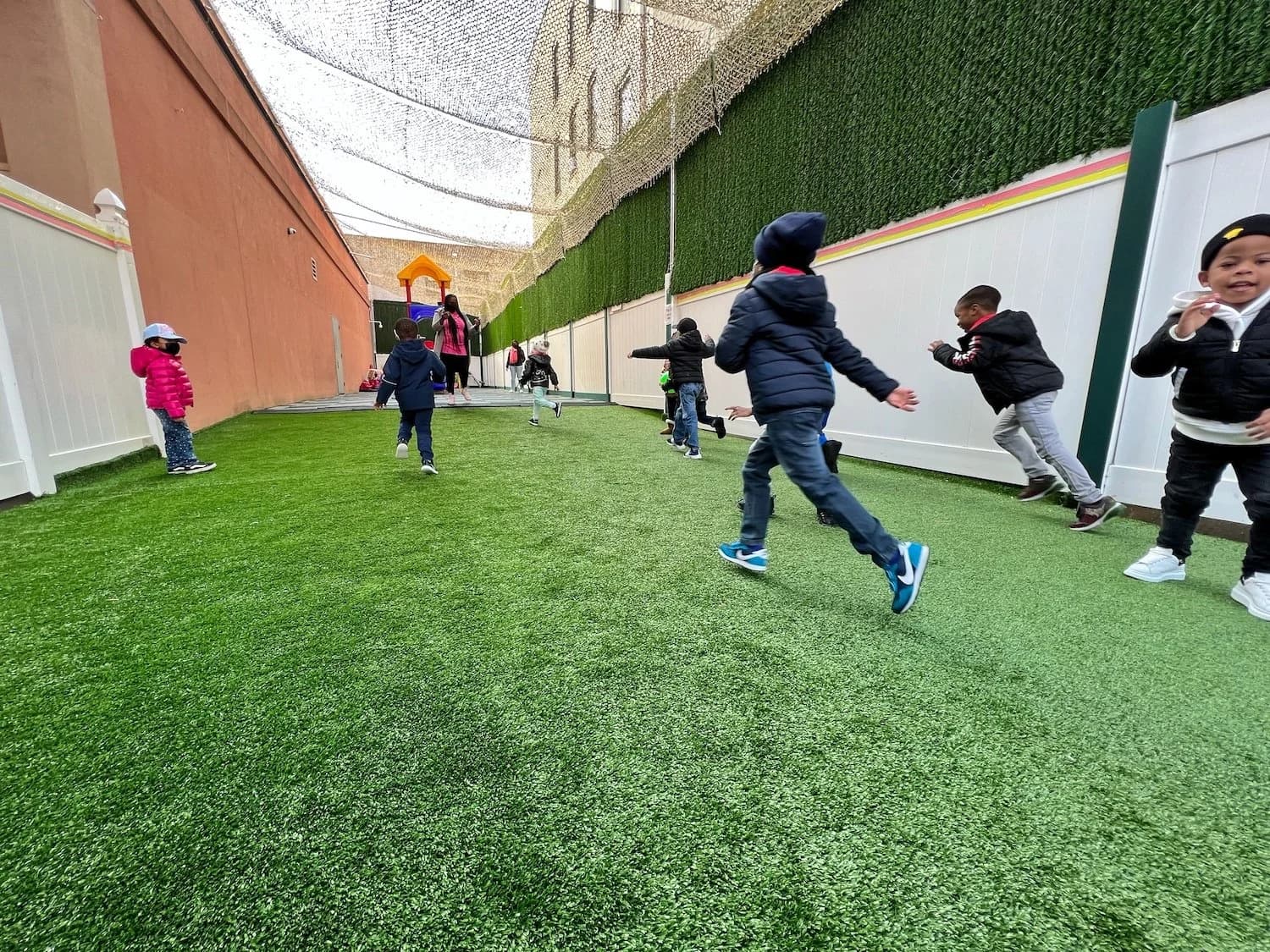
When parents think about getting their child ready for kindergarten, outdoor play rarely tops the list. Flashcards, letter recognition, counting to twenty, maybe some scissor practice. Those feel productive. Sending a three-year-old outside to run around the yard or dig in the dirt? That feels like a break from learning, not learning itself.
But the research tells a different story. Over the past decade, studies from pediatric and early childhood organizations have consistently found that outdoor play directly builds the exact skills kindergarten teachers are looking for. Not just physical fitness. We are talking about attention, self-control, problem-solving, cooperation, and the ability to follow multi-step directions.
At Einstein Daycare on Lenox Road in East Flatbush, Brooklyn, daily outdoor play is a core part of our program, not a reward or an afterthought. Here is what the science says about why that matters for your child.
What Kindergarten Readiness Actually Means
Parents sometimes assume kindergarten readiness is about academics: knowing the alphabet, writing their name, counting objects. Those are useful skills, but they are not what kindergarten teachers worry about most. The skills that predict how well a five-year-old adjusts to school are collectively called executive function, and they include working memory, impulse control, and cognitive flexibility.
A child with strong executive function can sit during circle time without poking the kid next to them. They can switch from one activity to another without a meltdown. They can remember a two-step instruction like "put your backpack in your cubby and come sit on the rug." These abilities develop over years of practice, and outdoor play is one of the most effective ways to build them.
Research published in the journal Early Childhood Research Quarterly found that free play in the preschool years predicts self-regulation skills years later, with outdoor, unstructured play being especially powerful because children have to manage their own behavior without the physical constraints of a classroom.
The Physical Foundation: Gross Motor Skills and the Brain
Before a child can hold a pencil and form letters, they need strong gross motor skills. That sounds counterintuitive. What does running have to do with handwriting? The answer is developmental sequencing. Children develop large muscle control first, then fine motor control. A child who can climb, jump, throw, and balance is building the shoulder stability, core strength, and hand-eye coordination that will later support writing, cutting, and drawing.
The American Academy of Pediatrics recommends that preschoolers get at least 60 minutes of structured physical activity and up to several hours of unstructured active play every day. They should not be sedentary for more than 60 minutes at a time, except when sleeping. Meeting these benchmarks indoors is nearly impossible. Outside, it happens naturally.
A 2024 study published in PMC found that outdoor free play is significantly associated with motor skill development in preschool-age children, and that the varied terrain, open space, and unpredictable surfaces outdoors challenge children's bodies in ways that flat indoor floors simply cannot. When a toddler walks across grass, climbs a small hill, or steps over a tree root, their brain is processing balance, spatial awareness, and muscle coordination all at once.
How Running Around Teaches Children to Pay Attention
This is the part that surprises most parents. Outdoor play does not just tire children out so they sit still later. It actively strengthens the brain circuits responsible for attention and focus.
A 2024 study examining the timing and amount of outdoor play in preschool children found that those who played outdoors for more than three hours daily showed stronger self-regulation and early learning skills compared to children with less outdoor time. Critically, the researchers found that working memory mediated the relationship between outdoor play and emotional regulation, meaning outdoor play improved children's ability to hold information in mind, which in turn helped them manage their emotions.
Think about what happens during a game of tag. A child has to track where the tagger is, decide which direction to run, remember the boundaries, regulate the impulse to push someone out of the way, and manage the frustration of being tagged. That is executive function in action, disguised as fun.
At Einstein Daycare, our curriculum intentionally blends structured outdoor activities with free play. Some days include teacher-directed games that build specific skills. Other days, children choose their own activities on the playground, practicing independence and decision-making.
Nature-Based Learning in East Flatbush
You do not need a forest to give children meaningful outdoor experiences. East Flatbush has more green space than many Manhattan neighborhoods, and families in the 11203 zip code are within walking distance of Wingate Park, which offers playgrounds, open fields, and a running track where even toddlers enjoy scooting and exploring.
Research from the International Journal of Early Childhood Environmental Education shows that nature-based practices in preschool settings significantly support children's executive function skills. The variety of textures, sounds, smells, and unpredictable elements in outdoor environments stimulates sensory processing in ways that plastic toys in a climate-controlled room cannot replicate. A child sorting rocks by size on a playground is doing the same cognitive work as sorting colored blocks inside, but with the added benefit of fresh air, vitamin D, and sensory richness.
Families in Crown Heights, Prospect Lefferts Gardens, and Flatbush are in a similar position. Brooklyn's parks system gives early childhood programs real options for outdoor learning, even in a dense urban setting. At Einstein Daycare, located at 900 Lenox Rd near the B44 and B41 bus routes, we take advantage of our outdoor space daily and incorporate natural materials into our classroom learning centers as well.
Social Skills: The Playground as Classroom
Kindergarten teachers consistently report that the biggest adjustment challenge for new students is not academic. It is social. Can the child share materials? Can they join a group activity without disrupting it? Can they resolve a disagreement with words instead of hands? Can they take turns?
Outdoor play is where these skills get their most intensive practice. The playground is less structured than the classroom, which means children have to negotiate more. Who gets the swing first? What are the rules of this made-up game? What happens when someone does not follow the rules? These small-stakes social negotiations are rehearsals for the real thing.
A review published by the Encyclopedia on Early Childhood Development found that outdoor play, because it tends to be more varied and self-directed than indoor play, gives children more opportunities to practice prosocial behavior, cooperation, and conflict resolution. Children who regularly engage in outdoor free play develop stronger peer relationships and more sophisticated social strategies.
Our infant, toddler, and preschool programs all include age-appropriate outdoor time specifically because social learning accelerates when children have space, freedom, and minimal adult micromanagement.
What Outdoor Play Looks Like at Different Ages
Outdoor play is not one-size-fits-all. What a 14-month-old needs outside is different from what a four-year-old needs. Here is how the benefits map to different developmental stages:
- Infants and young toddlers (6 months to 18 months): Sensory exploration is the priority. Feeling grass, hearing birds, watching leaves move in the wind. Tummy time on a blanket outside builds core strength while exposing babies to natural light, which helps regulate sleep cycles.
- Older toddlers (18 months to 3 years): Gross motor development takes center stage. Walking on uneven surfaces, climbing low structures, pushing wheeled toys, and running on open ground. This age group also benefits from simple outdoor routines like filling and dumping sand or water, which builds early math concepts like volume and quantity.
- Preschoolers (3 to 5 years): Complex physical challenges like climbing, balancing on beams, and throwing and catching balls. Imaginative play becomes central: sticks become fishing poles, a patch of dirt becomes a construction site. Group games with rules (red light green light, freeze tag) build the impulse control and working memory that kindergarten demands.
- Pre-K children preparing for kindergarten: Structured outdoor activities that mimic school expectations. Following multi-step directions during relay races, taking turns in organized games, observing and describing nature for early science skills, and practicing spatial vocabulary (over, under, through, between).
At Einstein Daycare, our teachers plan outdoor activities aligned with the Creative Curriculum framework and assess progress using Teaching Strategies GOLD, so outdoor play is documented and intentional, not just recess.
Practical Tips for Parents at Home
The benefits of outdoor play do not stop at pickup time. Here are straightforward ways to keep building kindergarten-ready skills outside of daycare:
Make it routine, not special. Going outside should be as automatic as brushing teeth. Even fifteen minutes after dinner counts. Consistency matters more than duration on any single day.
Resist the urge to direct everything. It is tempting to organize games and activities, but unstructured time is where children practice decision-making and self-regulation. Let them get bored. That is when creativity kicks in.
Use your neighborhood. A walk to the corner store builds observation skills, pedestrian safety awareness, and conversational language. A trip to Wingate Park on a Saturday morning gives your child open space to run that your apartment cannot provide. Even the sidewalk is a balance beam if you let it be.
Talk about what they see. Ask open-ended questions: "What do you notice about that tree?" "Why do you think the puddle is getting smaller?" This builds the scientific thinking and descriptive language that kindergarten teachers assess on day one.
Do not skip winter. Brooklyn winters are cold, but bundled-up outdoor play is still valuable. Cold air does not cause illness, and the sensory experience of crunching through frost or watching breath turn to mist is genuinely stimulating for young brains. As the Scandinavian saying goes, there is no bad weather, only bad clothing.
The Research Is Clear
A 2024 study examining over 10,000 preschoolers found that children who engaged in more than three hours of outdoor play daily scored higher on measures of school readiness, including cognitive development, psychosocial skills, and physical health. Only about 33% of the children in the study met that threshold on weekdays, suggesting that many families and programs are leaving significant developmental benefits on the table.
The CDC, the American Academy of Pediatrics, and the National Association for the Education of Young Children all emphasize active, outdoor play as a critical component of healthy child development. This is not a fringe position or a trend. It is the consensus of every major organization that studies how young children learn.
For families in East Flatbush and the surrounding Brooklyn neighborhoods, the good news is that incorporating outdoor play does not require expensive equipment or special training. It requires time, space, and adults who understand why it matters. That understanding starts with recognizing that when your child is climbing, running, digging, and arguing over whose turn it is on the slide, they are doing exactly the work their brain needs to get ready for school.
If you are curious about what a full day at a Brooklyn daycare looks like, including outdoor time, meals, and learning activities, read our post on a typical day at daycare. And for more on how movement and music contribute to early development, take a look at why movement and music matter in preschool.