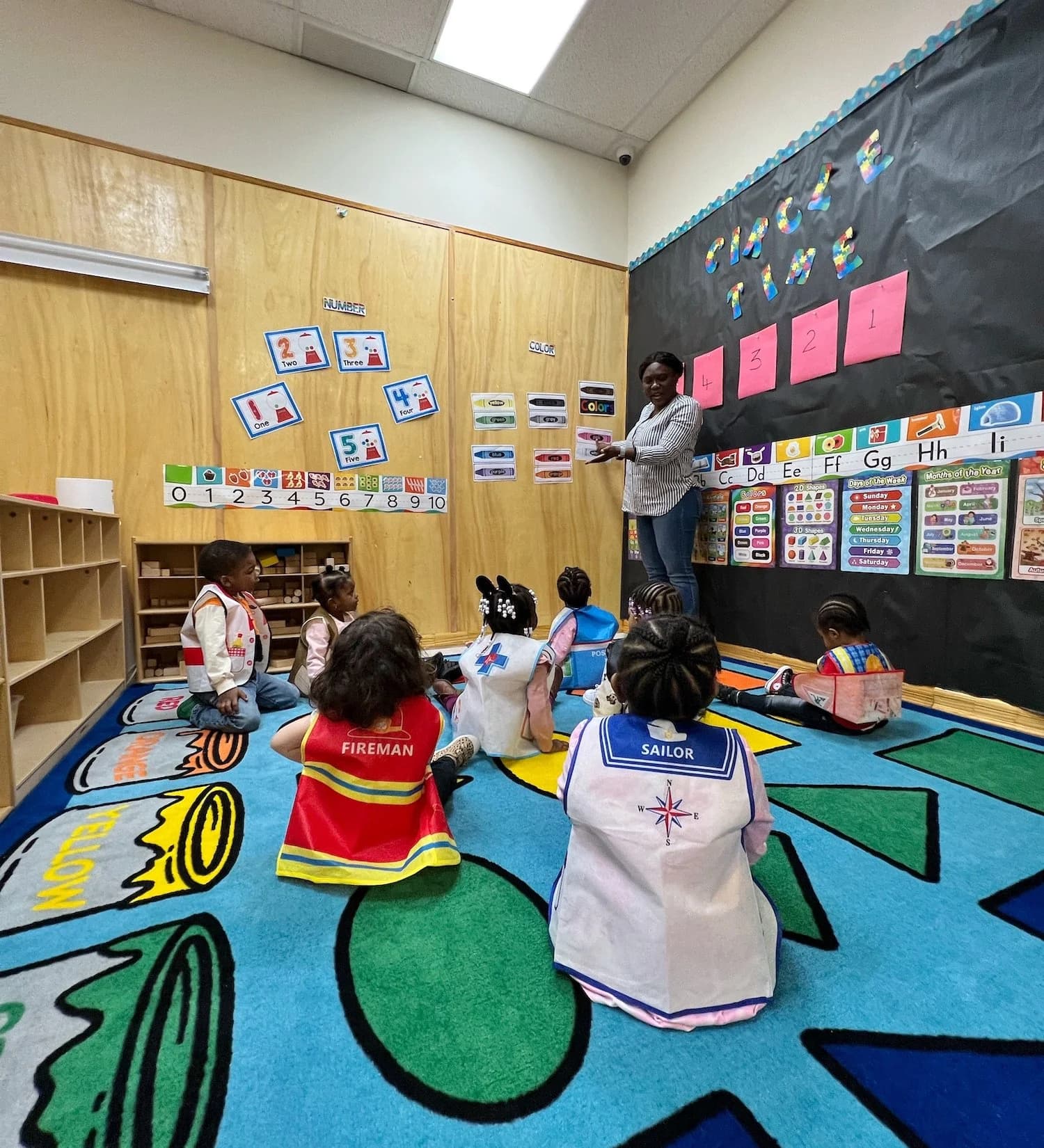
If your child hears Haitian Creole from grandma, English from you, and maybe French or Spanish from the neighbor downstairs, you are not confusing them. You are giving them one of the most powerful cognitive advantages a young brain can get. For families raising bilingual children in East Flatbush and enrolling them in daycare, the question is real: how will they handle a classroom where English is the main language?
In Community District 17, which covers East Flatbush, Brooklyn and surrounding blocks, 51% of residents are foreign-born. Haitian Creole is spoken in roughly one of every ten households. Spanish, French, and West African languages fill in much of the rest. Your child's multilingualism is not unusual here. It is the norm.
So what does the research actually say about bilingual toddlers starting daycare? What should you expect in the first weeks? And what should you look for in a program that will treat your child's home language as a strength rather than a problem to fix?
Bilingual Children Do Not Have Slower Language Development
This is the myth that will not die, so let us put a number on it. Researchers Byers-Heinlein and Lew-Williams reviewed the data in a study published in the Psychological Bulletin and found that bilingual children hit language milestones at the same rate as monolingual children. The rate of clinically significant language delays, around 5 to 10%, is identical in both groups. Identical. Not "similar" or "roughly the same." The same percentage.
What often gets misread as delay is something different. A bilingual two-year-old might know 30 words in Creole and 20 words in English. That is 50 words total, which is on track or ahead. But if a pediatrician only tests English vocabulary, the child appears to know 20 words and flags as behind. The measurement is wrong, not the child.
When you add up vocabulary across both languages, bilingual children typically match or exceed monolingual totals. If your child's doctor has raised concerns about speech, ask whether the screening accounted for all the languages your child hears.
Beyond keeping pace, bilingual children show measurable cognitive advantages. Zero to Three reports that bilingual children have enhanced executive functioning: better working memory and stronger attention control, along with more flexible thinking. Bilingual preschoolers also develop "theory of mind" earlier, which is the ability to understand that other people have different thoughts and knowledge than you do. A child who switches between Creole with grandma and English with a teacher is already practicing the idea that different people need different communication. That is sophisticated social reasoning for a three-year-old.
The University of Washington's Institute for Learning and Brain Sciences identifies ages zero to three as the most critical window for bilingual brain development. A child who hears two languages before age three does not just learn two languages. They build a brain that is structurally better at processing language in general.
What Is the "Silent Period" and Should You Worry About It?
Here is what catches many parents off guard. Your child talks nonstop at home in Creole or Spanish, and then starts daycare and barely says a word for weeks. Teachers might mention that your child is "quiet" or "not very verbal." The instinct is to panic.
Do not panic. What you are seeing is called the silent period, and it is a well-documented, normal stage of second-language acquisition. Your child is not shutting down. They are listening. Absorbing. Building a mental model of how English works before they start producing it.
A 2024 study published in Cambridge Core found that without support, this silent period can last up to two years. With active support from teachers and families, it shortens by approximately six months. "Active support" means teachers who acknowledge the home language, use visual cues and gestures alongside English, and do not pressure the child to speak before they are ready.
During the silent period, your child understands far more than they produce. They follow routines, respond to instructions with actions instead of words, and watch other children closely. If your child is participating but not talking much, that is not a red flag. That is a bilingual brain doing exactly what it is supposed to do.
If your child recently started daycare and seems quieter than usual, our post on separation anxiety at daycare dropoff can help you distinguish between language adjustment and emotional distress. They can overlap, but the strategies are different.
Code-Switching Is a Skill, Not a Problem
Your child says half a sentence in English and finishes it in Creole. Or they use a Spanish word in the middle of an English sentence because the Spanish word is the one they know. A relative might say the child is "mixing up" their languages. A well-meaning friend might suggest you stick to one language at a time.
The research says the opposite. Code-switching is a sign of sophisticated linguistic processing. The brain is managing two active language systems simultaneously, selecting the right word from the right language based on context and audience. Babies exposed to code-switching at home actually show more brain activity in language-production regions than babies in single-language environments. More activity, not less.
When a toddler at daycare says "I want the dlo" (Creole for water), they have not failed to learn the English word. They have grabbed the word that came to mind fastest from a mental dictionary that is twice the size of a monolingual child's. Over time, with English exposure at daycare, the English vocabulary fills in. The code-switching decreases naturally as both languages strengthen.
Tell your child's teacher what the home-language words mean. When a teacher knows that dlo means water, they can respond with "You want water? Here is your water" and the child hears the English word paired with comprehension instead of confusion.
What to Look for in a Daycare Program for Bilingual Children in East Flatbush
Not every daycare handles multilingual children the same way. Some programs treat a child's home language as a deficit to overcome. Others treat it as an asset to build on. The difference matters enormously for your child's development and self-esteem.
Here is what a strong program does:
- Labels classroom materials in multiple languages. Signs on shelves and vocabulary cards in common home languages alongside English. This tells your child that their language belongs here.
- Uses visual supports alongside verbal instructions. Picture schedules, gesture cues, and visual choice boards help children follow routines without depending entirely on spoken words.
- Includes multilingual books in the classroom library. Books in Haitian Creole, Spanish, French, and other community languages.
- Welcomes the home language rather than discouraging it. A teacher who says "Can you teach me how to say 'hello' in Creole?" is telling your child that their language has value in this space.
- Communicates with families in their preferred language when possible. NYC's DOE supports communications in nine languages, including Haitian Creole and French.
- Does not mistake the silent period for a developmental delay. Teachers trained in dual-language development know the difference between a child quietly acquiring English and one who needs a speech evaluation.
The National Association for the Education of Young Children (NAEYC) calls this an "asset-based" approach to dual-language learners. It starts from the premise that your child's home language is a foundation to build on, not an obstacle to remove.
Creative Curriculum, which is the framework used at Einstein Daycare, includes expanded daily resources specifically designed for dual-language learners. The curriculum integrates bilingual books, visual aids, and family partnership strategies that connect what happens in the classroom to what happens at home. It is not an add-on. It is built into how the program works.
Five Things You Can Do at Home to Support the Transition
1. Keep speaking your home language. This is the most important thing on this list. When your child starts daycare, they will get hours of English exposure every weekday. What they will not get at school is Creole, Spanish, French, or whatever language your family speaks. You are your child's only source of that language.
If you switch to English at home because you think it will help them at school, you are not adding English. You are subtracting their first language.
NAEYC data shows that over one in four U.S. children under six live in a home where a parent speaks a language other than English. The research is consistent: maintaining the home language supports, rather than hinders, English acquisition.
2. Read to your child in both languages. If you have books in Creole or Spanish, read them. If you only have English books, read them in your home language and tell the story your way. The Brooklyn Public Library's Flatbush branch on Linden Boulevard carries children's books in multiple languages. The Eastern Parkway branch near Prospect Lefferts Gardens does too.
3. Prepare your child for classroom vocabulary. Before their first week, practice the English words they will hear most: "bathroom," "snack," "outside," "teacher," "more," "help." Even five or six key words give a child handholds in a new environment. Our guide to preparing your child for their first week of daycare covers other practical steps for the transition.
4. Tell the teachers about your home languages. Write down the words your child uses for water, bathroom, hungry, tired, hurt, mama, papa. Give this list to the classroom teachers on day one. When a child is upset and says domi (Creole for "sleep"), a teacher who knows that word can respond immediately instead of guessing.
5. Do not correct code-switching. When your child mixes languages, respond to the meaning, not the mix. If they say "I want manje," say "You are hungry? Let us get you something to eat." They heard the English. They will file it away.
Correcting them ("Say 'food,' not 'manje'") sends the message that one language is right and the other is wrong. That is not the message you want.
Block Play, Music, and the Activities That Cross Language Barriers
One reason quality daycare programs work well for bilingual children is that much of early childhood learning does not depend on spoken language at all. A child who is still building English vocabulary can stack blocks, paint at the art table, do yoga stretches, clap along to a rhythm, and dig in a sensory bin right alongside their English-speaking peers. These activities are language-rich without being language-dependent.
Block play is a strong example. A child who does not yet say "taller" in English can still add a block to make the tower taller, and the teacher names the concept in the moment: "You made it taller!" The language sticks because it is tied to something the child just did with their own hands. Research consistently links block play to early STEM skills like mathematical thinking and engineering reasoning, and none of that requires fluency in a specific language to begin.
Music works the same way. Rhythm and movement are processed independently of language. A child learning English can sing along and follow dance movements from day one. Percussion instruments work too. Musical training also strengthens the auditory processing skills that help children distinguish between similar-sounding words in any language.
At Einstein Daycare, our programs for every age group include daily music, movement, yoga, art, and centers-based activities that give bilingual children multiple ways to participate, connect with peers, and learn while their English catches up to their comprehension.
Common Misconceptions That Hurt Bilingual Kids
Some of the most persistent advice Caribbean-American and immigrant families get about language is flat-out wrong. Here are the claims and what the evidence says.
"Speak only English at home so your child does well in school." Research finds the opposite. Children with a strong first language learn a second language faster. The skills transfer: phonemic awareness and grammar structures, among other building blocks. Cutting off the first language does not speed up English. It removes the foundation that English is supposed to build on.
"One parent, one language is the only approach that works." The one-parent-one-language method (mom speaks Creole, dad speaks English) is one strategy. It is not the only strategy, and it is not required for bilingual success. Plenty of children become fluent in two languages in households where both parents switch freely between them. What matters is total exposure hours in each language, not who speaks which one.
"Bilingual kids will always be behind in English." By kindergarten entry, bilingual children in quality early childhood programs typically perform on par with monolingual peers in English while also having an entire additional language. That is not behind. That is ahead. NYC runs 545 Dual Language programs across the K-12 system specifically because the city recognizes bilingualism as an academic advantage, not a handicap.
"The daycare should only use English so my child learns faster." Immersion works, but rigid English-only policies that punish or ignore the home language cause harm. A child who feels that their family's language is unwelcome at school may develop shame around their cultural identity. The Teaching Strategies approach to dual-language classrooms emphasizes building bridges between languages rather than replacing one with another.
Your Child's Two Languages Are Not Competing
The outdated model of bilingualism treated the brain like a container with limited space: more Creole means less room for English. That model is wrong. Current neuroscience shows bilingual brains build denser neural networks, with both languages sharing and strengthening the same cognitive systems. More Creole does not crowd out English. It builds the infrastructure that English will run on.
If you are a parent in East Flatbush, Brooklyn raising a bilingual child and weighing daycare options, the research is on your side. Your child's home language is not a barrier to their success in an English-speaking classroom. It is the reason they will succeed.
Keep speaking Creole at dinner. Keep reading Spanish at bedtime. Keep letting your child hear French from the aunties. And find a daycare program that sees those languages the way the science does: as a gift your child is lucky to have.
If you have questions about how Einstein Daycare supports bilingual and multilingual children, call us at (718) 618-7330 or request a tour online. We are at 900 Lenox Road, right off Utica Avenue, and we work with families across East Flatbush, Crown Heights, PLG, and Flatbush every day.