Monday through Friday, your child is immersed in a carefully planned learning environment at daycare. Teachers are guiding them through activities that develop language, math concepts, social skills, physical coordination, and creative expression. Then the weekend arrives, and you might wonder: how can I continue supporting what my child is learning without turning our home into a classroom?
The good news is that you do not need lesson plans, expensive materials, or a teaching degree. The everyday activities you already do with your child on weekends, along with the incredible resources available right here in Prospect Lefferts Gardens and across Brooklyn, naturally reinforce the skills your child is developing at daycare. The key is knowing which experiences connect to which areas of learning and being intentional about the moments you are already sharing.
Understanding the Learning Domains
Quality daycare programs that use the Creative Curriculum framework by Teaching Strategies organize learning across several developmental domains. When you understand these domains, you begin to see learning opportunities everywhere in your daily life. Our detailed article on what Creative Curriculum is and how it works provides a thorough overview, but here is a brief summary of the key areas and how you can extend them at home and around Brooklyn.
Language and Literacy: The Power of Conversation and Story
Language development is woven into every part of your child's daycare experience. Teachers narrate activities, ask open-ended questions, read stories, and sing songs throughout the day. On weekends, you can continue building these skills in natural, enjoyable ways.
Talk about what you see. Whether you are walking through the neighborhood, grocery shopping, or cooking together, narrate your actions and describe what you observe. "Look at that red truck. It's bigger than the blue car, isn't it?" This kind of running commentary, which researchers call "parentese" or enriched language input, is one of the most powerful tools for vocabulary development. The Zero to Three Foundation emphasizes that the quality and quantity of language children hear in their first three years directly predicts later academic success.
Visit the library regularly. The Brooklyn Public Library system is one of the best in the country and entirely free. The Flatbush branch on Linden Boulevard and the Crown Heights branch on New York Avenue are both accessible from Prospect Lefferts Gardens. Most branches offer weekly story time sessions for babies, toddlers, and preschoolers. These programs reinforce the same pre-literacy skills your child practices at daycare: listening comprehension, vocabulary, print awareness, and the simple joy of books. Let your child choose their own books to borrow. Autonomy in book selection builds motivation to read.
Sing together. Music and language are deeply connected in the developing brain. Songs with repetitive lyrics and hand motions, like "Itsy Bitsy Spider" or "Wheels on the Bus," reinforce vocabulary, rhythm, sequencing, and memory. You do not need to carry a tune. Your child does not care about pitch. They care about connection.
Math and Logical Thinking: Numbers Are Everywhere
At daycare, math is not worksheets. It is sorting, counting, patterning, comparing sizes, and exploring shapes. These same experiences happen naturally in weekend life.
Cook together. Measuring ingredients, counting eggs, comparing "more" and "less," and following sequential steps in a recipe all build mathematical thinking. Even a toddler can help pour pre-measured ingredients, stir, and count items. Baking is particularly rich in math concepts: fractions, measurement, temperature, and time.
Sort and classify. Laundry is a surprisingly effective math activity. Ask your child to sort socks by color, match pairs, or separate clothes by family member. At the grocery store, compare sizes of fruits. "Which apple is bigger?" During outdoor walks, collect leaves or rocks and sort them by size, color, or shape.
Count everything. Steps as you climb them, buses as they pass, dogs in the park, strawberries on a plate. Children learn to count not by memorizing numbers in sequence but by applying counting to real objects in context. The NAEYC's research on early math shows that informal math experiences in everyday life are just as important as structured math activities in the classroom.
Social-Emotional Development: Practice Being Together
During the week, your child is learning to share, take turns, manage frustration, express emotions, and build friendships. These skills need practice in many different contexts to become solid. Our article on social-emotional development at daycare explores why this domain is considered foundational to all other learning.
Arrange playdates with daycare friends. Seeing familiar children outside of the daycare context strengthens friendships and gives your child practice with social skills in a different setting. A playdate at the playground or at home provides opportunities for sharing, negotiation, and cooperative play in an environment where you can observe and gently guide.
Name and validate emotions throughout the day. "You seem disappointed that we cannot go to the park because of the rain. It is okay to feel disappointed." This emotional coaching, which mirrors what teachers do in Creative Curriculum classrooms, builds your child's emotional vocabulary and self-regulation capacity.
Play board games and simple turn-taking games. Even toddlers can participate in simplified versions of games that involve waiting for a turn, following a rule, and celebrating someone else's success. These are the same skills that make group activities at daycare successful. The American Academy of Pediatrics highlights the importance of unstructured play for developing social competence.
Physical Development: Move, Build, Create
At daycare, children develop both gross motor skills (running, jumping, climbing) and fine motor skills (cutting, drawing, threading beads) through daily activities. Weekends offer unlimited opportunities to continue this development.
Prospect Park is one of the greatest resources available to families in Prospect Lefferts Gardens. The park's multiple playgrounds offer climbing structures, slides, and swings that build strength, balance, and coordination. The Lakeside complex offers ice skating in winter and water play in summer. The open meadows are perfect for running, kicking a ball, or simply rolling in the grass. For toddlers, the wide paved paths are ideal for practicing walking, running, and riding tricycles.
For fine motor development, simple art activities at home are tremendously effective. Crayons, play dough, finger paint, stickers, and child-safe scissors all strengthen the small muscles in the hands and fingers that children need for writing later on. Your child's daycare teachers use these same materials in the classroom, so working with them at home reinforces both the skills and the confidence.
Sensory play is another powerful avenue for physical development. Our article on sensory play benefits in early childhood explains the research behind why hands-on exploration with different textures, temperatures, and materials supports brain development. At home, a bin of dried rice or pasta with cups and spoons, a container of water with funnels and squeeze bottles, or even a pile of shaving cream on a tray provides rich sensory and fine motor experience.
Science and Nature: Curiosity in Action
Young children are natural scientists. They observe, hypothesize, experiment, and draw conclusions constantly. Daycare programs nurture this curiosity through nature exploration, sensory tables, and simple experiments. Brooklyn offers extraordinary resources to extend this learning on weekends.
The Brooklyn Botanic Garden is a ten-minute walk or short drive from Prospect Lefferts Gardens and offers a world-class nature experience. The Discovery Garden, designed specifically for children, features a stream, meadow, and woodland where children can observe insects, plants, and seasonal changes up close. The garden offers family programs and seasonal festivals throughout the year. Membership is affordable and provides unlimited visits, making it practical for regular weekend outings.
The Brooklyn Children's Museum in Crown Heights is one of the oldest children's museums in the world and a remarkable resource for hands-on learning. Exhibits are designed for children from infancy through age ten and cover nature, culture, science, and the arts. The Totally Tots area is specifically designed for children under six. Weekend visits here directly reinforce the exploration-based learning your child experiences at daycare.
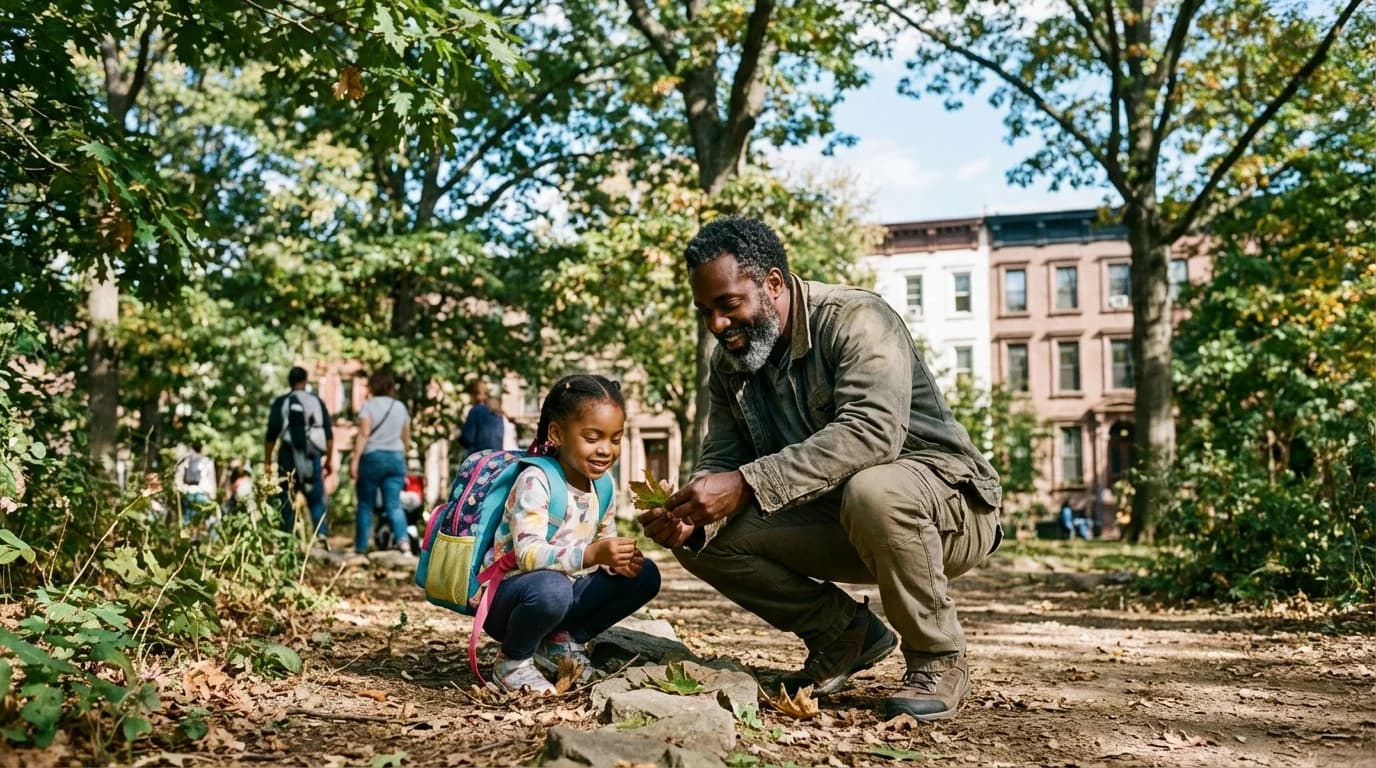
Nature walks in Prospect Park are free and endlessly variable. Bring a magnifying glass and examine bark, leaves, insects, and rocks. Collect natural materials and create art with them at home. Watch squirrels and birds and talk about what they eat and where they live. Point out weather changes. "It rained last night. Look at the puddles. Where do you think the water goes?" These conversations build scientific thinking, observational skills, and vocabulary simultaneously.
Creative Arts: Expression Without Rules
At daycare, art is process-oriented, not product-oriented. Children are encouraged to explore materials and express themselves rather than reproduce a teacher's model. You can continue this approach at home by providing materials and stepping back.
Set up an art station with paper, crayons, markers, paint, glue, and collage materials. Let your child create without directing the outcome. Resist the urge to ask "What is it?" Instead, comment on what you observe: "I see you used a lot of blue. Tell me about your picture." This open-ended approach, which mirrors how Creative Curriculum classrooms handle art, builds creativity, self-expression, and intrinsic motivation.
Music and movement are also part of creative arts. Put on music and dance together. Give your child pots and wooden spoons to drum. Encourage them to make up songs or stories. The CDC's developmental guidance highlights creative play as essential for cognitive and emotional development in the preschool years.
Building a Weekend Rhythm
You do not need to pack every weekend with planned activities. In fact, one of the most valuable things you can give your child on weekends is unstructured time. Children need downtime to process the week's experiences, engage in imaginative play, and simply rest.
A gentle weekend rhythm might include one outing, such as a trip to the park, library, or museum, one creative activity at home, and plenty of free play time. The daily routine structure your child follows at daycare provides a model: predictable transitions, a balance of active and quiet time, and consistent meal and rest times.
The most important ingredient in any weekend activity is not the materials, the destination, or the plan. It is your presence and attention. When you sit on the floor and play with your child, when you listen to their observations and respond thoughtfully, when you let them lead an activity at their own pace, you are providing the most powerful learning experience available: a responsive, caring relationship with a trusted adult.
Your Neighborhood Is a Classroom
Living in Prospect Lefferts Gardens means your family has access to world-class learning resources within walking distance or a short subway ride. Prospect Park, the Brooklyn Botanic Garden, the Brooklyn Children's Museum, the Brooklyn Public Library, and the vibrant, diverse community around you all offer opportunities to extend and deepen what your child learns at daycare every week.
At Einstein Daycare, we believe that learning does not stop at our doors. We are always happy to share what your child is currently exploring in the classroom so you can connect those themes to your weekend activities. When home and daycare work together, children thrive.
Want to Learn More About Our Curriculum?
At Einstein Daycare, we use the Creative Curriculum framework to create rich, developmentally appropriate learning experiences every day. Schedule a tour to see our classrooms in action and learn how you can extend your child's learning at home. Schedule a tour online or call us at (718) 618-7330.