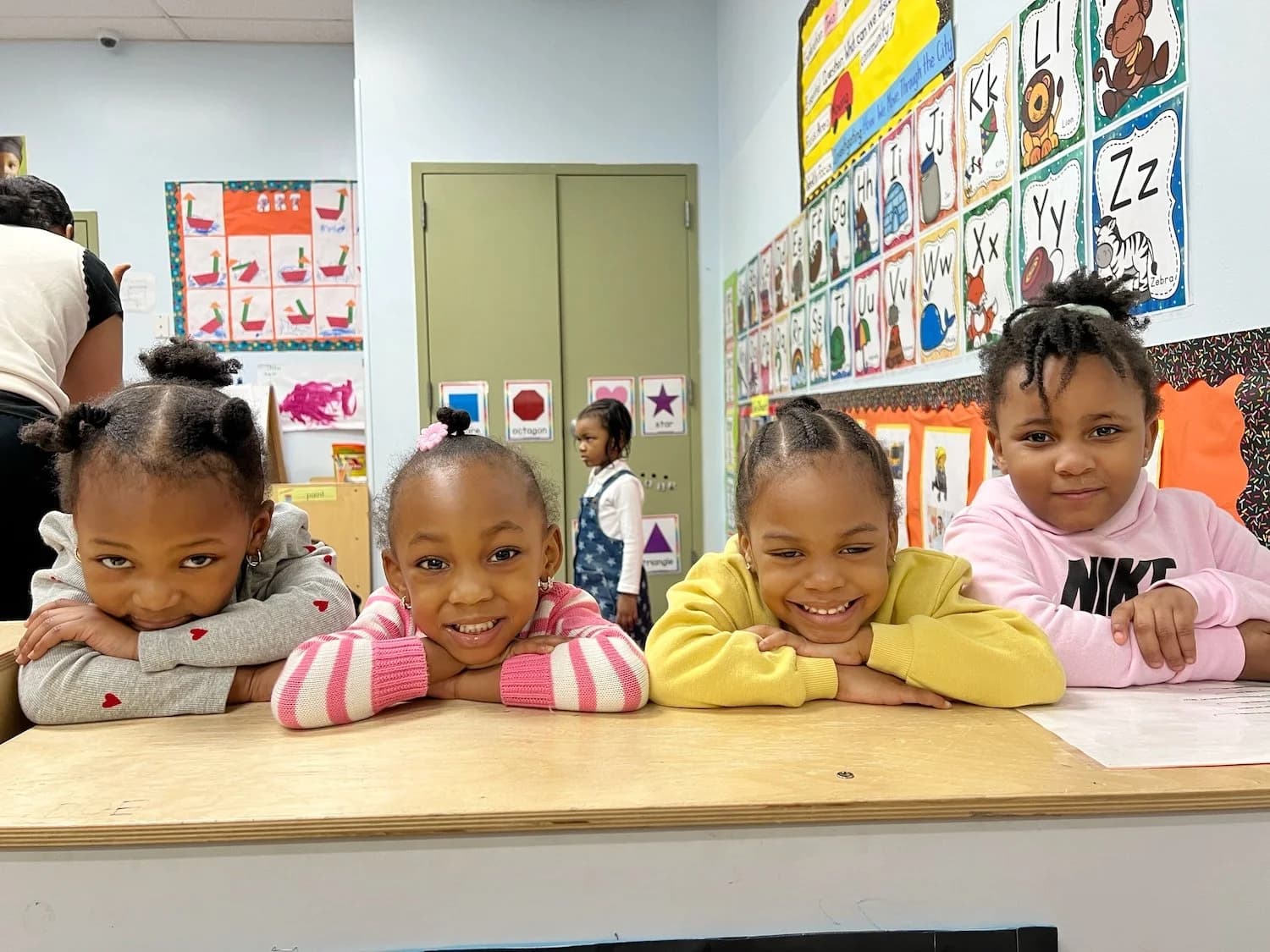
Your toddler melts down at the grocery store because you put the wrong crackers in the cart. Your three-year-old refuses to share a toy and screams when another child touches it. Your four-year-old clings to your leg at drop-off and cries for twenty minutes after you leave. Whether your family is in the 11212 or 11203 zip code, these moments are universal. They are also the raw material of social-emotional development, and how your child's daycare handles them matters more than most parents realize.
Social-emotional learning is not a buzzword. It is the process through which children learn to understand their own feelings, manage their behavior, show empathy for others, build relationships, and make responsible decisions. In East Flatbush, Brooklyn, and across the surrounding neighborhoods, the daycares that actively teach these skills produce measurably different outcomes from the ones that simply supervise children through the day.
What Social-Emotional Development Means for Children Under Five
Between birth and age five, children undergo the most rapid social-emotional growth of their entire lives. Zero to Three, the leading research organization for infant and toddler development, breaks this progression into stages. Babies learn who they are by how they are treated. Loving, consistent care builds the trust that becomes the foundation for every relationship that follows.
By 12 to 24 months, toddlers develop self-awareness and begin to understand that their internal experience is separate from other people's. This is the beginning of empathy. By 24 to 36 months, children experience more complex emotions like embarrassment and shame. Interactive peer play begins in earnest. Pretend play takes off, building language, thinking, and social skills as children take on roles and create their own stories.
Tantrums are a normal part of this development. Research published in the Journal of Developmental and Behavioral Pediatrics found that 87% of children between 18 and 24 months have tantrums, peaking at 91% of children aged 30 to 36 months. By ages 42 to 48 months, the rate drops to 59%. Tantrums are not bad behavior. They are what happens when a developing brain encounters emotions it does not yet have the tools to manage.
The Skills That Matter: Regulation, Empathy, Cooperation
CASEL, the Collaborative for Academic, Social, and Emotional Learning, identifies five core competencies: self-awareness, self-management, social awareness, relationship skills, and responsible decision-making. For children under five, the most critical of these are emotional regulation, empathy, and cooperation.
Emotional regulation is the ability to manage your feelings without being overwhelmed by them. For a two-year-old, this means learning to cry without hitting. For a four-year-old, it means using words to express frustration instead of throwing a toy. These are skills that develop through practice, and a quality daycare provides hundreds of practice opportunities every week.
Empathy begins earlier than most parents expect. By the end of the second year, children enter what researchers call the "veridical empathic distress" stage. They understand that their own feelings are distinct from another person's and can respond with concern when someone else is upset. By age three, children are capable of verbal and facial expressions of concern, interest in another person's distress, and helping behaviors. Research from Frontiers in Psychology found that preschoolers who could take another person's perspective were more likely to feel affected by others' emotions a year later.
Cooperation and conflict resolution develop alongside empathy. The American Academy of Pediatrics notes that by age three, children move beyond parallel play to truly interactive play. By four and five, improvements in theory of mind and emotional regulation allow children to negotiate, compromise, and solve social problems with decreasing adult intervention.
How Teachers Build These Skills in a Daycare Setting
Social-emotional development does not happen by accident in a quality daycare. Teachers use three evidence-based approaches: modeling, contingency, and direct teaching.
Modeling means children watch how adults handle emotions. When a teacher says "I am feeling frustrated that the paint spilled, but I can clean it up," she is demonstrating emotional vocabulary and coping strategy in real time. Children absorb this. They start using the same language in their own conflicts.
Contingency is how adults respond to children's emotions. When a child is upset, does the teacher dismiss the feeling ("You're fine, stop crying"), punish it ("Go sit in the corner"), or acknowledge it ("I can see you are really angry that she took your truck. That is frustrating.")? Research consistently shows that emotional validation, followed by guidance on appropriate behavior, produces the strongest outcomes. The feeling is always acceptable. The behavior is where boundaries apply.
Direct teaching includes naming emotions throughout the day, reading books about feelings, using puppets to practice social scenarios, and guiding children through conflict resolution step by step. At Einstein Daycare on Lenox Road, teachers in every classroom use these strategies as part of the Creative Curriculum framework, which places social-emotional development as the first of its 10 developmental domains.
What to Look for During a Tour
Teacher-child interactions reveal more about a daycare's quality than any brochure or website. During a tour, spend less time looking at the decorations and more time watching how staff respond to children in real moments.
- Watch how a teacher handles a conflict between two children. Does she get down to their level? Does she help both children name their feelings before solving the problem? Or does she simply separate them and move on? The first approach teaches social-emotional skills. The second just manages behavior.
- Listen for feeling words. In a classroom that prioritizes social-emotional development, you will hear teachers and children using words like frustrated, disappointed, excited, worried, and proud throughout the day.
- Notice the response to crying. A child who is upset should be comforted, not ignored or shushed. Watch whether teachers pick up on emotional cues quickly or wait until a situation escalates.
- Ask about the curriculum's social-emotional component. Programs using Creative Curriculum track social-emotional development through Teaching Strategies GOLD with specific objectives for managing feelings, building relationships, and participating in group situations. Ask the director to explain how they use this data.
For families near Brownsville, Crown Heights, or along the Utica Avenue corridor, visiting during active classroom hours rather than during nap time gives you the most honest picture of how teachers interact with children during the moments that matter.
The Research on SEL and Long-Term Outcomes
The strongest evidence for investing in social-emotional development comes from longitudinal studies that followed children for decades. The results are not subtle.
A 2015 study published in the American Journal of Public Health tracked children from kindergarten into their mid-twenties. For every one-point increase in a child's kindergarten social competency score, the child was twice as likely to graduate from college and 46% more likely to have a full-time job by age 25. The associations held across education, employment, criminal activity, substance use, and mental health.
The Dunedin Study followed 1,000 children from birth to age 32 in New Zealand. Children who scored lower on self-control measures at ages three to five were significantly more likely to have poorer physical health, substance dependence, financial problems, and criminal convictions as adults. These associations held even after controlling for IQ and social class. Self-control had independent predictive power above intelligence and family background.
The Perry Preschool Study, which began in the 1960s with disadvantaged children in Michigan, found that every dollar invested in quality early childhood education returned seven to twelve dollars to society. When researchers examined why, the answer was not academic gains. The program's main impact was on socio-emotional skills, including self-regulation and judgment. Those skills, developed before age five, largely explained the better employment and reduced criminal behavior observed at age 40.
Handling Separation Anxiety and Big Emotions
Separation anxiety peaks around 18 months and typically eases by age three. It is one of the most common concerns for parents starting daycare, especially first-time parents. The anxiety is actually a sign of healthy attachment. Your child misses you because you have built a secure bond.
Research from the Erikson Institute confirms that some degree of separation distress is nearly universal among toddlers entering group care. A study in Early Child Development and Care found that all toddlers in the sample struggled with separation anxiety at childcare. The key differentiator is how the program responds.
Strong programs use consistent drop-off routines, transition objects, and calm redirection. The AAP recommends keeping goodbyes brief and predictable: a quick hug, a clear statement like "I will be back after lunch," and a confident exit. The drawn-out goodbye, where a parent lingers and checks back multiple times, actually increases distress rather than reducing it.
If your child is between 18 and 24 months, some separation tears at the start are virtually guaranteed. Most children settle within a few weeks. If intense separation anxiety persists beyond six weeks or interferes with daily activities, consult your pediatrician.
Supporting Social-Emotional Growth at Home
What happens at daycare works best when it is reinforced at home. These strategies are drawn from recommendations by NAEYC, Zero to Three, and Head Start.
- Name emotions throughout the day. When you see your child experiencing a feeling, put a word to it: "You look frustrated that the tower fell down." Over time, children learn to use words instead of acting out. Model this for yourself too: "I am feeling a little disappointed that it is raining."
- Read books about feelings. Stories are a safe space to explore difficult emotions. Talk about what the characters feel and connect it to your child's own experiences.
- Encourage pretend play. Dramatic play lets children try on different emotions and practice strategies for handling them. Provide props and let your child lead.
- Validate feelings before correcting behavior. Acknowledge the emotion first ("I can see you are really angry"), then address the action ("but we do not hit"). This teaches children that all feelings are acceptable, even when certain behaviors are not.
- Play turn-taking games. Board games, card games, and simple sharing activities give children practice with patience, cooperation, and handling frustration in a low-stakes setting.
The daycare hours and the home hours are not separate systems. They are two halves of the same developmental process. When families and teachers use consistent language and strategies, children internalize the skills faster. Ask your child's teachers what vocabulary they use for emotions and conflict resolution, and mirror it at home. If you are still evaluating programs, our guide to choosing a daycare in Brooklyn covers the eight factors that matter most, including how to assess a program's approach to social-emotional learning. And for parents weighing nanny vs. daycare vs. family childcare, the research on socialization in group settings is worth reviewing.
For families looking at programs in the East Flatbush area, social-emotional development should be near the top of your evaluation criteria. The academic skills will follow. The self-regulation, empathy, and relationship-building that children develop before age five will shape their trajectory for decades. See our classrooms in action to get a sense of how we approach this work daily.