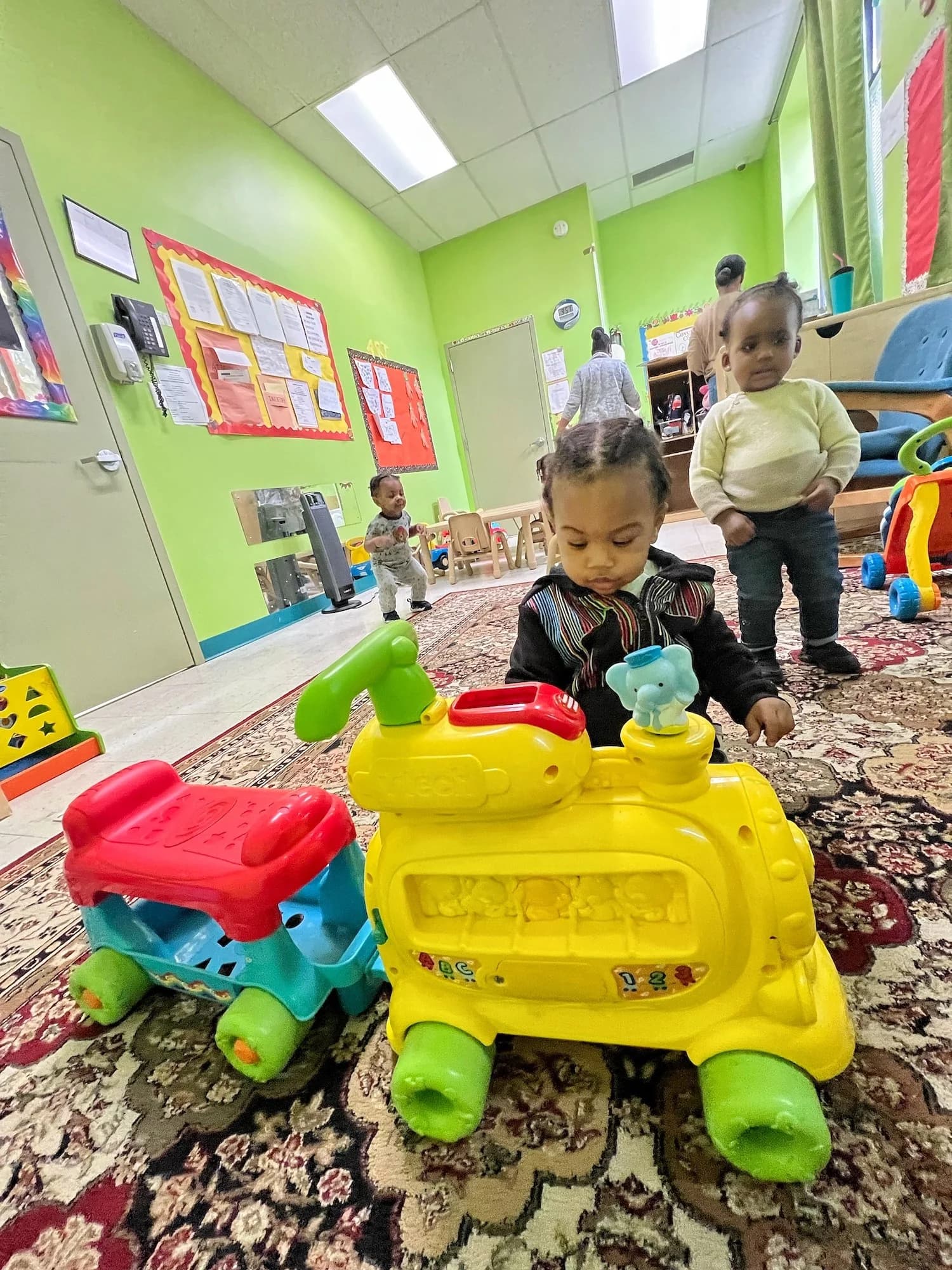
Deciding when your toddler should start daycare is one of those questions that keeps you up at night. You ask friends, you ask your pediatrician, you read conflicting advice on every parent forum in Flatbush, Brooklyn. And you still are not sure. The problem is that most answers focus on age, when the real answer is about development.
There is no magic birthday that makes a child "ready." But there are specific behavioral and developmental signals that tell you whether your toddler would benefit from a structured group setting. After years of working with families across East Flatbush and the surrounding neighborhoods, these are the seven signs we see most often in children who transition well into daycare.
Readiness Is About Development, Not Age
The American Academy of Pediatrics considers 18 to 36 months the primary window when toddlers begin to benefit from structured group care. Before 18 months, the developmental priority is building secure attachment with a primary caregiver. After 18 months, most children start showing interest in peers and can handle increasingly complex social interactions.
But 18 months is a guideline, not a cutoff. Some children show readiness signals at 14 months. Others are still working on them at 26 months. What matters is where your child is developmentally, not how many candles were on their last birthday cake. The CDC's developmental milestones for 18 months provide a useful baseline: copying others' actions, pointing to show you things, handing objects to adults, and exploring while checking back with a caregiver.
By age two, the CDC identifies additional social markers: noticing when others are upset, engaging in parallel play, copying older children, and asserting preferences. These behaviors indicate a child who can start to function in a group. They do not need to be perfectly consistent. Even emerging versions of these behaviors suggest a structured setting would support, not overwhelm, your child. For a deeper look at how these social markers develop into lasting skills, read our guide on why social-emotional skills are the foundation of early learning.
Seven Signs Your Toddler May Be Ready for Daycare in Flatbush
These are the signals that consistently predict a smooth transition into group care. Your child does not need all seven. Three or four strong indicators usually mean they are ready.
- Shows interest in other children. Does your toddler watch other kids at the playground or at Wingate Park? Do they try to approach, hand toys to, or imitate what other children are doing? Curiosity about peers is one of the strongest readiness indicators. Zero to Three notes that children aged 24 to 36 months show dramatic growth in pretend play and cooperative interaction.
- Communicates basic needs. Your child does not need to speak in full sentences. Pointing, gesturing, using a few words, or signing are all sufficient. What matters is that they can signal hunger, thirst, discomfort, or the need for help. Teachers at quality programs are trained to respond to pre-verbal communication too.
- Tolerates brief separations from you. Can your child spend 15 to 30 minutes with a trusted relative or friend without sustained distress? Brief separations that end positively build the confidence needed for longer periods of care.
- Follows simple instructions. "Bring me your shoes" or "put the cup on the table" are two-step directions that help children participate in classroom routines. If your toddler can follow these kinds of requests most of the time, they will be able to keep up with the flow of a group setting.
- Engages in pretend play. Feeding a doll, talking into a toy phone, or pretending a block is a car are signs of symbolic thinking. This kind of play takes off between 18 and 30 months and is central to how Creative Curriculum classrooms are designed, especially the dramatic play area.
- Shows curiosity about new environments. When you visit a new place, does your child explore, even cautiously? A child who hangs back for a few minutes and then starts touching and examining objects is showing healthy, age-appropriate curiosity.
- Eats independently or mostly so. Using fingers, a spoon, or a combination of both to get food from plate to mouth. Perfection is not required. Willingness to sit and eat without being fully hand-fed helps in a group mealtime setting.
What About Separation Anxiety?
Separation anxiety peaks between 10 and 18 months and typically begins to ease by age two. If your child cries when you leave the room, that does not mean they are not ready for daycare. It means they have a healthy attachment to you.
Research published in the European Early Childhood Education Research Journal found that virtually all toddlers show some separation distress at the start of childcare, and nearly all adjust within a few weeks. The quality of the program makes the difference. Trained teachers use consistent drop-off routines, transition objects, and calm redirection to help children settle.
The American Academy of Pediatrics recommends keeping goodbyes brief and predictable. A quick hug, a clear statement like "I will be back after lunch," and then a confident walk out the door. The hesitant, lingering goodbye actually increases distress rather than reducing it.
If your child is between 18 and 24 months, some separation anxiety at the start is almost guaranteed. This does not mean you should wait. It means you should choose a program where the staff has specific training in transition support and where the drop-off routine is predictable from day one. Ask the director how they handle the first week for new families. A strong answer will describe a gradual phase-in process, not just "they usually stop crying after a few days."
The Potty Training Question
This is the misconception that delays enrollment more than any other. Many parents assume their toddler needs to be fully potty-trained before starting daycare. In most cases, that is simply not true.
Licensed daycare programs in New York City that serve children under age three do not require toilet training. NYC DOHMH regulations and state-funded programs explicitly cannot use potty-training status as an enrollment barrier for toddlers. If a program tells you otherwise for a child under three, ask them to show you the policy in writing.
Most children begin showing potty-training readiness between 18 and 36 months, with wide individual variation. Quality daycares support the process as part of their daily routine, working with families to maintain consistency between home and school. Waiting until potty training is complete to start daycare means potentially missing months of social, cognitive, and language development that group care provides.
What Quality Daycare Means for a Toddler
Not all daycare is equal, and the research on this is clear. The NICHD Study of Early Child Care and Youth Development, which followed over 1,300 children for 15 years, found that children who experienced high-quality care in both the infant-toddler and preschool periods showed the highest cognitive and language outcomes. Quality matters more than the decision to use daycare at all.
What defines quality for toddlers? NAEYC recommends a maximum ratio of one adult for every six toddlers and a maximum group size of 12. Only 16 states meet that standard. A program using a recognized curriculum framework like Creative Curriculum, with observation-based assessment through Teaching Strategies GOLD, gives you measurable accountability for your child's progress.
When you visit, look at how teachers interact with children. Are they at eye level? Do they use children's names? How do they handle a conflict or a crying child? These small moments reveal more about program quality than any website or brochure. Our gallery gives you a preview, but there is no substitute for seeing it in person.
The 3-K Pipeline: Why Starting at Two Works for Flatbush Families
NYC offers free, full-day 3-K for children turning three by December 31 of the program year. For families in the 11226 zip code and across Prospect Lefferts Gardens, this is a significant resource. But children who arrive at 3-K with prior group care experience have a measurable advantage.
A child who spent a year in a quality daycare before entering NYC's 3-K program has already practiced separating from a parent, following classroom routines, eating in a group, and interacting with peers daily. They have a head start on the social-emotional skills that make the 3-K year productive rather than just an extended adjustment period.
Starting at age two also means your child gets an extra year of structured learning during the period when the brain is most responsive to language input and social development. The Zero to Three research on 24-to-36-month development describes this window as a time of dramatic growth in cooperative interaction and emotional regulation. A quality daycare puts your child in the right environment to make the most of that window.
How to Take the Next Step
If you recognized three or four of the readiness signs in your toddler, the next step is simple: visit a program. Not a website. The actual building. Walk through the classrooms during active hours. Watch how teachers respond to children. Ask the questions that matter to your family.
Bring your child along if you can. Their reaction to the environment will tell you something. A child who clings for the first five minutes and then starts eyeing the toy shelf is showing you exactly what readiness looks like in real time.
The B44 bus runs along Nostrand Avenue and stops near our location, and families taking the 2 or 5 train to Nostrand Avenue station are a short walk away. We are open for tours Monday through Friday during regular hours.