Finding childcare in Brooklyn is one of those experiences nobody fully prepares you for. You start with a simple Google search, maybe "daycare near me Brooklyn," and within minutes you're drowning in options, waitlists, and conflicting advice from parent Facebook groups. If you're still deciding between a nanny, a family daycare, and a center-based program, our comparison of nanny vs. daycare vs. family childcare breaks down the costs, regulations, and research for Brooklyn families.
Here's the thing: most daycare guides give you generic advice that could apply anywhere in the country. But Brooklyn has its own rules, its own licensing system, and its own community expectations. Whether you're in East Flatbush, Flatbush, Prospect Lefferts Gardens, or Crown Heights, the process of evaluating a daycare stays the same. You just need to know what to look for.
This guide covers the eight factors that actually matter when you're choosing a daycare in Brooklyn. Not the stuff that sounds impressive on a website, but the things that tell you whether a place will genuinely take care of your child.
1. Verify Licensing and Compliance
Before you look at anything else, confirm the daycare is licensed by the New York City Department of Health and Mental Hygiene (NYC DOHMH). This isn't optional. An unlicensed facility in NYC is operating illegally, and no amount of friendly staff or colorful walls makes up for that.
Licensed daycares in Brooklyn must meet specific requirements for staff-to-child ratios, fire safety, food handling, background checks on all employees, and regular health inspections. You can look up any facility's inspection history on the NYC DOHMH website. Do it. It takes five minutes and tells you more than any tour ever could.
Ask the director to show you their license during your visit. It should be posted in a visible location. If it's not, or if they hesitate when you ask, that tells you something.
2. Understand the Curriculum
Not all daycare programs are the same. Some follow a structured, research-backed curriculum. Others wing it day to day. Neither is inherently wrong, but you should know which one you're signing up for.
The most widely recognized frameworks in early childhood education include Creative Curriculum, Montessori, Reggio Emilia, and HighScope. Each has a different philosophy about how children learn best.
Creative Curriculum, for example, organizes the classroom into interest areas like blocks, dramatic play, art, and books. Teachers plan activities based on children's interests and developmental stages. The approach balances child-initiated exploration with teacher-directed instruction, which research consistently supports as effective for early learners.
When you visit a daycare, ask the director: "What curriculum do you follow, and how do your teachers implement it daily?" A strong program will give you a specific, confident answer. A vague response like "we do a little of everything" usually means there's no real structure behind the scenes.
3. Check Teacher-to-Child Ratios
Ratios matter more than almost anything else in a daycare. A beautiful facility with overworked, outnumbered teachers is not a good daycare. NYC sets minimum ratio requirements, but the best programs exceed them.
Here's what NYC requires as a baseline:
- Infants (under 12 months): 1 teacher for every 4 children
- Toddlers (12-24 months): 1 teacher for every 5 children
- Twos (24-36 months): 1 teacher for every 6 children
- Preschool (3-5 years): 1 teacher for every 8-10 children
During your tour, count. Literally count the number of children in a room and the number of adults. If the ratios are tight or over the limit on a random Tuesday, that's a red flag. Ask about staffing during transitions, outdoor time, and when teachers are on break. That's when ratios tend to slip.
4. Visit the Facility
A tour is non-negotiable. You cannot choose a daycare based on photos and phone calls alone. And when you visit, look past the decorations on the walls. Here's what actually matters:
Cleanliness and safety: Are surfaces wiped down? Are cleaning supplies stored out of children's reach? Are electrical outlets covered? Is the outdoor area fenced and free of hazards?
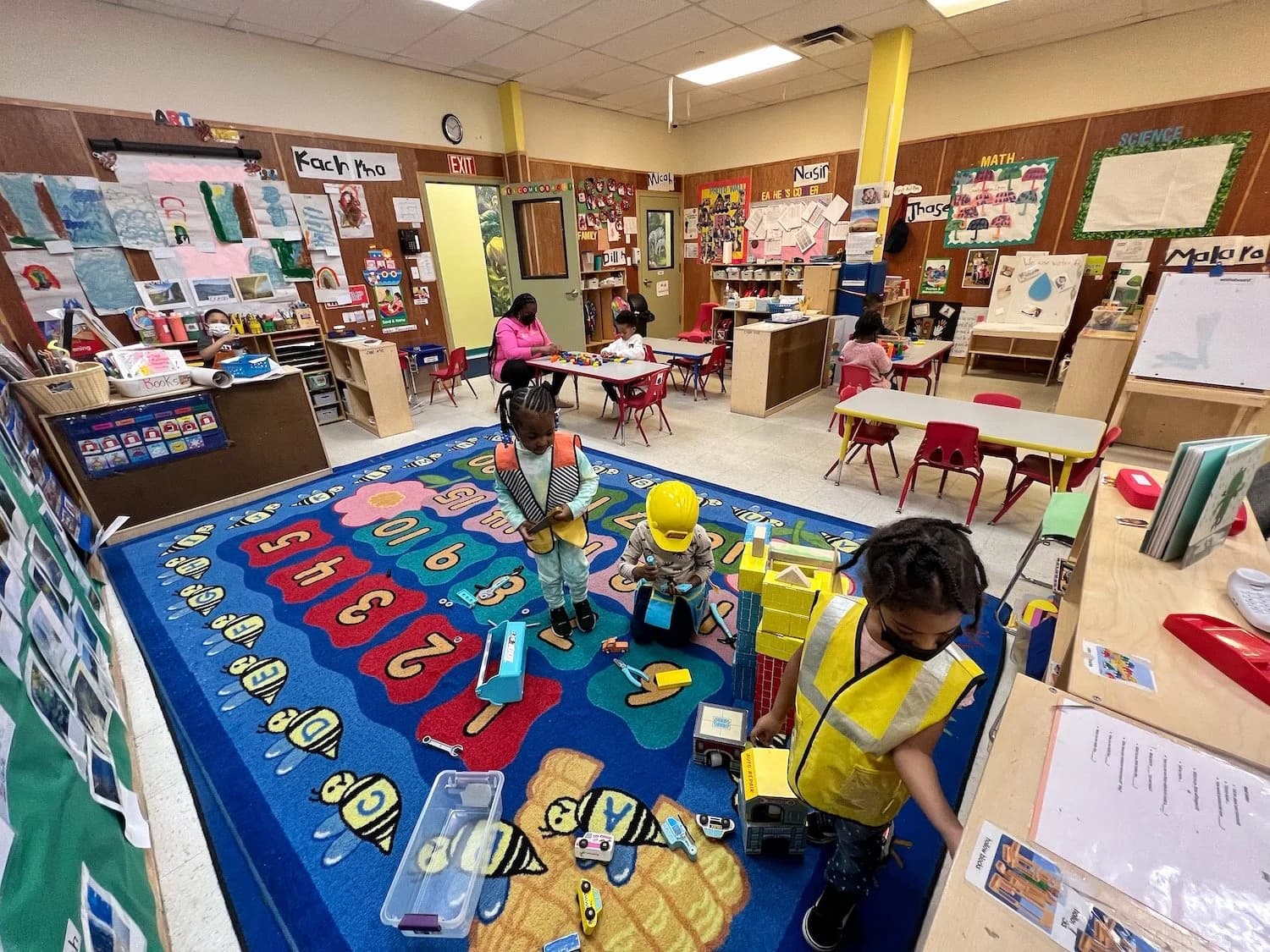
Classroom organization: A well-run classroom has clearly defined areas for different activities. You should see a reading corner, an art area, a block area, and space for gross motor play. This centers-based setup isn't just for aesthetics. It's how children learn to make choices, focus, and transition between activities.
Natural light and ventilation: Kids spend 8+ hours a day in these rooms. Windows matter. Fresh air matters. A basement classroom with fluorescent lighting should give you pause.
The noise level: A completely silent daycare is just as concerning as a chaotic one. Healthy classrooms have a productive hum. Kids talking, laughing, occasionally arguing over a toy. Teachers redirecting calmly, not shouting.
How staff interact with children: This is the most important thing you'll observe. Watch how teachers get down to eye level when speaking to a child. Notice whether they use children's names. See how they handle a conflict or a crying child. These small moments reveal everything about a program's quality.
Browse photos of Einstein Daycare's classrooms and activities to get a sense of our learning environment before your visit.
5. Ask About Assessment Methods
Good daycares don't just watch your child play. They observe, document, and assess developmental progress in a structured way. This matters because early identification of developmental delays leads to better outcomes.
Ask the director: "How do you track my child's development, and how will you communicate progress to me?"
Programs that use formal assessment tools like Teaching Strategies GOLD give you concrete data about your child's growth across multiple domains: social-emotional, physical, language, cognitive, literacy, and math. These aren't standardized tests. They're observation-based assessments that teachers complete over time as they watch children interact with materials and peers.
If a daycare says they "observe and take notes," that's fine as a starting point. But structured assessment tools provide a shared language between teachers and parents. They also help teachers individualize their approach for each child, rather than treating the whole class the same way.
6. Look for Enrichment Programs
Basic care, feeding, and supervision are the minimum. The daycares that stand out offer something beyond the basics. Look for programs that include enrichment activities like:
- Yoga or movement: Helps with body awareness, self-regulation, and focus
- Music and rhythm: Supports language development, pattern recognition, and social bonding
- Art exploration: Open-ended art (not coloring sheets) builds creativity and fine motor skills
- Outdoor and nature play: Critical for physical development and sensory learning
- STEM activities: Age-appropriate science and building activities develop problem-solving skills early
The key word here is "integrated." Enrichment should be woven into the daily schedule, not treated as an occasional add-on. A daycare that offers yoga once a month isn't really a yoga program. A daycare where movement and mindfulness are part of the daily routine has internalized those values.
7. Consider Location and Hours
This sounds obvious, but Brooklyn parents often underestimate how much a difficult commute to daycare wears on a family. A program that's twenty minutes by car can turn into forty-five minutes during school drop-off traffic on Flatbush Avenue or Nostrand Avenue. Multiply that by two trips a day, five days a week.
Think about your actual daily route. If you're commuting from East Flatbush to Manhattan for work, a daycare on Lenox Road or Nostrand Avenue might save you significant time compared to one in Park Slope or Cobble Hill. Proximity to public transit matters, too. Being near the B44 or the 2/5 line can make or break your morning.
Hours are just as important. Most Brooklyn daycares operate from roughly 8:00 AM to 6:00 PM, but some close at 5:00 PM. Make sure the hours work for your actual schedule, not your ideal schedule. Late pickup fees add up fast, and the stress of rushing to beat the clock every afternoon is real.
8. Read Reviews and Ask for References
Google Reviews and Yelp give you unfiltered parent feedback. Read them, but read them critically. One negative review from three years ago doesn't define a program. A pattern of complaints about the same issue does.
Pay attention to what parents praise and what they complain about. Common themes in positive reviews for strong daycares: communication with parents, warmth of the staff, child's developmental progress. Common red flags in negative reviews: disorganization, high staff turnover, lack of communication about incidents.
Don't be afraid to ask the director for references from current parents. Most good programs are happy to connect you with families who can speak to their experience. If a director refuses or deflects, consider why.
Trust Your Gut
After you've checked the licensing, asked about the curriculum, counted the ratios, and read the reviews, you'll probably have two or three strong options. At that point, trust your instincts. You know your child. You know your family's needs. The daycare that feels right probably is right.
The best way to get a real sense of a program is to visit in person. Walk through the classrooms during active hours. Watch the teachers. Talk to the director. Ask your questions. A strong daycare will welcome your curiosity because they have nothing to hide. Once you have chosen a program, our guide to preparing your child for their first week of daycare covers everything from packing the bag to handling drop-off.