If you are a parent in Crown Heights, Prospect Heights, or anywhere in Brooklyn raising a child under five, screen time is probably one of those topics that keeps you up at night. Tablets at restaurants, cartoons during dinner prep, educational apps that promise to teach your toddler to read. The messaging is everywhere, and it is contradictory. Some experts say screens are fine in moderation. Others say they are rewiring your child's brain. The truth, as usual, lives somewhere in between, and the research is clearer than most parents realize.
At Einstein Daycare, we get questions about screen time from families almost every week. Parents want to know what we do during the day, what they should be doing at home, and how to evaluate whether a daycare is using screens as a teaching tool or a babysitter. This guide walks through the current research, the official recommendations, and practical strategies that actually work for Brooklyn families with young children.
What the American Academy of Pediatrics Actually Recommends
The American Academy of Pediatrics (AAP) updated its screen time guidelines in 2016, and those recommendations remain the gold standard in pediatric health. Here is the breakdown by age:
- Under 18 months: Avoid all screen media except video chatting with family members. FaceTime with grandma in Jamaica or a relative overseas is fine. YouTube videos, even "educational" ones, are not.
- 18 to 24 months: If you choose to introduce digital media, select high-quality programming and watch it together with your child. Children this age cannot learn effectively from screens without an adult helping them understand and apply what they are seeing.
- Ages 2 to 5: Limit screen use to one hour per day of high-quality programs. Again, co-viewing is important. Programs like Sesame Street, Daniel Tiger, and Bluey are designed with child development research in mind. Random YouTube autoplay is not.
These guidelines are not arbitrary. They are based on decades of developmental research examining how screen exposure affects language acquisition, attention span, sleep quality, and social-emotional growth during the most critical years of brain development.
How Screen Time Affects Language Development
One of the most well-documented effects of excessive screen time in young children is its impact on language development. A 2019 study published in JAMA Pediatrics used MRI brain imaging and found that children aged 3 to 5 with higher screen use had lower measures of brain white matter integrity in areas that support language and literacy skills. These are the neural pathways that help children process words, understand stories, and eventually learn to read.
The mechanism is not complicated. Language development in young children depends on what researchers call "serve and return" interactions. A child babbles, a caregiver responds, the child adjusts, the caregiver responds again. This back-and-forth is how vocabulary grows, how grammar develops, and how children learn the social rules of conversation. Screens, even interactive ones, cannot replicate this exchange. A tablet app does not pause when your child looks confused. It does not rephrase a sentence because the child did not understand. It does not ask follow-up questions or share in the excitement of a new word.
Research from the National Institute of Child Health and Human Development confirms that every hour a toddler spends with a screen is an hour not spent in the kinds of face-to-face interactions that build language. This is why high-quality daycares prioritize conversation, storytelling, songs, and read-alouds over any screen-based activity. If you are evaluating how language-rich environments support early childhood growth, our post on raising bilingual and multilingual children in daycare explores how consistent spoken interaction drives language acquisition across multiple languages.
The Attention and Self-Regulation Connection
Beyond language, researchers have found consistent links between early screen exposure and difficulties with attention and self-regulation. A longitudinal study published in Pediatrics found that children who watched more than two hours of television per day before age three were significantly more likely to have attention problems by age seven.
Why does this happen? Screens deliver information at a pace that the real world does not match. Rapid scene changes, bright colors, sound effects, and constant stimulation train a child's brain to expect high levels of input. When that child sits down for circle time or tries to focus on building a block tower, the slower pace of real life feels boring by comparison. The child has not developed the internal capacity to sustain attention without external stimulation.
Self-regulation, the ability to manage emotions, wait for a turn, and resist impulses, develops through practice in real social situations. Children learn to regulate by navigating disagreements over toys, waiting for their turn on the slide, and managing frustration when a block tower falls. These are the experiences that build executive function, and they cannot happen through a screen. Our post on social-emotional development in daycare explains how trained educators support these critical skills throughout the day.
Why Quality Daycares Minimize or Eliminate Screens
If you are touring daycares in Crown Heights, Bed-Stuy, Prospect Lefferts Gardens, or anywhere along the B44 or Franklin Avenue corridor, one of the most telling questions you can ask is: "What is your screen time policy?"
The answer will tell you a lot about a program's philosophy and quality. High-quality early childhood programs, those following research-backed curricula like Creative Curriculum, Montessori, or HighScope, minimize or completely eliminate screen use for children under five. This is not because they are old-fashioned. It is because the research is clear that hands-on, play-based learning produces better developmental outcomes than any screen-based alternative.
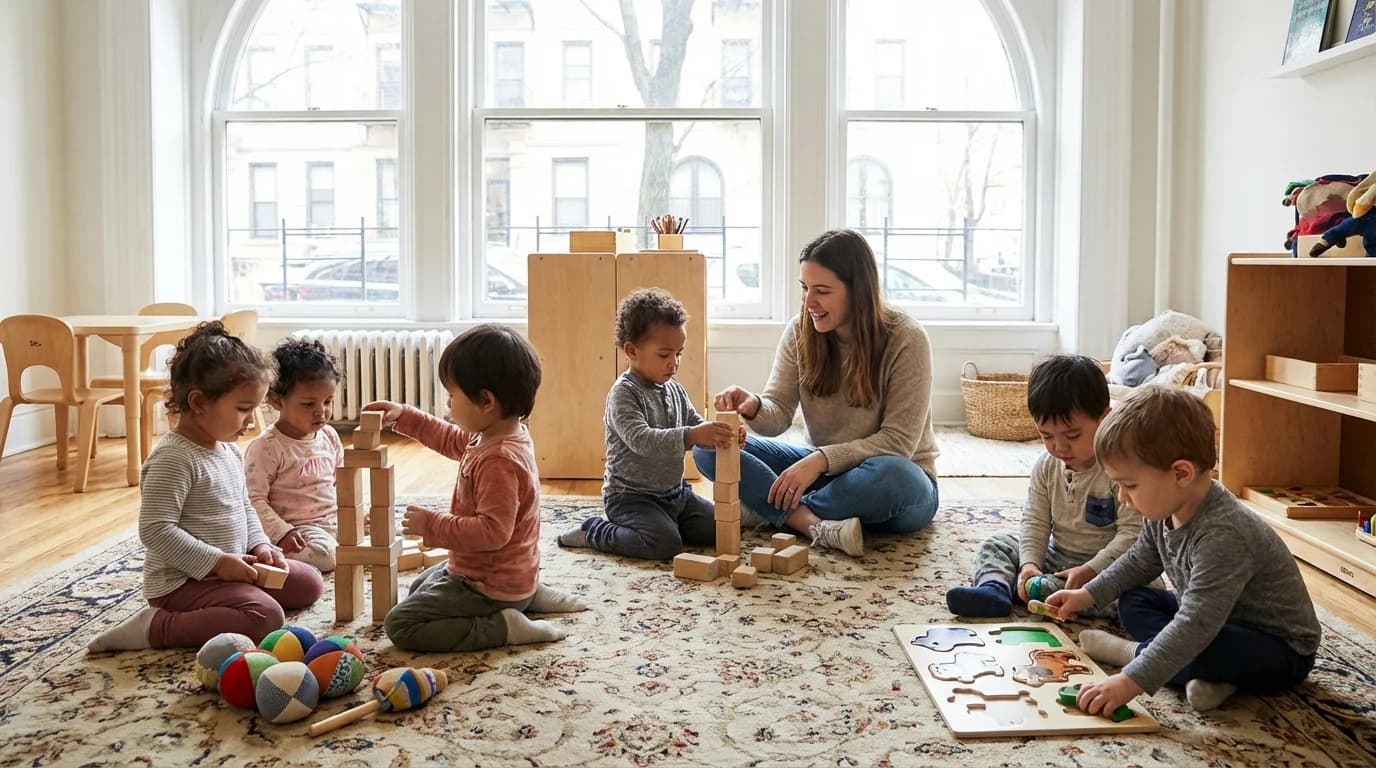
At Einstein Daycare, our classrooms are screen-free. We do not use tablets, televisions, or computers as part of our daily program. Instead, our teachers use the Creative Curriculum framework to design learning environments that are rich in hands-on materials, open-ended play opportunities, and meaningful adult-child interactions. Our curriculum page details how these interest areas work in practice across every age group we serve.
Here is what replaces screen time in a well-designed classroom:
- Block play: Develops spatial reasoning, math concepts, and collaborative problem-solving. When two preschoolers negotiate how to build a bridge together, they are practicing engineering and social skills simultaneously.
- Dramatic play: Builds language, empathy, perspective-taking, and emotional regulation. A child pretending to be a doctor uses complex vocabulary and practices caring for others.
- Art activities: Develops fine motor skills, self-expression, and creativity. Process-focused art, where the experience matters more than the product, teaches children to experiment and take risks.
- Sensory exploration: Water tables, sand play, playdough, and sensory bins develop tactile awareness and scientific thinking. Children learn cause and effect, measurement, and classification through direct experience.
- Music and movement: Our yoga and music programs develop body awareness, rhythm, coordination, and emotional regulation. These activities engage the whole child in ways a screen simply cannot.
- Outdoor play: Running, climbing, digging, and exploring nature build gross motor skills, risk assessment, and environmental awareness.
Each of these activities engages multiple senses simultaneously, requires active participation rather than passive consumption, and involves social interaction with peers and caring adults. No app can replicate that.
Passive vs. Interactive Screen Use: Does It Matter?
Parents often ask whether interactive screen use, such as educational apps, drawing programs, or video calls, is different from passive screen use like watching cartoons. The answer is yes, but with significant caveats.
Research does suggest that interactive, high-quality content produces better learning outcomes than passive viewing. A child using a well-designed app with a parent's guidance can learn vocabulary or practice letter recognition. Video calls with relatives genuinely support social connection and are explicitly excluded from the AAP's screen time limits.
However, the distinction matters less than most parents hope. Even the best educational apps are inferior to equivalent hands-on activities for children under five. A child learns more about letters by finger-painting them, forming them with playdough, and finding them on signs during a walk through Crown Heights than by tracing them on a tablet. The multi-sensory, physical experience creates stronger neural connections and deeper learning.
The real risk with the passive-vs-interactive distinction is that it becomes a justification for more total screen time. "It is educational" can quickly become two or three hours a day, which exceeds the AAP's recommendation regardless of content quality. The most important factor is not what is on the screen. It is what is not happening while the child is looking at it.
What Brooklyn Parents Can Do at Home
Reducing screen time at home is genuinely hard, especially for Brooklyn families juggling long commutes, small apartments, and the reality of needing a few minutes to cook dinner without a toddler climbing the stove. Nobody is judging you for turning on Bluey while you prepare a meal. The goal is not perfection. It is awareness and intentionality.
Here are practical strategies that work for real families:
- Create screen-free zones and times. Meals, the hour before bedtime, and the first hour after waking are the most impactful times to keep screens off. The AAP specifically notes that screen use before bed disrupts sleep quality in young children.
- Offer alternatives before reaching for the tablet. Keep a low shelf stocked with crayons, playdough, simple puzzles, and board books. When your child says they are bored, point them there first. Boredom is not a crisis. It is the starting point of creativity.
- Co-view when screens are on. If your child is watching a show, watch it with them. Pause to ask questions. "What do you think will happen next?" "How do you think that character feels?" This transforms passive viewing into an interactive language experience.
- Use the Brooklyn neighborhood as your classroom. A walk to the farmers market at Crown Heights, a trip to the Brooklyn Botanic Garden, or even a stroll to the playground on St. Johns Place offers more learning opportunities than any app. Children learn by exploring the real world with people they trust.
- Model the behavior you want. Children notice when adults are on their phones constantly. Setting your own screen boundaries, especially during family time, teaches your child that screens are one part of life, not the center of it.
- Replace screen routines gradually. If your child currently watches an hour of TV after daycare, try replacing 15 minutes of it with a simple activity like drawing or building with blocks. Small, consistent changes are more sustainable than dramatic overhauls.
How to Evaluate a Daycare's Screen Time Policy
When you are visiting daycares in Crown Heights or nearby neighborhoods, here are the specific questions to ask about screen time:
- "Do you use screens, tablets, or televisions in the classroom?" A clear "no" is the best answer for children under five. If they say yes, ask how often, for how long, and for what purpose.
- "How do you handle rainy days or schedule disruptions?" Some programs default to screens when outdoor play is not available. Strong programs have backup plans that do not involve screens: indoor gross motor activities, music and movement, or sensory play.
- "What does a typical day look like?" If the answer includes extended periods of unstructured time without mention of specific activities, screens may be filling those gaps. Our post on what a typical day at daycare looks like gives you a benchmark for what a well-structured day should include.
- "How do you keep children engaged during transitions?" Transitions between activities (cleanup time, lining up, waiting for lunch) are when screens most often appear. Quality programs use songs, fingerplays, and short movement activities instead.
A daycare that is confident in its programming will answer these questions directly and without defensiveness. If a program becomes evasive or dismissive when you ask about screens, that is valuable information. For a broader checklist of what to evaluate during a daycare visit, our complete guide to choosing a daycare in Brooklyn covers licensing, ratios, curriculum, and more.
The Bigger Picture: Presence Over Perfection
The screen time conversation can easily become another source of parental guilt, and that is not the goal. The research is not saying that a toddler who watches 20 minutes of Sesame Street is damaged. It is saying that the first five years of life represent an extraordinary window for brain development, and the experiences that matter most during that window are real, physical, social, and human.
Conversation. Play. Touch. Exploration. Laughter. Mess. These are the raw materials of early learning, and they are available to every family regardless of income, education, or neighborhood. The best thing you can do for your child's development is not to buy the right app or find the perfect educational show. It is to be present, responsive, and engaged as often as you can.
At Einstein Daycare, that is exactly what our teachers do every day. Through Creative Curriculum's research-backed framework, Teaching Strategies GOLD assessments, and enrichment programs in yoga and music, we fill every hour with the kinds of hands-on, screen-free experiences that build strong minds and confident children. We serve families across Crown Heights, Prospect Lefferts Gardens, Flatbush, and East Flatbush, and we welcome you to see our classrooms in action.