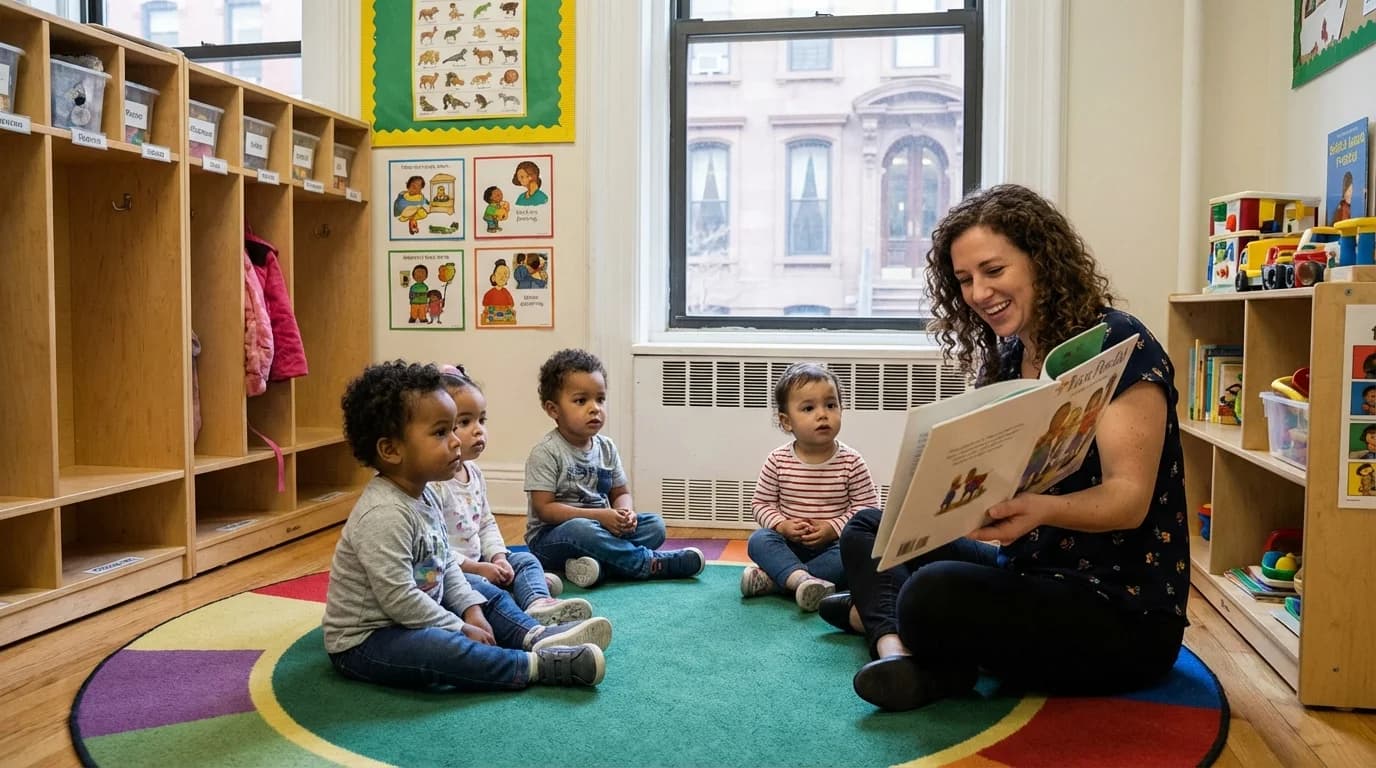
When your child turns three in New York City, a significant option opens up that many Brooklyn parents do not fully understand until the application deadline is almost past: 3-K for All. This is the city's free, universal early education program for three-year-olds, and it is available to every NYC family regardless of income, immigration status, or neighborhood. If you live in East Flatbush, Flatbush, or the surrounding 11203 zip code area, your child is eligible.
But "free" and "simple" are not the same thing. The application process runs through a centralized system, the timeline has firm deadlines, and the difference between program types matters more than most families realize. This guide breaks down how 3-K for All works, how to apply, what to expect, and how it fits into the broader early childhood landscape for Brooklyn families.
What Is 3-K for All?
3-K for All is a New York City Department of Education (DOE) program that provides free, high-quality early childhood education to all three-year-old children in the city. The program launched in 2017 in a limited number of districts and has since expanded citywide. By the 2025-2026 school year, 3-K seats are available in every community school district in New York City, including District 17, which covers East Flatbush, and District 22, which includes parts of Flatbush and Midwood.
The program is modeled on the success of Pre-K for All, which the city rolled out for four-year-olds starting in 2014. The logic is straightforward: if one year of free early education before kindergarten produces measurable benefits in school readiness, two years should produce even more. Research from the National Institute for Early Education Research (NIEER) supports this. Children who attend two years of high-quality preschool show stronger gains in language, literacy, and math than those who attend for just one year, with the greatest benefits observed among children from low-income families.
3-K for All is free for all families. There is no income requirement, no means testing, and no citizenship or residency documentation requirement beyond proof that you live in New York City and that your child is age-eligible. If your child turns three during the calendar year of the program (for the 2026-2027 school year, that means born in 2023), they are eligible.
Types of 3-K Programs
Not all 3-K seats are the same. Understanding the differences between program types is important because they affect your daily schedule, the length of the school year, and what happens during breaks and summer.
School-day programs run for 6 hours and 20 minutes per day, typically from approximately 8:00 AM to 2:20 PM, following the DOE school calendar. This means the program is closed during school breaks (winter break, February break, spring break) and during the summer. For parents who work standard full-time hours, school-day 3-K alone does not cover the full workday.
Extended-day, extended-year programs run for up to 10 hours per day, year-round. These programs are operated by community-based organizations (CBOs) that contract with the DOE. They typically run from around 8:00 AM to 6:00 PM and remain open during most school breaks and through the summer, with limited closures for major holidays. For working parents, extended-day programs are significantly more practical.
Both types of programs follow DOE-approved curricula and must meet the same quality standards. The educational experience during the school-day portion is equivalent. The difference is in the total hours of care provided and the calendar.
When you are applying through MySchools, you will be able to see which type each program offers. Pay attention to this. If you need full-day coverage to maintain your work schedule, prioritize extended-day, extended-year programs in your application ranking. Many families in East Flatbush who work in Manhattan or Downtown Brooklyn, commuting via the 2/5 line from Flatbush Avenue or Church Avenue, need the longer hours that only extended-day programs provide.
How to Apply Through MySchools
All 3-K applications go through MySchools (myschools.nyc), the DOE's centralized enrollment platform. This is the same system used for Pre-K, kindergarten, and middle and high school applications. Here is the step-by-step process:
Step 1: Create a MySchools account. Visit myschools.nyc and register with your email address. You will need your child's name, date of birth, and your home address. If you have applied for a DOE program before (for an older child, for example), you may already have an account.
Step 2: Research programs. Use the MySchools directory to browse 3-K programs in your area. You can filter by district, borough, program type (school-day vs. extended-day), language, and accessibility features. Each program listing includes the curriculum used, hours of operation, contact information, and a description of the program. For District 17 in East Flatbush, you will typically find a mix of DOE-operated programs in school buildings and CBO-operated programs in community centers and standalone early childhood facilities.
Step 3: Rank your choices. You can list up to twelve programs in order of preference. Your ranking matters. The matching algorithm considers your preferences along with program priorities (such as siblings already enrolled, geographic zone, or district). List your true first choice first. Do not try to game the system by ranking a less popular program higher. The algorithm is designed to give you the best possible match based on your honest preferences.
Step 4: Submit your application by the deadline. The main application round typically opens in January and closes in March, with offers going out in April or May. After the main round, a second round opens for remaining seats. If you miss the main deadline, you can still apply in the second round, but your choices may be more limited. Check myschools.nyc for exact dates for the current application cycle.
Step 5: Accept your offer. When you receive a placement offer, you must formally accept it by the deadline indicated in your offer letter. If you do not accept, your seat may be given to another family.
What Happens If You Do Not Get a Seat
Demand for 3-K seats in Brooklyn is high, and not every family gets their first-choice program. If you do not receive a placement in the main round, you have several options:
- Apply in the second round. Remaining seats are offered through a second application round, typically in the late spring. Some excellent programs have openings in this round, so it is worth applying.
- Join the waitlist. After accepting your offer (or if you did not receive one), you can add yourself to waitlists for your preferred programs. Seats do open up as families move, change plans, or do not follow through on their acceptances.
- Enroll in a licensed daycare or preschool. Many families choose a licensed daycare or preschool program independently, especially if they need the flexibility of a program that runs year-round with extended hours. Licensed daycares in East Flatbush and surrounding areas that use research-backed curricula provide an educational experience comparable to, or in some cases stronger than, what 3-K sites offer. If you are exploring this option, our post on what Creative Curriculum looks like in an East Flatbush daycare explains the educational framework many quality programs use.
- Combine programs. Some families use a school-day 3-K seat for the structured educational hours and a licensed daycare for before-care, after-care, and school break coverage. This hybrid approach works well for families who want the DOE program but also need full-day, year-round care.
3-K Curriculum and Quality Standards
One of the strengths of 3-K for All is that every participating program must use a DOE-approved curriculum and meet established quality benchmarks. The DOE works with program providers to ensure that classrooms are set up effectively, teachers are qualified, and instruction aligns with what research tells us about how three-year-olds learn.
Many 3-K programs use Creative Curriculum, the same research-backed framework used at Einstein Daycare and at early childhood programs nationwide. Creative Curriculum organizes the classroom into interest areas, including blocks, dramatic play, art, library, and discovery, and guides teachers to plan activities based on each child's developmental level and interests. The approach balances child-initiated exploration with intentional, teacher-directed learning.
Other approved curricula include HighScope, Montessori-based approaches, and Tools of the Mind. Each has a different emphasis, but all share the core principle that three-year-olds learn best through hands-on, play-based experiences rather than worksheets and rote instruction. For a deeper look at how play-based learning prepares children for kindergarten, our guide on Pre-K readiness and play-based learning covers the research and the practical details.
DOE also requires that 3-K programs conduct developmental screenings and ongoing assessments. Many programs use the same assessment tools used in quality daycare settings, including Teaching Strategies GOLD, which tracks children's progress across developmental domains like social-emotional growth, physical development, language, cognitive skills, and early literacy and math.
3-K vs. Private Daycare: What Is the Difference?
Families in East Flatbush often ask us how 3-K compares to enrolling in a licensed daycare or preschool program. The honest answer is that both can provide an excellent educational experience, but they differ in important practical ways.
Cost: 3-K for All is free. Licensed daycare programs charge tuition, though many accept childcare vouchers and subsidies (see our guide to childcare vouchers and subsidies for details). For families who qualify for vouchers, the out-of-pocket cost of licensed daycare can be minimal or zero.
Hours and calendar: School-day 3-K runs approximately 6 hours per day on the DOE calendar. Extended-day 3-K programs offer up to 10 hours. Most licensed daycares operate 10 or more hours per day, year-round, with fewer closures. Einstein Daycare, for example, is open Monday through Friday from 8:00 AM to 5:00 PM, year-round.
Class size and ratios: 3-K classrooms typically have 15 children with one teacher and one assistant. Licensed daycare centers must meet NYC DOHMH ratio requirements, which vary by age. For three-year-olds, the ratio is one teacher for every eight to ten children. Smaller licensed programs may offer lower ratios than 3-K classrooms.
Flexibility: 3-K placement is assigned through the centralized MySchools process, and switching programs mid-year is difficult. Licensed daycares offer more flexibility in enrollment timing and can often accommodate mid-year starts.
Continuity of care: Many families value having their child in the same program from infancy through preschool, building relationships with the same teachers and peers over several years. Licensed daycares that serve multiple age groups offer this continuity. 3-K, by contrast, is a one-year program. Your child will need to transition to a Pre-K program the following year.
Neither option is universally better. The right choice depends on your family's schedule, budget, and priorities. Some families find that 3-K is the ideal fit. Others prefer the flexibility and continuity of a licensed daycare. And as mentioned earlier, some families combine both.
The Connection Between 3-K, Pre-K, and Kindergarten Readiness
3-K for All is designed as the first step in a continuum: 3-K at age three, Pre-K for All at age four, and kindergarten at age five. Each year builds on the previous one. Children who attend both 3-K and Pre-K arrive at kindergarten with two full years of structured early education, strong social skills, and familiarity with classroom routines.
For East Flatbush families, this pipeline matters. Schools in District 17 have seen meaningful improvements in kindergarten readiness scores as 3-K and Pre-K enrollment has increased. Children who have spent two years in a quality early childhood program enter kindergarten knowing how to sit in a group, listen to a story, express their needs with words, hold a pencil, recognize letters and numbers, and navigate social interactions with peers. These skills are not innate. They are taught and practiced, day after day, in programs that know how to support three- and four-year-olds effectively.
At Einstein Daycare, our preschool program for three- to five-year-olds is designed with this trajectory in mind. We use Creative Curriculum to build the exact skills that kindergarten teachers expect, and we track progress with Teaching Strategies GOLD assessments so that families have concrete evidence of their child's growth. Our enrichment programs in yoga and music complement the academic preparation by supporting self-regulation, focus, and body awareness, skills that are just as important as knowing the alphabet when the first day of kindergarten arrives.
Important Dates and Deadlines
The 3-K application process follows a predictable annual timeline, but exact dates shift slightly each year. Here is the general schedule to keep in mind:
- November through January: Research programs, attend open houses and information sessions. Many 3-K sites in East Flatbush and Flatbush hold open houses during this period. Attend as many as you can.
- January: The main application round opens on MySchools. You can begin submitting your ranked list of programs.
- March: Main round application deadline. Submit your application before this date to be included in the first round of offers.
- April or May: Offers are released. You will receive notification of your placement through MySchools and by email.
- May: Deadline to accept your offer. If you do not accept, your seat is released to another family.
- Late spring through summer: Second round applications for remaining seats. Waitlist movement continues.
- September: The school year begins.
The most important thing you can do is start early. Create your MySchools account in the fall, visit programs during open house season, and have your application ready to submit the day the round opens. Families who wait until the last week of the application window sometimes encounter technical issues or realize they have not gathered the information they need.
Making the Right Choice for Your Family
3-K for All is a remarkable resource for New York City families. Free, high-quality early education for three-year-olds was not available a decade ago, and East Flatbush parents today have access to options that previous generations did not. Whether 3-K is the right fit depends on your specific circumstances: your work schedule, your childcare needs during breaks and summer, your child's temperament, and the particular programs available in your area.
What matters most is not the label on the program but the quality of the experience your child receives. A strong 3-K program with qualified teachers, a research-backed curriculum, and a warm, stimulating classroom is an excellent choice. A licensed daycare with the same qualities is equally excellent. The question is which option, or combination of options, gives your child the best foundation and gives your family the practical support you need.
If you are exploring your options for a three-year-old in East Flatbush or the 11203 zip code, take the time to visit programs in person. Watch the teachers interact with children. Ask about the curriculum. Look at the daily schedule. Read the factors that matter most when evaluating any early childhood program. Trust what you observe, and trust your instincts as a parent.