Long before a child writes their first letter, an extraordinary sequence of physical development must unfold. The ability to hold a pencil, form shapes, and eventually write words depends on years of fine motor skill building that begins in infancy and progresses through the preschool years. For families in East Flatbush and the 11203 area, understanding this developmental timeline can transform how you view your child's daily activities at daycare -- from stacking blocks to tearing paper to painting with their fingers.
At Einstein Daycare, we see fine motor development as one of the most important building blocks of kindergarten readiness. Our approach, grounded in The Creative Curriculum, weaves fine motor practice into nearly every activity throughout the day. But what exactly are fine motor skills, why do they matter so much, and what should parents expect at each age?
What Are Fine Motor Skills?
Fine motor skills involve the coordinated use of small muscles in the hands, fingers, and wrists. These skills work in partnership with the eyes (a process called hand-eye coordination) to allow children to perform precise movements. While gross motor skills govern large movements like running, jumping, and climbing, fine motor skills control the smaller, more intricate actions that children need for self-care, academic tasks, and creative expression.
According to the American Academy of Pediatrics, physical development -- including fine motor milestones -- follows a predictable sequence, though the exact timing varies from child to child. Fine motor skills are not isolated abilities. They connect deeply to cognitive development, as the brain must coordinate visual input with physical output, and to emotional development, as children build confidence through mastering increasingly complex tasks.
The Fine Motor Development Timeline: Birth to Age 5
Understanding the typical progression of fine motor development helps parents appreciate where their child is on the journey and recognize the purpose behind many daycare activities. The CDC's developmental milestones provide a helpful framework for tracking these skills.
Infants (Birth to 12 Months)
Fine motor development begins with reflexive grasping. In the first months of life, babies grip objects placed in their palms involuntarily. By around three to four months, they begin reaching for objects intentionally. Between six and nine months, most infants develop the ability to transfer objects from one hand to the other and begin using a raking grasp to pick up small items. The pincer grasp -- using the thumb and forefinger to pick up tiny objects -- typically emerges between nine and twelve months, marking a major fine motor milestone.
Toddlers (12 to 24 Months)
Toddlers refine their grasp and begin using tools. They can hold chunky crayons in their fists and make marks on paper, stack two to four blocks, turn pages in a board book (several at a time at first, then one at a time), and begin using a spoon with increasing accuracy. According to Zero to Three, this is also when children first discover the connection between holding a crayon and the marks it leaves on paper, an exciting cause-and-effect revelation that lays the groundwork for all future writing.
Twos (24 to 36 Months)
Two-year-olds make significant leaps in fine motor control. They can string large beads, use scissors with supervision (snipping rather than cutting along lines), build towers of six or more blocks, and begin to imitate vertical and horizontal lines. Their scribbles become more controlled, featuring repeated patterns of circles, lines, and curves. This is also when many children begin showing a hand preference, though it may not become firmly established until age four or five.
Preschoolers (3 to 5 Years)
The preschool years bring dramatic fine motor refinement. Three-year-olds can copy circles, use scissors to cut along a straight line, and begin holding crayons with a more mature grip. By age four, most children can copy squares and crosses, cut along curved lines, and draw recognizable pictures of people with two to four body parts. Five-year-olds can typically copy triangles, write some letters, cut out simple shapes, and use a tripod grasp (holding the writing tool between thumb, index finger, and middle finger) comfortably. The AAP notes that these milestones represent skills most children demonstrate within a given age range, with natural variation being expected.
Pre-Writing Milestones: The Path to Letter Formation
Pre-writing skills are the specific fine motor abilities that children need before they can form letters. These skills develop in a predictable sequence, and each one builds on the last. Early childhood educators refer to these foundational shapes and strokes as "pre-writing strokes," and they typically emerge in this order: vertical lines (top to bottom), horizontal lines (left to right), circles, crosses (combining vertical and horizontal), diagonal lines, squares, and finally triangles.
This progression matters because letters are composed of these basic strokes. A child who has mastered circles and vertical lines, for example, has the foundation to write letters like "b," "d," "p," and "q." Research highlighted by the AAP's guidance on handwriting confirms that developing fine motor skills in early childhood can predict not only writing success, but also better performance in reading and math in elementary school.
This is why we never rush children at Einstein Daycare toward letter writing before they have mastered the underlying strokes. Pushing a child to write the alphabet before they can comfortably draw circles and lines is like asking them to run before they can walk. The foundation must come first.
How Creative Curriculum Builds Fine Motor Skills
At Einstein Daycare, our Creative Curriculum approach embeds fine motor practice into activities that children find genuinely engaging. Rather than isolated drill exercises, children build these skills through purposeful, play-based experiences across multiple learning centers.
The Art Center
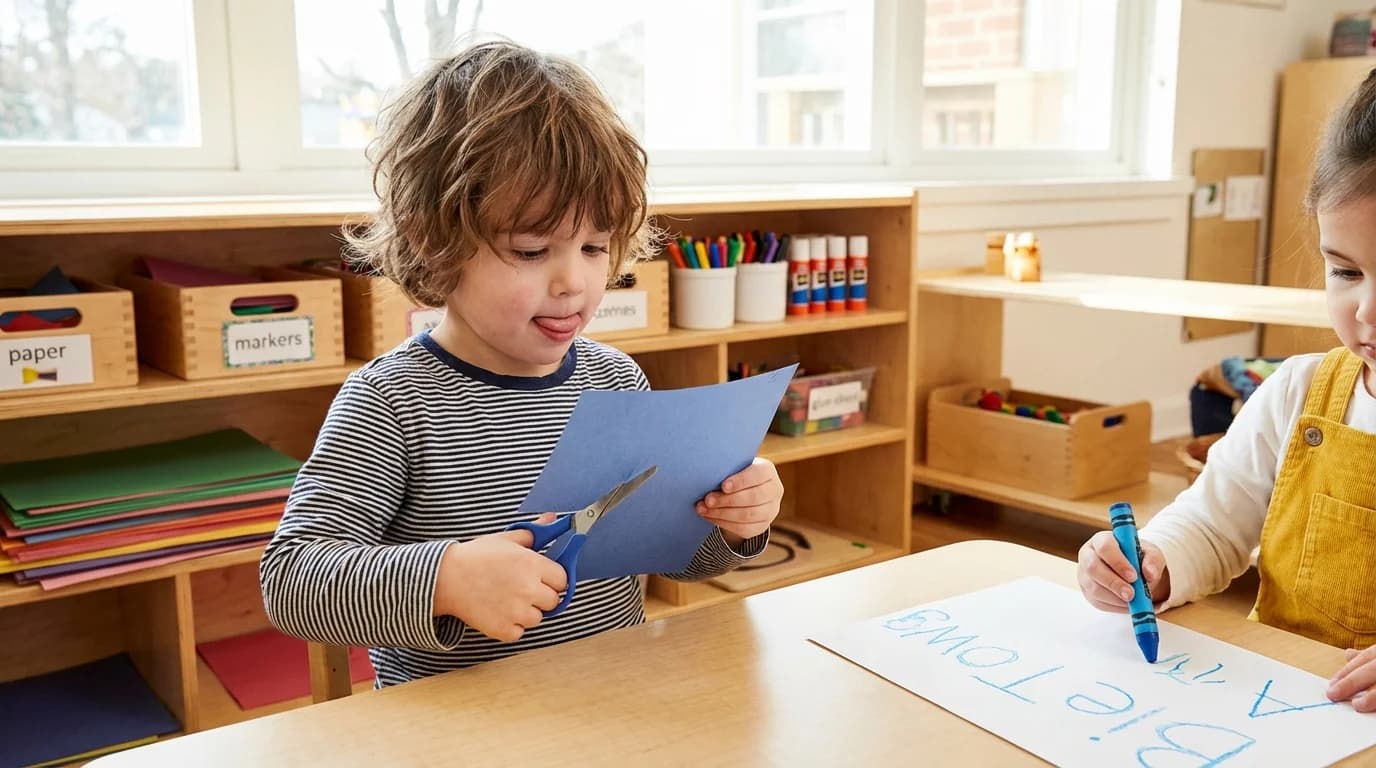
Our art center is one of the most powerful environments for fine motor development. Children tear paper (building hand strength), use brushes and rollers of various sizes (developing grip control), squeeze glue bottles (strengthening hand muscles), cut with scissors (practicing bilateral coordination), and manipulate clay and playdough (building overall hand strength and dexterity). As we have discussed in our article on art and school readiness, these creative activities serve a dual purpose: they foster artistic expression while systematically building the physical skills children need for writing.
The Block Center
Block play requires children to use precise hand movements to balance, align, and position blocks. This strengthens hand-eye coordination and spatial awareness while building the hand stability needed for controlled writing movements. Our exploration of block play and STEM learning details how these seemingly simple activities develop sophisticated physical and cognitive skills simultaneously.
Sensory and Manipulative Activities
Stringing beads, working puzzles, using tongs and tweezers at the sensory table, pouring water between containers, and lacing cards all develop the precise finger control that underlies writing. Our sensory play activities are carefully selected to strengthen the specific muscle groups children will need for pencil control.
Daily Living Activities
Buttoning coats, zipping backpacks, opening containers at snack time, and washing hands all require fine motor coordination. We intentionally give children opportunities to practice these self-help skills rather than doing everything for them, because each successful button and zipper builds the hand strength and dexterity that support pre-writing development.
Tracking Progress with Teaching Strategies GOLD
Our teachers use Teaching Strategies GOLD to observe and document each child's fine motor development over time. This research-based assessment tool allows us to track progress in areas like "demonstrates fine motor strength and coordination" with specific, observable indicators at each developmental level. When we notice a child needs additional support or challenge, we can adjust activities and materials to meet them exactly where they are.
This individualized approach is particularly important with fine motor skills because the range of typical development is wide. One four-year-old may be writing recognizable letters while another is still mastering circles and lines. Both can be developing normally. What matters is that each child is progressing along the developmental continuum, and that our teachers are providing the right scaffolding to support that progression.
What Parents Can Do at Home
Fine motor development does not stop when the daycare day ends. There are many simple, everyday activities that parents in East Flatbush and throughout Brooklyn can incorporate to support their child's development without turning home into a classroom.
For toddlers, offer chunky crayons, finger paint, and playdough. Let them practice feeding themselves with a spoon, even when it is messy. Encourage them to help with simple cooking tasks like stirring, tearing lettuce, or pressing cookie cutters into dough. For preschoolers, provide child-safe scissors and paper for cutting practice. Encourage drawing, coloring, and painting. Let them help with buttoning, snapping, and zipping their own clothing. Offer small building materials like interlocking blocks and simple craft projects.
The Zero to Three organization emphasizes that the most effective fine motor activities are ones that children find enjoyable and choose to engage in willingly. Forced handwriting practice for young children is counterproductive. Instead, provide interesting materials and watch as children naturally develop the skills they need through purposeful play.
The Connection to Kindergarten Readiness
When kindergarten teachers describe the skills they hope incoming students will have, fine motor readiness consistently ranks near the top. Children who enter kindergarten with the ability to hold a pencil correctly, cut with scissors, and form basic shapes are better positioned to participate in classroom activities from day one. The National Association for the Education of Young Children (NAEYC) emphasizes that all areas of development are interconnected, and fine motor skills support not only writing readiness but also the confidence and independence that children need to thrive in a kindergarten setting.
At Einstein Daycare, we see this connection play out every year as our graduates move on to kindergarten. Children who have spent years building hand strength through playdough, developing precision through bead-stringing, and practicing pre-writing strokes through drawing arrive at kindergarten ready to learn. They can manage their own belongings, hold a pencil comfortably, and focus on the content of writing rather than struggling with the physical mechanics.
When to Talk to Your Pediatrician
While there is a wide range of normal fine motor development, there are some signs that may warrant a conversation with your child's pediatrician. If your two-year-old is not yet scribbling, if your three-year-old cannot stack blocks or shows no interest in drawing, or if your four-year-old has significant difficulty using scissors or cannot copy a circle, it may be helpful to discuss these observations with your doctor. The CDC's milestone checklists offer age-specific guidance that can help you identify areas to discuss at your child's next visit.
Early identification and support can make a meaningful difference, and fine motor delays often respond well to targeted intervention. Our teachers at Einstein Daycare are also valuable partners in this process, as they observe your child's fine motor development daily and can share detailed observations to support conversations with healthcare providers.
Every scribble, every torn piece of paper, every carefully stacked block is part of the remarkable journey from first grasp to first written word. At Einstein Daycare in East Flatbush, we are honored to guide Brooklyn families through this journey, providing the materials, experiences, and expert support that help each child's fine motor skills -- and future writing abilities -- flourish.
See our fine motor development program in action. Schedule a tour of Einstein Daycare at 900 Lenox Rd, Brooklyn, NY 11203 to observe how our Creative Curriculum approach builds the pre-writing skills your child needs for kindergarten success. Request a tour online or call us at (718) 618-7330.