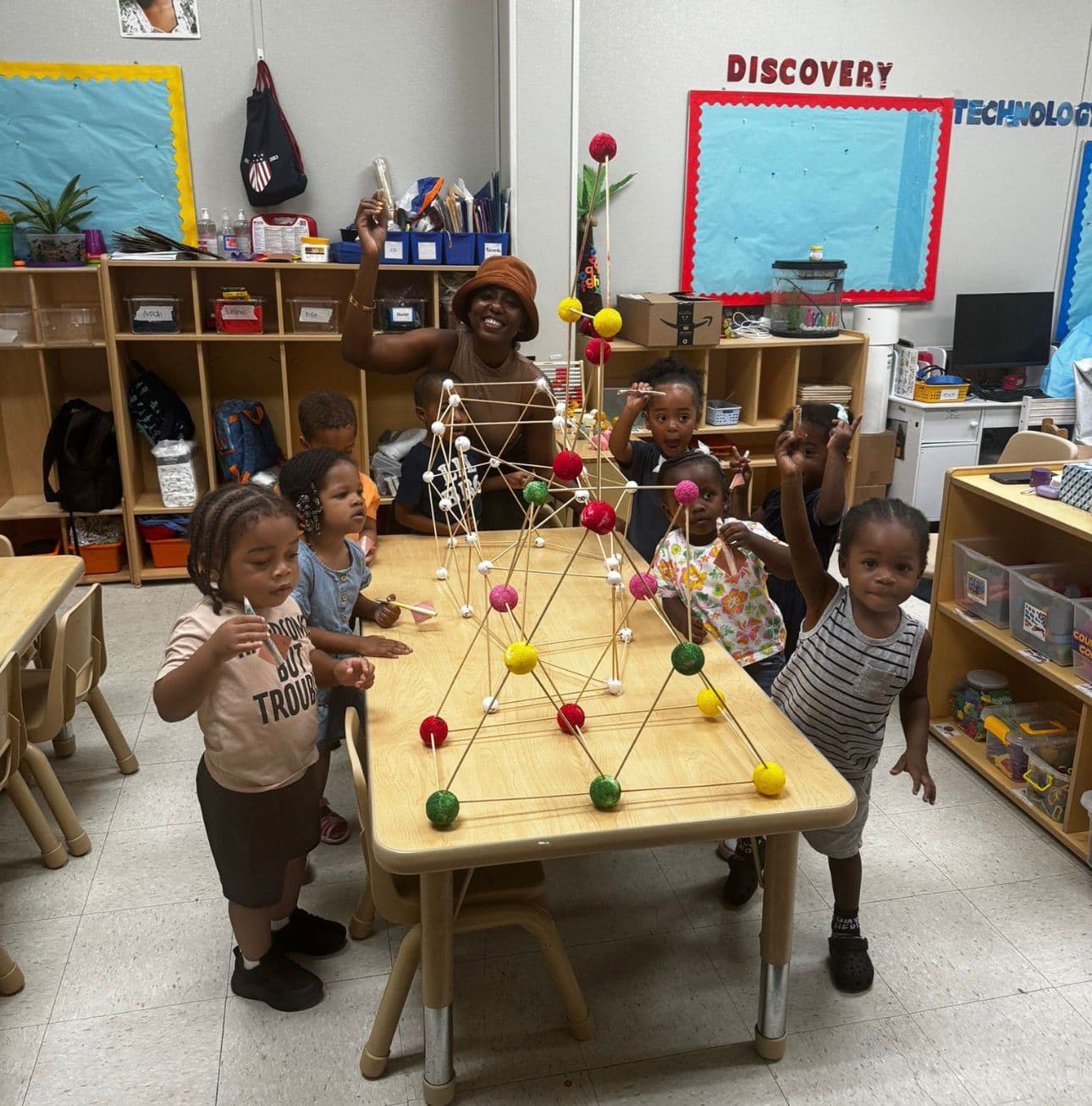
Your three-year-old spent the morning at daycare stacking wooden blocks into a tower, knocking it down, and doing it again. The daily report says "block play" and not much else. You might wonder whether anything academic happened today, or whether your child just played for six hours. That question comes up constantly among parents in East Flatbush, and the answer from sixty years of research is clear: block play is STEM learning in preschool, and it predicts academic success further into the future than almost any other activity a young child can do.
That is not a soft claim. A longitudinal study tracked children from preschool block play at age three and found that their block-building complexity directly predicted spatial skills at age five, which in turn predicted math and science performance through high school. The blocks are not a warm-up for learning. They are the learning.
What Happens in a Child's Brain During Block Play
When a preschooler picks up a wooden unit block, their brain is solving multiple problems at once. How heavy is this piece? Where does it balance? If I put this rectangle on top of that triangle, will it stay?
Each of those questions activates spatial reasoning, early physics, and mathematical thinking in real time. The child is not just stacking. They are running experiments.
Researchers Wolfgang, Stannard, and Jones followed preschoolers for over a decade and published their findings in the Journal of Research in Childhood Education. Children who engaged in more complex block play at ages three and four showed higher math achievement scores through seventh grade. The correlation held even after controlling for IQ and socioeconomic background. Block play at three predicted math performance at thirteen.
A separate study by Verdine and colleagues, published in Child Development in 2014, found that spatial construction ability at age five directly predicted math achievement at age seven. The children who could build more complex structures could also solve more complex math problems two years later. The connection between hands and numbers runs deep.
Why? Because blocks teach geometry, measurement, symmetry, balance, and proportion through direct physical experience. A child does not need to know the word "symmetry" to build a symmetrical tower. Their hands learn it before their vocabulary catches up.
The Block Center in a Creative Curriculum Classroom
In a classroom using Creative Curriculum, the block center is one of eleven designated interest areas. It is not filler. It is engineered to support learning across all four developmental domains: social-emotional, physical, cognitive, and language.
At Einstein Daycare on Lenox Road, near the corner of New York Avenue, the preschool block area includes standard wooden unit blocks in multiple sizes, cardboard blocks, and accessories like small vehicles, figures, and architectural props. The accessories change based on the current study topic. During a study on buildings, teachers might add photos of Brooklyn brownstones and bridges. During a study on transportation, small road signs and ramps appear.
Teachers do not stand back and watch. They circulate, ask open-ended questions, and introduce spatial language: "Your tower is taller than the shelf now. How many more blocks do you think it can hold before it falls?"
That kind of guided interaction matters. A 2011 study by Ferrara and colleagues in Mind, Brain, and Education found that children in guided block play produced significantly more spatial language than children in unstructured free play. The teacher's words become the child's words.
Teachers also document what they observe during block play using Teaching Strategies GOLD, the assessment system paired with Creative Curriculum. A child who builds a bridge with two vertical supports and a horizontal span is demonstrating cognitive objectives that map directly to the framework's 38 developmental indicators. Parents see the tower. Teachers see the data.
Why Blocks Beat Expensive STEM Toys
Walk into any toy store in Crown Heights or along Flatbush Avenue and you will find shelves of products labeled "STEM" in bright letters. Magnetic tiles, coding robots, circuit kits designed for four-year-olds. Some of these are fine toys. None of them are more effective than a set of plain wooden unit blocks.
Caroline Pratt designed the first standardized unit blocks in 1913 at the City and Country School in Manhattan. Harriet M. Johnson published "The Art of Block Building" in 1933 through Bank Street College of Education, documenting seven developmental stages children move through as their block structures grow more complex. Over a century later, the research keeps confirming what Pratt figured out: simple wooden blocks remain among the most powerful learning tools available to young children.
The reason is open-endedness. A magnetic tile kit can build what the instructions show. A set of unit blocks can build anything. That open-ended quality forces children to plan, test, fail, revise, and try again.
The National Association for the Education of Young Children identifies this build-knock down-rebuild cycle as the foundation of persistence and engineering thinking. The child who rebuilds a collapsed wall four times before lunch is practicing the same iterative design process used by actual engineers.
You do not need to spend $80 on a subscription STEM box. A bag of wooden blocks from a thrift store on Utica Avenue will do more for your child's spatial reasoning than most products marketed at preschool parents.
Block Play Develops More Than Math
The STEM connection gets the most attention, but blocks build skills across every developmental domain. Here is what the research documents:
- Language development: Children narrate their building, negotiate roles during collaborative construction, and learn spatial vocabulary like "behind," "underneath," "taller," and "next to." These positional words are the foundation of later reading comprehension and mathematical language.
- Social-emotional skills: When two preschoolers build together, they negotiate who places the next block, whose design to follow, and how to handle the inevitable collapse. Conflict resolution, compromise, and shared planning happen in the block center every day.
- Fine and gross motor development: Lifting, carrying, stacking, and balancing blocks strengthens hand muscles, improves hand-eye coordination, and develops the core stability needed for sitting at a desk in kindergarten.
- Executive functioning: A randomized controlled trial found that children in structured block play interventions showed gains not just in numeracy and shape recognition, but in executive functioning. Planning a structure, holding the design in working memory while building, and inhibiting the impulse to knock it down before it is finished are all executive function tasks.
- Self-regulation: A 2024 study published in ScienceDirect found that free play with blocks was significantly related to both geometry skills and behavioral self-regulation in preschoolers. The same activity that teaches shapes also teaches a child to manage frustration when a tower falls.
These skills overlap with the developmental milestones teachers track across the preschool years. Just as potty training readiness depends on a combination of physical, cognitive, and emotional development, block play strengthens all three domains simultaneously. That is what makes it so efficient as a learning tool.
Closing the Gap: Why Access to Blocks Matters in 11203
Not all children arrive at preschool with the same level of block experience. Research shows that by age three, children from lower-income families are already falling behind in spatial skills, in part because of limited access to construction toys and building materials at home. This gap is not about ability. It is about exposure.
A preschool with a well-stocked, well-supported block center helps close that gap. When every child in the classroom has daily access to blocks with teacher guidance, the starting-point differences shrink. The longitudinal research on block-building complexity confirms that structured block play interventions produce measurable gains in numeracy, shape recognition, and mathematical language across income levels.
For families in East Flatbush, Brooklyn and the 11203 zip code, this means the quality of your child's preschool block center is not a nice-to-have. It is a direct investment in kindergarten readiness and math achievement years down the line. A program that treats the block area as an afterthought is leaving measurable learning on the table.
What Good Block Play Looks Like at Different Ages
Johnson's 1933 research identified seven stages of block building that children progress through, and modern researchers have confirmed the sequence holds up. Knowing the stages helps you understand what your child is actually doing, even when it looks like random stacking.
Stage 1 (around age 2): Children carry blocks around without building. They are learning the weight, shape, and feel of the materials. This is not wasted time. It is foundational sensory learning.
Stage 2 (age 2-3): Children lay blocks in rows, either flat on the floor or stacked vertically. The rows might not look like much, but the child is learning about alignment and repetition.
Stage 3 (age 3): Bridges appear. A child places two vertical blocks and spans a horizontal block across the top. This is a breakthrough in spatial understanding. The child is thinking about structural support for the first time.
Stage 4 (age 3-4): Enclosures. Children build walls that form a boundary around a space. They start naming their structures: "This is a house" or "This is a zoo." Symbolic thinking has entered the block center.
Stages 5-7 (age 4-5): Structures become elaborate, symmetrical, and named before construction begins. Children plan, discuss their designs with peers, incorporate accessories, and rebuild when something does not work. By this point, the child is demonstrating planning, spatial reasoning, and collaborative problem-solving in a single play session.
Understanding these stages also helps parents avoid a common frustration. A two-year-old who carries blocks around the room without building is not "playing wrong." They are at stage one, and stage two is coming.
Five Misconceptions About Block Play That Hold Children Back
"They are just playing, not learning." This is the most persistent myth in early childhood education, and blocks are where it does the most damage. Every time a parent or administrator prioritizes worksheets over block time, they are choosing an activity with weaker research support over one with decades of longitudinal data behind it. NAEYC's research on the pre-K block center directly links block play to later math competence and interest in STEM fields.
"Worksheets prepare children for kindergarten better than play." The evidence runs the other direction. A child who has spent two years building increasingly complex structures has internalized quantity, shape, spatial relationships, and pattern recognition through direct physical experience. A child who has spent two years filling in worksheets has practiced holding a pencil. Both matter, but one builds deeper understanding.
"Block play is only about building towers." Towers are stage two. By age four, children in a strong program are designing structures with enclosures, bridges, ramps, and symmetrical facades. They are also negotiating with peers, explaining their designs in words, and revising plans when gravity delivers feedback.
"Girls are less interested in blocks than boys." This belief persists despite evidence to the contrary. When teachers actively invite all children into the block area and model building alongside them, participation gaps between boys and girls disappear. The difference is in invitation, not interest.
"Only some children are interested in blocks." When block areas are well-stocked, well-located in the classroom, and actively supported by teachers, engagement across all children increases. A block center shoved into a corner with a handful of worn-out pieces will not attract interest from anyone. The program design matters.
Blocks at Home: Simple and Effective
You do not need a classroom setup to support block play at home. A set of plain wooden blocks is enough. If your child is in the preschool age range, 50 to 100 unit blocks give them enough material to build structures with real complexity. Cardboard boxes, shoe boxes, and food containers work too.
Sit with your child while they build, but resist the urge to direct. Ask questions instead: "What are you making?" "What happens if you put that one on top?" "How could you make it taller without it falling?" These questions mirror what teachers do in the block center, and they push the child to think about their choices rather than just stack.
When a structure falls, let your child react before you do. If they are upset, acknowledge it. If they shrug and start over, let them.
That rebuild is where persistence lives. NAEYC calls this cycle of build, knock down, and rebuild one of the earliest forms of scientific experimentation: hypothesis, test, revise.
Pair blocks with accessories from around the house. Small figures, toy cars, fabric scraps for "roofs," and tape for connecting pieces all extend the play. When your child starts telling you a story about the people who live in their block building, spatial play has merged with narrative thinking.
If you are evaluating preschool programs in East Flatbush or anywhere in central Brooklyn, the block area tells you just as much about a program's educational depth as anything in the brochure.
Is the block area large enough for multiple children to build at the same time? A cramped corner with ten blocks signals low priority. Are there photos of children's past structures displayed nearby, showing that teachers value and document what happens here?
Watch how teachers interact with children in the block area. Do they sit at child level and ask questions, or do they treat block time as a break from "real teaching"? The answer tells you whether the program understands what the research says about constructive play and early STEM development.
Our post on pre-K readiness and play-based learning covers how activities like block play connect to the specific skills kindergarten teachers expect. If you are wondering whether your preschooler will be "ready" for school, the block center is a better predictor than any flashcard set.
The wooden unit block has been in American classrooms for over a century. It has outlasted every educational trend, every curriculum fad, and every generation of expensive toys marketed to replace it. The reason is simple: it works.
If your child came home today and the report said "block play," they had a good day. A better day, in terms of long-term academic outcomes, than most worksheets could provide. The research is not ambiguous on this point.
To see how Einstein Daycare's block centers support STEM learning for preschoolers, call (718) 618-7330 or schedule a tour online. We are at 900 Lenox Road in East Flatbush, a short walk from the Winthrop Street station on the 2/5 line, and we welcome families from across Crown Heights, Flatbush, Prospect Lefferts Gardens, and the 11213 zip code.