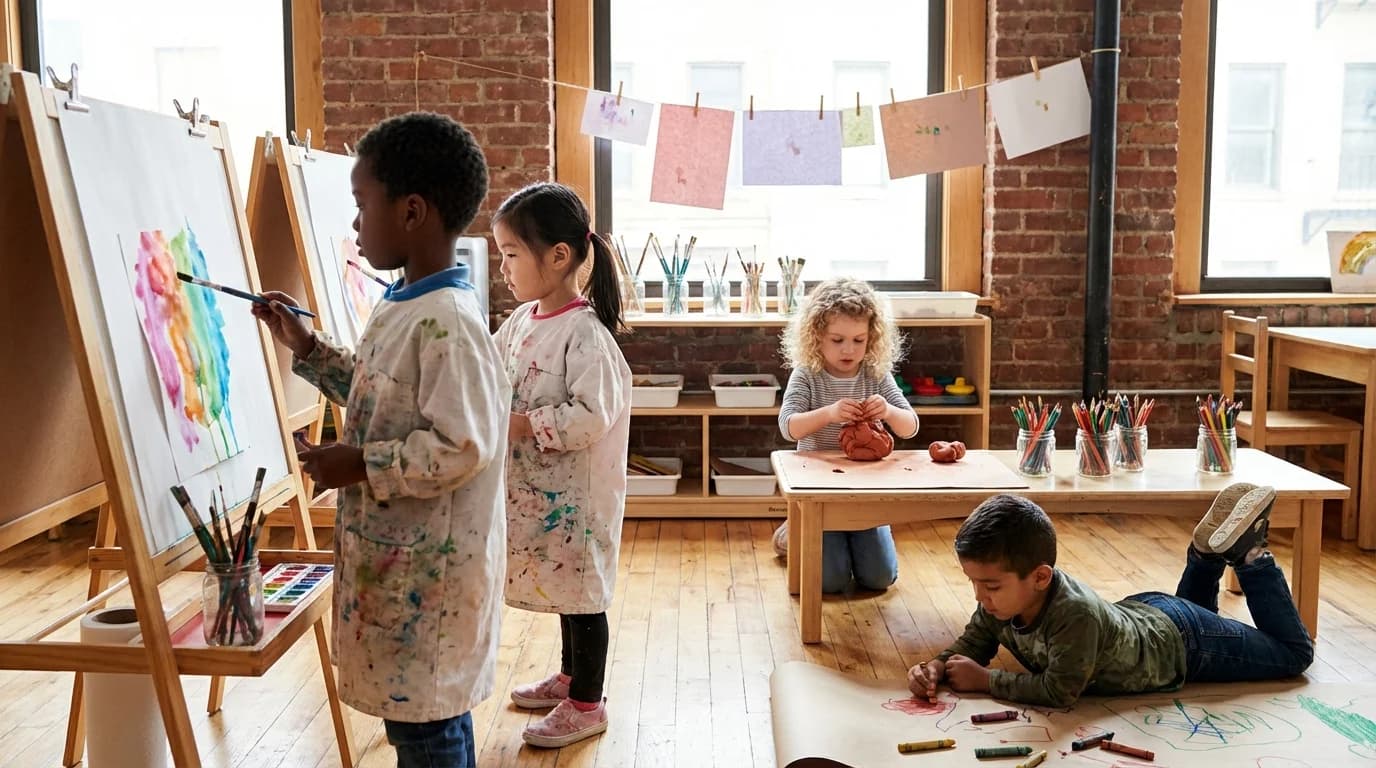
When your child comes home from daycare with paint under their fingernails and a paper covered in swirls of color, it is easy to see that as a fun but educationally lightweight part of their day. The reading corner feels academic. The math manipulatives feel serious. The art table feels like play.
But here is what decades of early childhood research tells us: those paint-covered fingers are doing some of the most important developmental work of the day. Art and creative activities in the early years build the exact skills that kindergarten teachers look for when assessing school readiness. Fine motor control, spatial awareness, problem-solving, self-expression, focus, and the ability to plan and execute an idea from start to finish. These are not soft skills. They are foundational ones.
For East Flatbush families in the 11203 zip code and surrounding neighborhoods, understanding what art looks like in a quality daycare program can help you ask better questions when choosing a center and better appreciate the developmental milestones your child is hitting at the easel.
The Connection Between Art and Fine Motor Development
Before a child can write their name, they need to be able to control a pencil. Before they can control a pencil, they need to develop the small muscles in their hands and fingers. This is fine motor development, and it is one of the most significant predictors of early academic success.
The National Association for the Education of Young Children (NAEYC) identifies fine motor skill development as a key component of kindergarten readiness. Children who enter kindergarten with strong fine motor control are better equipped to write letters, cut with scissors, manipulate small objects, button their coats, and manage the dozens of small physical tasks that a school day demands.
Art activities are among the most effective ways to build these skills naturally. Consider what happens when a toddler grips a thick crayon and drags it across paper. They are practicing the palmar grasp, the same grip pattern that will eventually evolve into the tripod pencil grip used for writing. When a three-year-old squeezes a glue bottle, they are building hand strength. When a four-year-old cuts along a curved line with scissors, they are developing bilateral coordination, the ability to use both hands together with each performing a different action.
These are not incidental benefits. They are the primary developmental purpose of art in early childhood. The picture itself, whatever it looks like, is secondary to the physical and cognitive work that produced it.
Process Art vs. Product Art: Why the Journey Matters More
Walk into two different daycares and you might see two very different approaches to art. In one, every child's project looks essentially the same: a pre-cut turkey shape with identical feathers glued in the same spots, a snowman assembled from three circles the teacher cut out, a butterfly made from a template. This is product art, and its defining characteristic is that the adult has determined what the final result should look like.
In the other daycare, you see a wall of paintings that look wildly different from one another. Some are dense with color. Others have a single line across the page. One child made a collage from torn paper and fabric scraps. Another spent twenty minutes mixing paint colors on a palette before applying a single brushstroke. This is process art, and its defining characteristic is that the child is in control.
Zero to Three, the national nonprofit focused on infant and toddler development, has published extensively on why process art is developmentally superior for young children. When children direct their own creative work, they practice decision-making, problem-solving, and self-expression. They learn to tolerate ambiguity, because there is no "right answer." They develop persistence, because their vision requires effort to realize. And they build intrinsic motivation, the internal drive to create something because it is satisfying, not because an adult told them to.
Product art has its place. Following step-by-step instructions builds listening skills and the ability to follow directions. But when product art dominates a program's approach, children miss the deeper developmental benefits. The best programs lean heavily toward process art while occasionally incorporating directed projects for specific learning goals.
When you visit a daycare, look at the art on the walls. If every piece looks the same, that tells you something. If every piece looks different, that tells you something, too.
How Creative Curriculum's Art Center Works
In a Creative Curriculum classroom, the art center is one of several dedicated interest areas where children can choose to spend their time during free-choice periods. It is not a station where every child rotates through the same activity. It is an open, well-stocked space where children can explore materials at their own pace and follow their own creative instincts.
A well-equipped art center in a Creative Curriculum classroom typically includes:
- Drawing materials: Crayons, markers, colored pencils, chalk, and oil pastels in a range of sizes for different grip abilities
- Painting supplies: Easels, tempera paint, watercolors, brushes of various widths, sponges, and rollers
- Sculpting and modeling: Playdough, clay, sculpting tools, rolling pins, and cookie cutters
- Collage materials: Glue, scissors, tape, fabric scraps, buttons, feathers, yarn, tissue paper, magazines for cutting
- Paper: Construction paper, cardstock, newsprint, recycled paper, and paper in different shapes and sizes
- Found and natural materials: Leaves, sticks, shells, bottle caps, and other items that invite open-ended creativity
The teacher's role at the art center is to observe, facilitate, and occasionally extend children's thinking through open-ended questions. Instead of saying, "Let's make a flower," a Creative Curriculum teacher might say, "I see you're using a lot of green today. Can you tell me about what you're making?" This approach keeps the child in the driver's seat while showing genuine interest in their process.
At Einstein Daycare, our art centers are stocked and refreshed regularly with a wide variety of materials. Teachers rotate supplies to maintain novelty and challenge. When a child who has mastered tearing paper is ready for scissors, the scissors appear. When a group becomes fascinated with mixing colors, the teacher might set out primary paint colors and let them discover secondary colors on their own. The curriculum guides the teacher, and the teacher follows the child.
Art and Cognitive Development: Thinking Through Creating
Art does not just build hand muscles. It builds thinking skills. When a child stands in front of a blank piece of paper and decides what to create, they are engaging in planning, one of the executive function skills that researchers at Harvard's Center on the Developing Child identify as critical for school and life success.
Consider the cognitive steps involved in a simple collage project:
- The child surveys available materials and makes selections (decision-making)
- They consider where to place each piece (spatial reasoning)
- They apply glue in the right amount, not too much and not too little (self-regulation and calibration)
- They step back, evaluate their work, and decide whether to add more (reflection and critical thinking)
- They notice that the red paper next to the yellow paper creates a certain effect (pattern recognition and aesthetic awareness)
- If something falls off or does not look the way they imagined, they problem-solve a fix (flexibility and persistence)
All of this happens in the course of what looks, from the outside, like a child gluing paper to paper. The cognitive complexity of open-ended art is remarkable, and it is exactly the kind of thinking that kindergarten and first grade will demand in increasingly structured forms.
Research published by NAEYC in Young Children has shown that children who regularly engage in open-ended creative activities demonstrate stronger divergent thinking skills, the ability to generate multiple solutions to a single problem. This is the foundation of creativity, but it is also the foundation of mathematical reasoning, scientific inquiry, and reading comprehension. The child who can think of four different ways to attach a feather to a piece of cardboard is practicing the same mental flexibility they will need when they encounter a word problem in second-grade math.
Color, Shape, and Spatial Awareness
Art activities naturally teach concepts that are explicitly assessed in kindergarten readiness screenings. Color recognition, shape identification, spatial vocabulary (above, below, beside, between), and pattern awareness are all embedded in everyday art experiences.
When a child mixes red and blue paint and discovers purple, they are learning about color relationships in a way that is far more memorable than a flashcard drill. When they draw a circle and add two smaller circles for eyes, they are practicing shape recognition and proportional reasoning. When they describe their painting as having "a big tree next to a little house," they are using spatial and comparative language.
These are not trivial observations. The vocabulary of spatial relationships, words like "above," "through," "around," and "between," is directly connected to early math and reading skills. Children who can describe where things are in relation to each other are better prepared to understand concepts like number lines, graphs, and left-to-right text directionality. Art gives them authentic, repeated opportunities to practice this language in a context that feels natural.
This connects closely to the work children do in other Creative Curriculum interest areas, particularly blocks. Our post on block play and STEM learning explores how spatial reasoning developed through building translates directly to mathematical thinking.
Self-Expression and Social-Emotional Growth
For children who do not yet have the vocabulary to express complex emotions, art provides an alternative language. A child who cannot tell you that they feel anxious about a new sibling can paint a storm of dark colors. A child who is bursting with excitement about a weekend trip can fill an entire page with frantic, joyful scribbles. Art gives children a safe, pressure-free outlet for feelings they are still learning to name.
This is not pop psychology. The American Art Therapy Association and numerous research studies have documented the therapeutic and developmental benefits of creative expression for young children. In a daycare setting, art activities support social-emotional development in several specific ways:
- Self-regulation: Sustained art projects require children to manage their impulses, wait for materials, and persist through frustration when something does not work as planned
- Confidence: Completing a creative project, one that the child conceived and executed themselves, builds genuine self-efficacy
- Identity: Art allows children to represent themselves, their families, their experiences, and their imaginations in tangible form
- Collaboration: Group art projects, like a class mural or a collaborative collage, teach negotiation, compromise, and shared ownership
For a deeper look at how daycare supports the emotional side of development, our post on social-emotional development at daycare covers the research and practical strategies teachers use every day.
What Art-Based School Readiness Looks Like at Different Ages
Art development follows a predictable trajectory, and understanding where your child falls on that continuum can help you appreciate their progress and set appropriate expectations.
Infants (6-12 months): At this stage, art is pure sensory exploration. Infants might grasp a thick crayon and make marks on paper, but they are more interested in the feel of the crayon in their hand than the marks it makes. Finger painting with edible paint, tearing paper, and squishing playdough are age-appropriate art experiences that build hand strength and sensory awareness.
Toddlers (12-24 months): Toddlers enter the scribbling stage. Their marks become more intentional, and they begin to notice cause and effect: "I move my hand, and a line appears." They may not be representing anything specific yet, but the act of making marks is deeply satisfying and developmentally important. This is also when children begin to show hand preference, which will eventually determine whether they are right- or left-handed writers.
Twos (24-36 months): Children in this age range begin to control their scribbles more deliberately. They might make circular motions, dots, or lines with increasing precision. They start to name their drawings after the fact: "That's a dog." The naming comes after the drawing, not before, which is an important distinction. They are making meaning from their marks rather than planning representational art.
Preschoolers (3-5 years): This is when representational drawing emerges. Children begin to plan what they want to draw before they start. They create recognizable shapes, people (those wonderful circle-with-stick-legs figures), houses, suns, and scenes from their lives. Their fine motor control allows for more detailed work: cutting, gluing with precision, painting within boundaries when they choose to, and manipulating smaller materials. By age five, many children can write some letters, draw recognizable self-portraits, and use scissors with reasonable accuracy. All of these skills were built through years of art exploration.
What Parents Can Do at Home
The art experiences your child has at daycare are powerful, but you can reinforce them at home with minimal effort and expense. Here are a few principles:
- Keep materials accessible: A low shelf or bin with crayons, paper, markers, and playdough lets your child choose to create whenever inspiration strikes
- Resist the urge to direct: When your child is drawing, avoid asking "What is that?" Instead, try "Tell me about your picture" or "I notice you used a lot of blue today"
- Display their work: Hanging your child's art at their eye level communicates that their creative efforts have value
- Provide variety: Rotate materials periodically. Chalk on the sidewalk, painting with water on a fence, collage with junk mail, drawing in sand or shaving cream. Art does not have to mean sitting at a table with crayons
- Let it be messy: The developmental benefits of art are highest when children are free to explore without constant correction about neatness. Put down newspaper. Use washable everything. Let them work
East Flatbush has resources for families who want to extend art experiences beyond home and daycare. The Brooklyn Public Library's branches offer regular children's art programs. The Brooklyn Museum, accessible by the B41 or 2/5 line from the 11203 area, has a dedicated family gallery and weekend workshops for young children. These community resources complement what your child experiences in the classroom and help them see art as a valued part of their world.