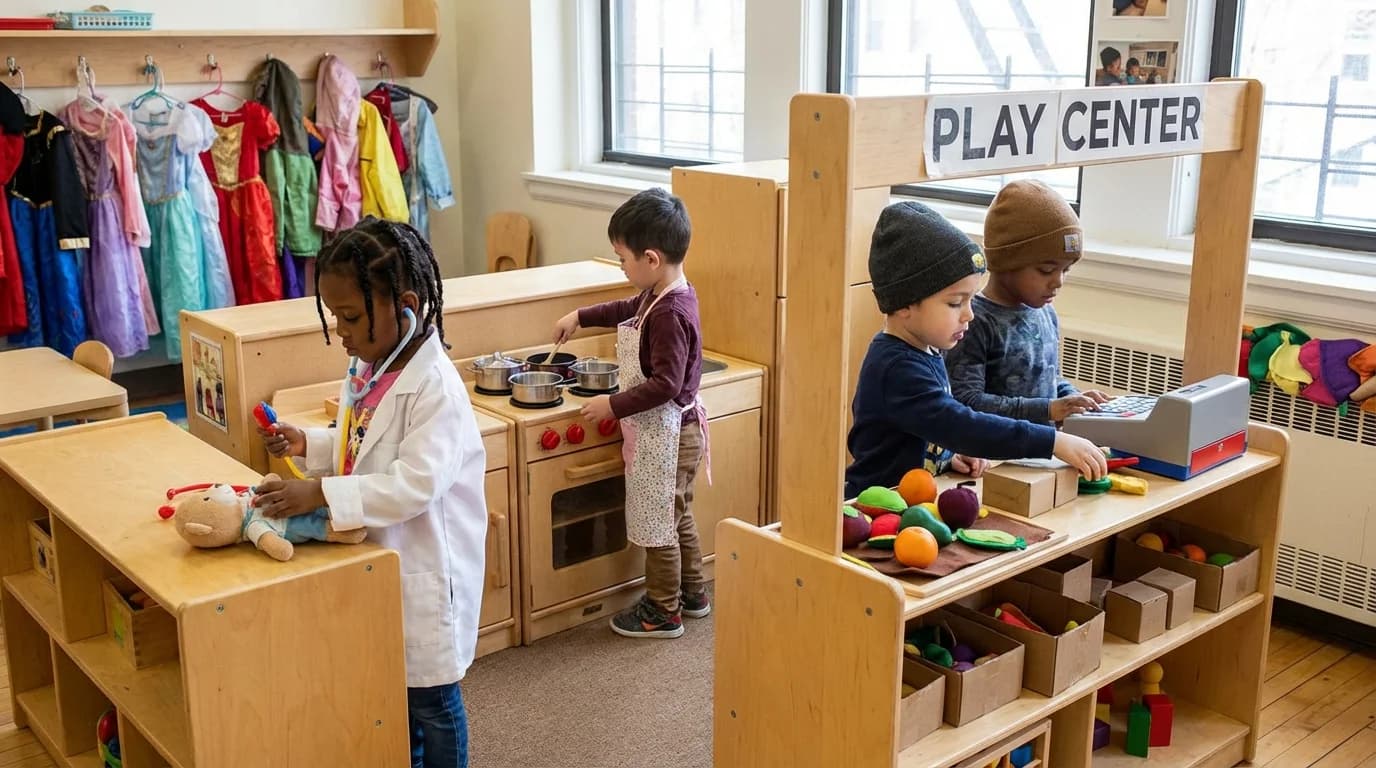
Walk into any well-designed preschool classroom in Flatbush, and you will find a corner stocked with child-sized kitchen equipment, dress-up clothes, dolls, a toy cash register, and maybe a doctor's kit. To an untrained eye, it looks like a play area. Something to keep children busy while the "real learning" happens elsewhere. But to early childhood educators and developmental psychologists, that corner is one of the most powerful learning environments in the entire room.
Dramatic play, also called pretend play, imaginative play, or sociodramatic play, is the act of children taking on roles, creating scenarios, and acting out stories. It is the three-year-old who "cooks dinner" for her stuffed animals. The four-year-old who becomes a firefighter rescuing people from a burning building made of blocks. The two children who negotiate who gets to be the doctor and who has to be the patient. These moments look simple, but the cognitive, social, and emotional work happening beneath the surface is extraordinary.
At Einstein Daycare, dramatic play is not a filler activity. It is a core component of our Creative Curriculum framework and one of the defined interest areas in every preschool classroom. This post explains why researchers, including the field's most influential developmental psychologists, consider dramatic play essential to healthy child development and kindergarten readiness.
What the Research Actually Says
The scientific case for dramatic play begins with Lev Vygotsky, the Russian psychologist whose work in the 1930s remains foundational to how we understand early childhood learning. Vygotsky argued that pretend play is the leading activity of the preschool period, meaning it is the primary context through which children develop higher-order thinking skills. His most famous observation was deceptively simple: "In play, a child always behaves beyond his average age, above his daily behavior. In play, it is as though he were a head taller than himself."
What Vygotsky meant is that dramatic play creates what he called the "zone of proximal development," a space where children stretch beyond their current abilities. A child who cannot sit still for a story will maintain focus for 20 minutes while playing "school." A child who struggles to share will negotiate complex rules about whose turn it is to use the pretend stethoscope. Play does not just reflect what children have already learned. It drives new learning forward.
More recent research confirms and extends Vygotsky's insights. A comprehensive review published by the American Academy of Pediatrics in 2018, titled "The Power of Play," concluded that play-based learning, including dramatic play, produces superior outcomes in language development, executive function, social competence, and academic readiness compared to direct instruction approaches. The National Association for the Education of Young Children (NAEYC) identifies dramatic play as a developmentally appropriate practice for all children ages 3 to 5.
How Dramatic Play Builds Language Skills
If you want to understand why early childhood educators are so passionate about pretend play, start with language. Dramatic play is one of the most language-rich activities a preschooler can engage in, and it develops language skills that structured lessons often miss.
When children play pretend, they use language for purposes that go far beyond naming objects or reciting the alphabet:
- Narrative language: Children create and tell stories. "First we have to go to the store, then we cook, then we eat dinner, then it is bedtime." This sequential storytelling develops the narrative skills that are foundational to reading comprehension.
- Negotiation language: "I want to be the mommy." "No, I am the mommy. You can be the big sister." This back-and-forth requires children to state desires, listen to others, propose compromises, and agree on shared rules. These are sophisticated communication skills.
- Vocabulary expansion: A child playing "restaurant" learns words like menu, order, waiter, chef, receipt, and tip in a meaningful context. Research from Zero to Three shows that vocabulary learned through meaningful experiences is retained far better than vocabulary taught through flashcards or apps.
- Register shifting: Children instinctively change how they talk based on their role. The "doctor" uses a calm, authoritative voice. The "baby" uses a high-pitched, simplified voice. This awareness that language changes depending on context is a marker of advanced linguistic development.
A 2015 study in the journal Early Childhood Research Quarterly found that the amount of time preschoolers spent in sociodramatic play was a significant predictor of their expressive language skills at the end of the school year, even after controlling for family income and initial language ability. For a deeper look at how everyday daycare activities support communication growth, our post on bilingual and multilingual children in daycare explores how play-based environments help children develop strong language foundations across multiple languages.
Executive Function and Self-Regulation
Executive function is the set of mental skills that includes working memory, flexible thinking, and self-control. It is what allows a child to follow multi-step instructions, resist the urge to grab a toy from another child, and adapt when plans change. Research from the Center on the Developing Child at Harvard University identifies executive function as a stronger predictor of school readiness than IQ or early academic skills.
Dramatic play is one of the most effective ways to develop executive function in young children, and the reason is built into the structure of pretend play itself. When a child takes on a role, they must:
- Hold the rules of the role in working memory. A child playing "teacher" has to remember what teachers do and do not do. Teachers read stories, they do not crawl on the floor. This constant self-monitoring exercises working memory.
- Inhibit their impulses. A child playing "sleeping baby" has to stay still and quiet, even though their natural impulse is to run and shout. Vygotsky noted that play contains its own system of self-imposed rules that children follow voluntarily, something they resist in non-play contexts.
- Think flexibly. When a playmate introduces an unexpected plot twist ("Now there is a fire and we have to evacuate the restaurant!"), children must adapt their behavior, shift their thinking, and incorporate new information on the fly.
A landmark study by Elias and Berk published in Early Childhood Research Quarterly found that preschoolers who engaged in more complex sociodramatic play showed greater self-regulation during cleanup time and transitions. The skills practiced in play transferred directly to real classroom situations. Understanding how these skills develop throughout the daycare day can help parents see the full picture. Our post on social-emotional development in daycare covers additional strategies that teachers use to nurture these abilities.
Perspective-Taking and Empathy
One of the most remarkable things about dramatic play is how naturally it teaches empathy, a skill that cannot be taught through instruction alone. When a four-year-old pretends to be a crying baby, she has to imagine what a baby feels like, what a baby needs, and how a caregiver should respond. She is practicing perspective-taking, the cognitive ability to understand that other people have thoughts, feelings, and experiences different from her own.
Developmental psychologists call this "theory of mind," and it typically emerges between ages 3 and 5. Children who engage in regular dramatic play develop theory of mind earlier and more robustly than children who do not. A study published in the British Journal of Developmental Psychology found that the frequency and complexity of pretend play at age 3 predicted performance on theory-of-mind tasks at age 4.
This matters for more than academic reasons. Children with strong perspective-taking abilities are better at resolving conflicts, forming friendships, understanding stories, and navigating the social complexity of a classroom. In a diverse community like Flatbush, where children in a single classroom may come from families with different languages, cultural backgrounds, and family structures, the ability to understand and respect other perspectives is not optional. It is essential.
Types of Dramatic Play in the Classroom
At Einstein Daycare, our teachers design the dramatic play interest area to reflect themes that are meaningful and familiar to children. The space transforms regularly based on what children are studying, what they are curious about, and what connects to their real lives in Brooklyn. Here are some of the most common dramatic play setups and what children learn from each:
- Housekeeping and family play: The most classic form of dramatic play. Children cook, clean, care for babies, and enact family routines. This is where children process their daily experiences and practice caregiving, cooperation, and domestic vocabulary.
- Doctor's office or veterinary clinic: Children practice empathy and caregiving in a different context. They learn vocabulary related to health, use fine motor skills with play medical instruments, and work through any anxieties about their own doctor visits.
- Restaurant or bakery: Rich in math (counting plates, setting tables, making change) and literacy (reading menus, writing orders, making signs). This setup also introduces concepts about community roles and how businesses work.
- Grocery store or farmers market: Sorting, categorizing, counting, and making transactions. Children practice social interactions like greeting customers, asking "what would you like," and saying thank you.
- Construction site: Connects to block play and STEM learning. Children wear hard hats, draw blueprints, and build structures. This setup appeals to children who gravitate toward building and physical activity.
- Post office or library: Introduces literacy concepts naturally. Children write letters, sort mail, stamp envelopes, check out books, and scan library cards. These setups make reading and writing purposeful and fun.
The key is that teachers do not just set up the space and walk away. They observe, they enter the play when invited, and they scaffold the experience by introducing new vocabulary, asking questions that extend the storyline, and helping children resolve conflicts that arise naturally during play.
How Teachers Scaffold Dramatic Play
Scaffolding is the educational term for providing just enough support to help a child reach the next level of understanding without doing it for them. In dramatic play, skilled teachers scaffold in several ways:
- Setting the stage: Teachers arrange materials thoughtfully, introduce props that connect to current classroom studies, and ensure the space has enough materials for multiple children to play simultaneously.
- Joining the play: Sometimes a teacher enters the dramatic play area as a character. "Excuse me, I would like to order a pizza. Do you have a menu?" This models complex language, introduces new plot possibilities, and shows children how to extend a scenario.
- Narrating and expanding: When a teacher observes two children playing, they might narrate what they see: "I notice you are checking the baby's temperature. The baby must not be feeling well." This gives children language for what they are doing and validates their play as meaningful.
- Facilitating conflict resolution: When two children both want to be the cashier, the teacher does not solve the problem for them. Instead, they guide: "It sounds like you both want to be the cashier. What could you do so that everyone gets a turn?" This teaches problem-solving within a context that matters to the children.
- Connecting play to real experiences: After a class trip to the local library on Flatbush Avenue or a visit from a community helper, teachers stock the dramatic play area with related materials so children can process and extend what they learned.
This intentional approach is central to how Creative Curriculum works at Einstein Daycare. Our teachers observe each child's play, document their development using Teaching Strategies GOLD assessments, and use those observations to plan future learning experiences. To learn more about how observation-based assessment works, our post on understanding your child's daycare progress reports explains the process in detail.
Why It Is Not "Just Playing"
Parents sometimes worry that their child spends "too much time playing" at daycare and not enough time on academics. This concern is understandable, especially when other programs advertise that their three-year-olds are doing worksheets and memorizing sight words. But the research is consistent and clear: for children under five, play-based learning produces better long-term academic outcomes than early academic instruction.
A large-scale study from the University of Virginia found that children who attended play-based preschool programs performed as well or better on kindergarten readiness measures than children who attended academically focused programs. More importantly, the play-based group showed stronger social skills and fewer behavioral problems, factors that predict long-term academic success more reliably than early reading ability.
The Alliance for Childhood, a research and advocacy organization, put it this way: "Play is not a break from learning. It is the way young children learn." When a child spends 30 minutes in the dramatic play area, they are practicing language, math, social skills, emotional regulation, creative thinking, and physical coordination simultaneously. No worksheet can do that.
If you are a parent in Flatbush, Ditmas Park, Midwood, or the surrounding neighborhoods exploring preschool options for your child, look for programs that take play seriously. Ask to see the dramatic play area. Ask how teachers interact with children during pretend play. Ask how play connects to the curriculum. The answers will tell you whether a program understands how young children actually learn. For a broader view of what to look for in a daycare program, our guide to choosing a daycare in Brooklyn covers the key factors that matter most.
Supporting Dramatic Play at Home
You do not need a fully stocked dramatic play center at home to support your child's pretend play. In fact, some of the best dramatic play happens with the simplest materials:
- Cardboard boxes: A large box becomes a spaceship, a car, a house, or a boat. Let your child decide what it is.
- Old clothes and accessories: Hats, scarves, purses, and shoes from a thrift store on Church Avenue create an instant dress-up collection.
- Kitchen items: Pots, wooden spoons, and plastic containers become a full restaurant kitchen.
- Follow your child's lead: If they hand you a block and say "here is your phone," pick it up and answer it. Enter their world on their terms.
- Resist the urge to direct: Your job is to be a willing participant, not the scriptwriter. Let the child set the scene, assign the roles, and determine the plot.
Dramatic play is one of those rare areas where less adult intervention often produces more learning. Give your child space, time, simple materials, and a willing play partner, and watch what they create.