When you drop your child off at daycare in the morning, you are trusting that program with just about everything that matters: your child's safety, their learning, their emotional well-being, and what goes into their body. For many Brooklyn parents, questions about food rank right up there with questions about teacher ratios and curriculum. What will my child eat? Is it healthy? What if my child has allergies? What about cultural or religious dietary requirements?
These are not small concerns. Children in full-time daycare eat one to two meals and one to two snacks at their program every day. That adds up to a significant portion of their total weekly nutrition. The quality of that food affects everything from energy levels and mood to long-term eating habits and physical development.
This guide covers what licensed NYC daycares are required to provide, how federal nutrition programs work, how strong programs handle allergies and dietary needs, and what questions you should ask before enrolling your child.
CACFP: The Federal Nutrition Program Behind Daycare Meals
Most licensed daycare centers in New York City participate in the Child and Adult Care Food Program, known as CACFP. This is a federal program administered by the U.S. Department of Agriculture (USDA) that reimburses childcare providers for serving nutritious meals and snacks that meet specific dietary guidelines.
CACFP is not optional for many programs. In New York City, daycare centers that serve low-income communities, which includes much of Brooklyn from Prospect Lefferts Gardens to East Flatbush to Crown Heights, are strongly incentivized to participate because the reimbursement helps cover food costs. For parents, this means that meals and snacks at participating daycares follow federally established nutrition standards.
Under CACFP guidelines, meals and snacks must include specific food components:
- Breakfast: A grain or bread component, a fruit or vegetable, and milk
- Lunch and supper: A meat or meat alternative (beans, cheese, yogurt), a grain or bread, two different fruits or vegetables, and milk
- Snacks: Two of the following five components: milk, meat or meat alternative, grain, fruit, or vegetable
The USDA updated CACFP meal patterns in recent years to align with current nutritional science. These updates limit added sugars, require more whole grains, encourage a wider variety of fruits and vegetables, and restrict juice to once per day. Whole milk is served to children ages one to two, and low-fat or fat-free milk is served to children two and older, consistent with recommendations from the American Academy of Pediatrics (AAP).
When you are evaluating daycares in Brooklyn, ask whether the program participates in CACFP. If they do, that is a solid baseline. If they do not, ask how they fund their meal program and what nutritional guidelines they follow instead. A program that charges families separately for meals should still be meeting equivalent nutritional standards.
What NYC Licensing Requires for Daycare Meals
Beyond CACFP, the New York City Department of Health and Mental Hygiene (NYC DOHMH) sets its own requirements for food service at licensed daycare centers. These requirements apply to every licensed program, whether or not they participate in CACFP.
NYC DOHMH requires that licensed daycare centers:
- Serve meals and snacks at regular intervals appropriate for the age group
- Maintain a written menu posted where parents can see it, updated at least weekly
- Accommodate documented food allergies and medical dietary restrictions
- Follow safe food handling and storage practices, including proper refrigeration, handwashing protocols, and separation of allergens
- Ensure that drinking water is available to children throughout the day
- Never use food as a reward or punishment
During inspections, DOHMH reviewers check that menus match what is actually served, that food is stored at correct temperatures, and that allergy documentation is on file and accessible to all staff in the classroom. For a broader look at what DOHMH inspects and why it matters, our post on daycare health and safety standards in Flatbush covers the full picture.
How Allergies and Dietary Restrictions Are Handled
Food allergies in young children are common and increasing. According to the Centers for Disease Control and Prevention (CDC), approximately 8% of children in the United States have a food allergy, with the most common allergens being milk, eggs, peanuts, tree nuts, wheat, soy, fish, and shellfish. For families in Brooklyn's diverse communities, religious and cultural dietary requirements, including halal, kosher, vegetarian, and vegan diets, are also an important consideration.
A well-run daycare takes allergy management seriously because the consequences of a mistake can be severe. Here is what you should expect from a licensed program:
Written allergy action plan: When you enroll your child, the daycare should ask you to complete a detailed form listing all known allergies, the severity of each allergy, symptoms to watch for, and what to do in case of an allergic reaction. If your child has a prescribed epinephrine auto-injector (EpiPen), the daycare should have it on-site, stored in an accessible location, with trained staff who know how to use it.
Classroom-level awareness: Every teacher and aide in your child's classroom should know about your child's allergies, not just the director or the cook. Allergy information should be posted in the classroom and kitchen (without using your child's full name for privacy) so that anyone serving food or supervising meals can check before offering a new item.
Substitution, not exclusion: A good program does not simply remove the allergen and leave your child with an empty plate. They provide a safe, nutritionally equivalent substitute. If the class is having yogurt parfaits and your child is allergic to dairy, your child should receive a comparable snack, not crackers and water.
Cultural and religious accommodations: Brooklyn is one of the most culturally diverse places in the world. In Prospect Lefferts Gardens alone, families come from Caribbean, West African, South Asian, Orthodox Jewish, and dozens of other cultural backgrounds, each with different food traditions and requirements. A strong daycare asks about these needs during enrollment and incorporates them into meal planning. This is not about being trendy. It is about respecting the families you serve.
Family-Style Dining: Why It Matters for Development
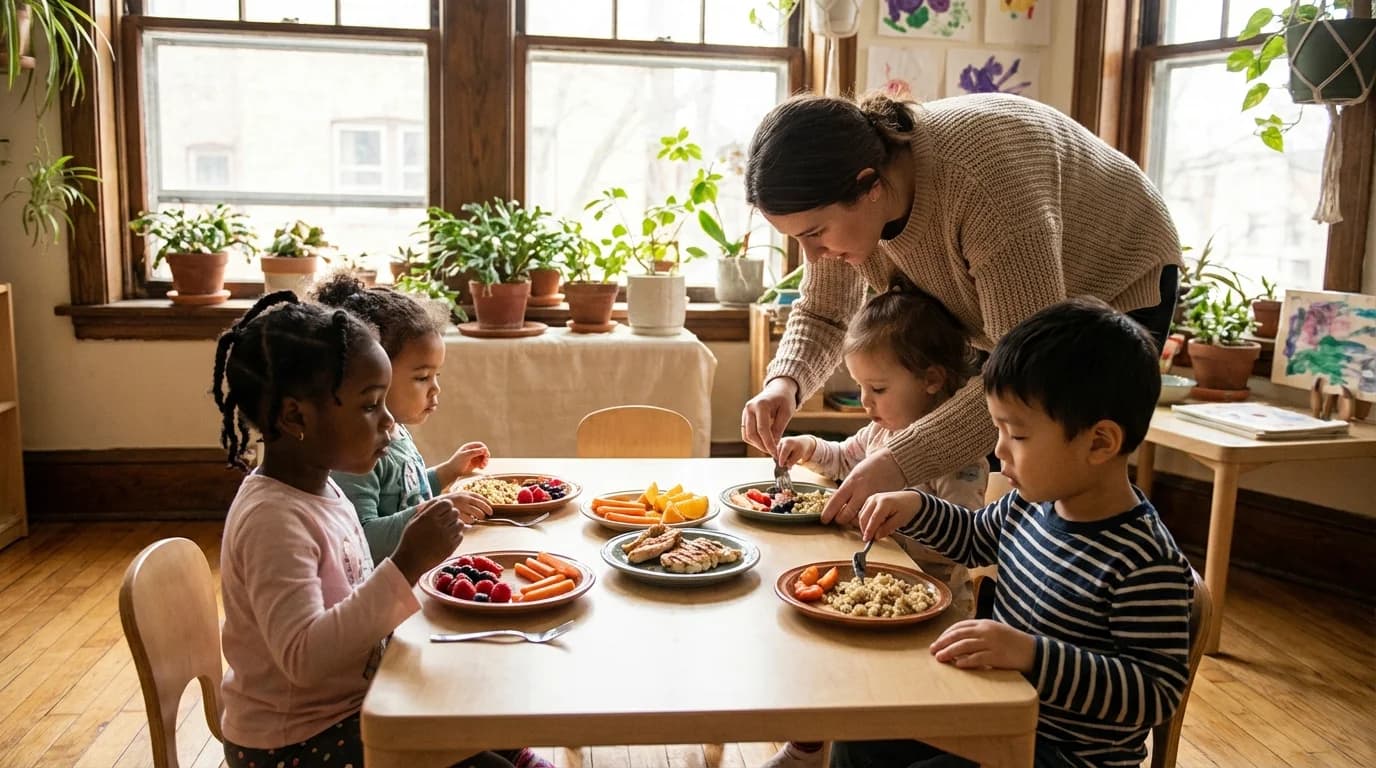
How children eat at daycare matters just as much as what they eat. Many high-quality early childhood programs, including those following Creative Curriculum, practice family-style dining. This means that children and teachers sit together at a table, food is placed in serving bowls, and children serve themselves with assistance as needed.
This might sound like a small thing, but the research behind it is compelling. The National Association for the Education of Young Children (NAEYC) recommends family-style meals because they support multiple areas of development simultaneously:
- Fine motor skills: Scooping, pouring, and using utensils build the same hand muscles children need for writing
- Language development: Mealtime conversation between children and teachers is one of the richest language-building opportunities in the day
- Social skills: Waiting your turn, passing a bowl, saying "please" and "thank you," and learning to eat with others are foundational social competencies
- Self-regulation: When children serve themselves, they begin to learn about portion sizes and hunger cues, which supports healthy eating habits long-term
- Independence and confidence: A two-year-old who successfully pours milk from a small pitcher feels a genuine sense of accomplishment
Not every daycare practices family-style dining. Some pre-plate meals and set them in front of children, which is faster but misses these developmental opportunities. When you tour a daycare, ask how meals are served. If they use family-style dining, watch a mealtime if possible. You will learn a lot about the program's culture by seeing how teachers and children interact over food. For more on what a full day looks like at a quality program, our guide to a typical day at daycare walks through the routine from drop-off to pickup.
Building Healthy Eating Habits Early
The eating patterns children develop between ages one and five have a lasting impact on their relationship with food. Zero to Three, the leading research organization focused on infant and toddler development, emphasizes that the early childhood years are a critical window for establishing preferences for fruits, vegetables, and whole foods.
A daycare that approaches nutrition thoughtfully can be a powerful partner in building these habits. Here is what that looks like in practice:
Repeated exposure without pressure. Research published in the journal Appetite found that children may need to be offered a new food 10 to 15 times before they accept it. Good daycare teachers understand this. They offer new foods consistently without forcing children to eat them. "You don't have to eat it, but it is here if you want to try it" is a phrase you will hear in well-trained classrooms.
Variety across the week. Menus should rotate and include a range of fruits, vegetables, proteins, and grains. If your child eats the same chicken nuggets and applesauce every day for a month, the program is not trying hard enough. Look at posted menus when you visit. A diverse menu is a sign that someone is thinking carefully about nutrition.
Cooking and food exploration activities. Many programs incorporate simple cooking projects into the curriculum. Making banana muffins, tearing lettuce for salad, or rolling dough connects children to the food they eat and makes them more willing to try new things. At Einstein Daycare, these hands-on activities align with our Creative Curriculum approach, where real-world experiences drive learning across subjects.
Hydration. Water should be available and offered throughout the day, not just at meals. Young children are not always good at recognizing thirst, especially when they are engaged in active play. Teachers should be proactively offering water, particularly after outdoor time and gross motor activities.
What About Infants? Feeding Policies for the Youngest Children
Feeding policies for infants require special attention. If your child is under twelve months, the daycare's approach to breastfeeding, formula, and the introduction of solid foods should align with your pediatrician's recommendations and the latest AAP guidelines.
A quality infant program will:
- Store and label breast milk properly (and never microwave it)
- Feed infants on demand rather than on a rigid schedule, consistent with AAP recommendations
- Introduce solid foods only with written parental consent and in coordination with the family's pediatrician
- Hold infants during bottle feeding rather than propping bottles, which supports bonding and reduces ear infection risk
- Communicate daily what and how much the infant ate, including any new foods introduced
For families considering infant care, these details matter enormously. Our post on infant and toddler daycare in Crown Heights covers what to look for in a program for the youngest children, including feeding, sleep, and caregiver attachment.
Questions to Ask About Nutrition Before Enrolling
When you are touring daycares in Prospect Lefferts Gardens, Flatbush, Crown Heights, or anywhere else in Brooklyn, bring this list of nutrition-related questions. The answers will tell you a lot about how seriously the program takes this part of care.
- Do you participate in CACFP? If not, what nutrition standards do you follow?
- Can I see your current meal and snack menu?
- How do you handle food allergies? Can I review your allergy management policy?
- Do you accommodate religious or cultural dietary needs?
- Do you practice family-style dining? At what age does that begin?
- How do you handle picky eaters? Do you ever force children to eat?
- Are meals prepared on-site or catered? Who plans the menus?
- How do you communicate with parents about what my child ate during the day?
- What is your policy on food brought from home (birthdays, snacks, etc.)?
- Is water available to children throughout the day?
A program that answers these questions confidently and thoroughly has thought about nutrition as part of their overall quality, not as an afterthought. A program that seems caught off guard by these questions, or that gives vague answers, may not have the systems in place to manage your child's dietary needs safely.
Nutrition as Part of the Bigger Picture
At Einstein Daycare, we view mealtime as an integral part of the learning day, not a break from it. Our menus follow CACFP guidelines and are planned with input from staff and families. Teachers sit with children during meals and use that time for conversation, vocabulary building, and social skill development. We accommodate allergies and dietary needs with documented plans that every classroom teacher understands.
We also believe that healthy eating connects to everything else we do. A child who has had a balanced breakfast and a good morning snack is more focused during circle time, more patient during a building project, and more regulated during transitions. Nutrition is not separate from education. It supports it.
For families in Prospect Lefferts Gardens and the surrounding Brooklyn neighborhoods, finding a daycare that takes food seriously is one more piece of the puzzle. Combine it with a strong curriculum, qualified teachers, and a safe physical environment, and you have a program that is truly caring for the whole child. If you are just beginning your daycare search, our comprehensive guide on how to choose a daycare in Brooklyn covers all the factors that matter most.