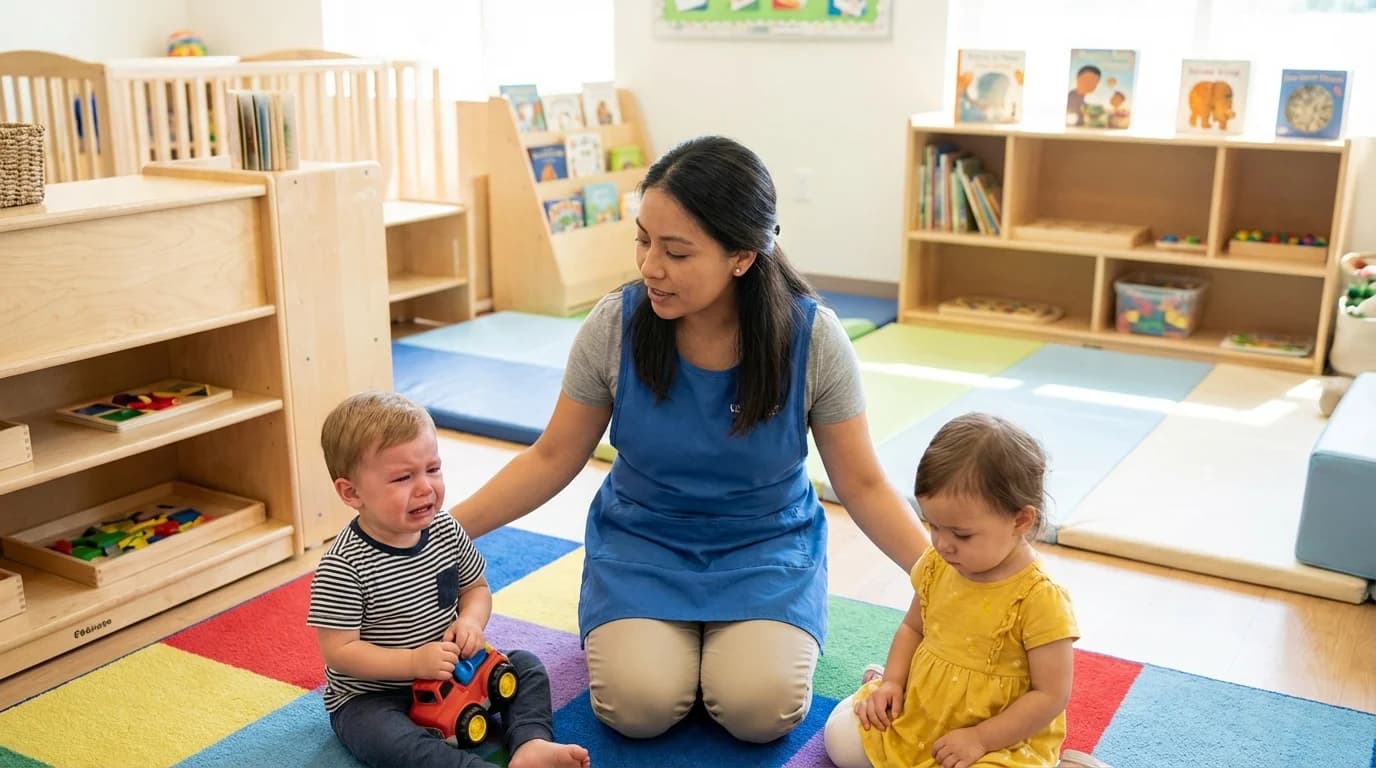
You pick up your toddler from daycare and notice a small bite mark on their arm. Or worse, you receive a call from your child's teacher saying your child bit another child. Either way, the experience can feel alarming, embarrassing, or deeply worrying. If this has happened to you, take a breath. You are not alone, and your child is not broken.
Biting, hitting, pushing, and other forms of physical aggression are among the most common behaviors in toddler classrooms across Crown Heights, East Flatbush, and every other neighborhood in Brooklyn. They are also among the most misunderstood. While these behaviors can be distressing for parents on both sides of the incident, they are a normal and well-documented part of early childhood development. Understanding why they happen and how skilled daycare teachers respond to them can bring enormous relief and help you support your child through this phase.
Why Toddlers Bite and Hit: The Developmental Picture
Before we talk about solutions, it is important to understand the root causes. Toddlers do not bite or hit because they are mean, poorly raised, or destined for behavioral problems. According to the Zero to Three Foundation, these behaviors are a predictable part of development between roughly 12 and 36 months of age.
Here are the primary reasons toddlers resort to physical behaviors:
Limited Language Skills
The most common driver of biting and hitting is simple: toddlers feel big emotions but lack the vocabulary to express them. A two-year-old who wants a toy another child is holding may have a vocabulary of only 50 to 200 words. They cannot say, "I was playing with that truck and I would like it back, please." So they communicate the only way their developing brain allows: physically. The American Academy of Pediatrics notes that expressive language develops significantly between ages two and three, which is precisely why these behaviors tend to decrease as children gain more words.
Sensory Exploration
For younger toddlers, especially those between 12 and 18 months, biting can be a form of sensory exploration. They are learning about cause and effect. They bite a teething ring and it feels good. They bite a person and get a dramatic reaction. Their developing brain is cataloging information about the world, not plotting harm. Our article on sensory play benefits in early childhood explores how children learn through their senses during this critical period.
Overwhelming Emotions
Toddlers experience frustration, excitement, anxiety, and overstimulation with the same intensity as adults but without any of the coping mechanisms. The prefrontal cortex, the part of the brain responsible for impulse control and emotional regulation, does not fully develop until the mid-twenties. According to the CDC's developmental milestones guidance, toddlers are just beginning to learn how to manage their emotions, and that learning process includes setbacks.
Seeking Control
Toddlers are at a stage where they are beginning to assert independence. When they feel powerless, whether because a transition is happening, a toy was taken, or a routine changed, physical behavior can be an attempt to regain a sense of control. This is also closely connected to the adjustment challenges we discuss in our guide to separation anxiety at daycare drop-off.
How NYC Daycare Teachers Handle Biting and Hitting
Licensed daycare programs in New York City, including those in Crown Heights and the 11213 zip code area, follow strict guidelines from the NYC Department of Health and Mental Hygiene (DOHMH) regarding how behavioral incidents are managed. Punitive responses such as yelling, shaming, time-outs in isolation, or physical discipline are never appropriate and are prohibited in licensed settings.
At quality daycare programs, teachers use evidence-based strategies grounded in child development research. Here is what that looks like in practice.
Immediate, Calm Intervention
When a biting or hitting incident occurs, the teacher's first response is to stay calm. They attend to the child who was hurt first, offering comfort and first aid as needed. Then they address the child who did the biting or hitting at their eye level, using a firm but gentle tone: "I can see you are frustrated, but I cannot let you hit. Hitting hurts." This approach validates the emotion while setting a clear boundary around the behavior.
Creative Curriculum Conflict Resolution
Programs that use the Creative Curriculum framework by Teaching Strategies have a structured approach to conflict resolution that goes far beyond simply separating children. Teachers are trained to guide children through a process of identifying emotions, understanding the impact of their actions, and practicing alternative behaviors. For toddlers, this looks simple but intentional: the teacher might say, "You wanted the block. Let's use our words. Say, 'My turn, please.'" Over time, these guided interactions build the neural pathways for self-regulation. You can learn more about how this framework operates in our detailed guide on what Creative Curriculum is and how it works.
Environmental Adjustments
Experienced teachers know that the classroom environment itself can contribute to or reduce aggressive behavior. If biting incidents tend to occur during free play when too many children crowd into one area, the teacher may restructure the room to create more defined centers with adequate materials. The National Association for the Education of Young Children (NAEYC) emphasizes that well-designed environments with appropriate materials and clear boundaries significantly reduce behavioral challenges.
Observation and Pattern Tracking
Teachers trained in the Teaching Strategies GOLD assessment system document behavioral incidents and look for patterns. Is the biting happening at a specific time of day? Is it triggered by a particular transition? Does it involve the same children? This data-driven approach allows teachers to intervene proactively rather than reactively, often preventing incidents before they occur.
Teaching Replacement Behaviors
The most effective long-term strategy is teaching children what they can do instead. For a child who bites when frustrated, a teacher might introduce a "bite toy" or teether that the child can use when they feel the urge. For a child who hits when they want a turn, the teacher practices the language "Can I have a turn?" throughout the day during calm moments, not just during conflicts. This proactive coaching is central to social-emotional development in quality daycare programs.
What Parents Can Do at Home
When your child is going through a biting or hitting phase, consistency between home and daycare is important. Here are strategies that align with what your child's teachers are doing in the classroom.
Practice feeling words at home. Name emotions throughout the day: "You look frustrated that your tower fell down." "You seem excited to go to the park." The more emotional vocabulary your child absorbs, the less they need to communicate physically.
Avoid overreacting to incidents. When your child bites or hits at home, respond calmly and consistently. Big reactions, even negative ones, can inadvertently reinforce the behavior because toddlers crave attention and do not differentiate between positive and negative attention.
Role-play gentle touches. Practice "gentle hands" and "soft touches" with stuffed animals, dolls, or family members. Make it a game during calm moments so your child has practiced the skill before they need it during a stressful moment.
Ensure adequate rest and nutrition. Toddlers who are tired, hungry, or overstimulated are far more likely to bite or hit. A consistent daily routine, as we discuss in our article about toddler daily routines at daycare, supports emotional regulation both at the program and at home.
Read books about feelings together. Stories are a powerful tool for teaching empathy and emotional literacy at this age. Ask your local Brooklyn Public Library branch librarian for recommendations on books about feelings, sharing, and friendship for toddlers.
When Should Parents Be Concerned?
While biting and hitting are normal in the toddler years, there are some signs that warrant further evaluation. The American Academy of Pediatrics recommends discussing the behavior with your pediatrician if:
The behavior persists beyond age three or four with the same frequency and intensity. Most children naturally decrease physical aggression as their language skills improve. If the behavior is not declining, it may indicate an underlying issue that needs support.
The behavior is accompanied by other developmental concerns, such as significant language delays, difficulty with social interaction, extreme reactions to sensory input, or regression in skills the child previously mastered.
The behavior seems unconnected to a clear trigger. Most toddler aggression is situational, occurring in response to frustration, a desire for an object, or overstimulation. If your child is biting or hitting seemingly at random, without any identifiable cause, further assessment may be helpful.
The behavior is severe enough to cause injury requiring medical attention, or it occurs many times per day despite consistent intervention.
In these cases, your pediatrician may recommend an evaluation by an early intervention specialist or a child psychologist. Early support, when it is needed, leads to the best outcomes.
A Phase, Not a Personality
If your toddler is currently in a biting or hitting phase, remember that this is a chapter, not the whole story. With patient, consistent responses from caring adults at daycare and at home, the vast majority of children move through this stage and develop the social and emotional skills they need to interact peacefully with others. The fact that you are reading this article and seeking to understand your child's behavior tells us everything we need to know about the kind of parent you are.
At Einstein Daycare, our teachers are trained in the Creative Curriculum approach to conflict resolution and social-emotional development. We work closely with families to ensure consistency between home and school, and we are always available to discuss your child's development and behavior.
Questions About Your Toddler's Behavior?
Our experienced teachers at Einstein Daycare are here to support your family through every stage of development. Schedule a tour to see our classrooms and learn more about our approach to guiding toddler behavior. Schedule a tour online or call us at (718) 618-7330.