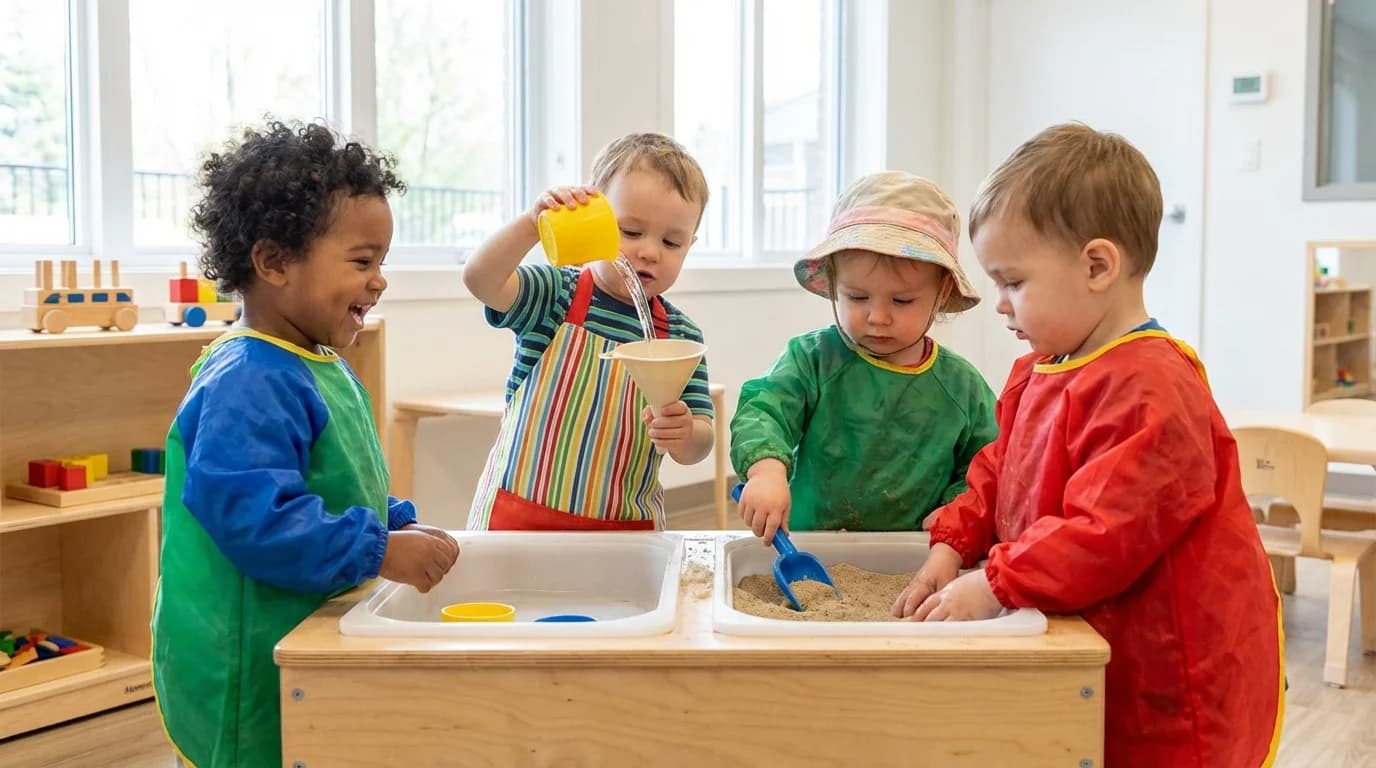
If you have ever watched a toddler pour water back and forth between two cups with absolute concentration, you have witnessed something remarkable: a young scientist at work. Water and sand play may look like simple fun, but these activities are among the most powerful learning experiences available in early childhood education. At Einstein Daycare, our sand and water areas are not just play stations. They are carefully designed learning centers where children build foundational skills in science, math, language, and social development every single day.
For families in Canarsie and across Brooklyn, understanding what happens at the water and sand table can transform how you see your child's daycare experience. What looks like splashing and scooping is actually the beginning of scientific reasoning, and the research backing this is substantial.
The Science Hiding in Every Splash
When children play with water and sand, they are conducting experiments. They may not be wearing lab coats or writing hypotheses, but they are engaging in the same fundamental processes that drive all scientific inquiry: observation, prediction, testing, and drawing conclusions.
Consider what happens when a child pours water from a tall, narrow container into a short, wide one. They are grappling with the concept of volume conservation, a principle that developmental psychologist Jean Piaget identified as a milestone of cognitive development. When they pack sand into a mold and flip it over, they are learning about properties of matter. When they add water to dry sand and notice it holds its shape differently, they are observing how materials change when combined.
According to the National Association for the Education of Young Children (NAEYC), sand and water play introduces children to higher-level thinking concepts like volume, weight, and cause-and-effect relationships. Children learn which container holds more, how many small cups fill a larger bucket, and what happens when you change one variable in their play. These are the same inquiry skills that will serve them in science classrooms for years to come.
How Creative Curriculum Structures Sand and Water Learning
At Einstein Daycare, we use The Creative Curriculum framework, which designates sand and water as a distinct interest area in every classroom. This is not an afterthought or a rainy-day activity. It is a core component of the learning environment, intentionally stocked with materials that invite exploration and discovery.
Our sand and water centers include measuring cups and spoons of various sizes, funnels and tubes for channeling water, sifters and colanders for separating materials, small figurines and natural objects for imaginative play, eyedroppers and turkey basters for developing hand strength, and waterproof magnifying glasses for close observation. Each of these materials is chosen to support specific developmental objectives tracked through Teaching Strategies GOLD, our assessment system. When a child uses a funnel to pour sand into a bottle, our teachers are observing fine motor control, problem-solving strategies, and emerging math concepts all at once.
As we explore in our post on what Creative Curriculum looks like in practice, this interest-area approach ensures that children encounter rich learning opportunities throughout their day, not just during structured lesson times.
Sensory Development: Why Messy Play Matters
The tactile experience of sand and water play is essential for healthy sensory development. Children need to feel different textures, temperatures, and consistencies to build a well-integrated sensory system. Wet sand feels different from dry sand. Cool water feels different from warm water. Sticky mud feels different from smooth clay.
Zero to Three, a leading research organization focused on infant and toddler development, emphasizes that sensory play helps children process and respond to sensory information in their environment. Children who have rich sensory experiences in their early years develop stronger neural pathways for processing the world around them.
This matters beyond the classroom. Children with well-developed sensory processing are better able to sit comfortably in a chair, tolerate the textures of different foods, manage the noise levels of a busy classroom, and handle the feel of different clothing fabrics. For more on how sensory experiences support overall development, see our detailed look at the benefits of sensory play in early childhood.
Fine Motor Development Through Scooping, Pouring, and Squeezing
Every time a child squeezes a turkey baster, pinches a clump of wet sand, or carefully pours water from one container to another, they are strengthening the small muscles in their hands and fingers. These are the same muscles they will need for holding a pencil, buttoning a coat, tying shoes, and using scissors.
The beauty of sand and water play is that children practice these fine motor skills with genuine motivation. No child needs to be convinced to squeeze water out of a sponge or dig for buried treasures in a sand table. The activity is inherently engaging, which means children practice for longer periods and with more focus than they might with worksheet-based activities. At Einstein Daycare, we see this daily: children who spend time at the sand and water table develop the hand strength and dexterity they need for writing and drawing activities that come later.
Math Concepts That Emerge Naturally
Sand and water play is one of the richest environments for early math learning. Without any direct instruction, children at the sand and water table naturally encounter and practice concepts including volume and capacity (how much does this container hold?), measurement and comparison (this cup is bigger than that cup), counting (how many scoops does it take to fill the bucket?), estimation (will all this sand fit in this container?), weight and balance (which bucket is heavier?), and spatial reasoning (how do I build this tunnel so it does not collapse?).
The NAEYC notes that hands-on measuring activities give children an intuitive understanding of mathematical relationships that abstract number work simply cannot replicate at this age. When a three-year-old discovers that two small cups of water fill one big cup, they are building a concrete understanding of mathematical equivalence that will support fraction learning years later.
Social Skills at the Water Table
Sand and water centers are inherently social spaces. Children must share materials, negotiate roles, communicate their ideas, and collaborate on projects. A group building a sand castle together must decide who digs, who packs, and who decorates. Children at the water table must take turns with popular tools and learn to ask for what they need.
These are the real-world social skills that matter most in early childhood: using words to express needs, listening to another child's idea, compromising when two children want the same tool, and working together toward a shared goal. Our teachers facilitate these interactions, helping children develop the language and strategies they need to navigate social situations successfully.
The Role of Teacher Scaffolding
What separates play at a quality daycare from play at home is the role of the teacher. At Einstein Daycare, our educators are trained to scaffold children's learning at the sand and water table through intentional strategies.
Scaffolding means meeting children where they are and helping them reach the next level of understanding. A teacher might ask open-ended questions like "What do you think will happen if you add more water to the sand?" or "How could you make the water flow faster through the tube?" These questions encourage children to think, predict, and test their ideas, which are the foundations of the scientific method.
Teachers also introduce new vocabulary during sand and water play. Words like "dissolve," "absorb," "overflow," "measure," "predict," and "compare" become part of children's working vocabulary when they are connected to real, hands-on experiences. According to the American Academy of Pediatrics, this kind of guided play, where adults support and extend children's natural curiosity, produces the strongest learning outcomes in early childhood.
Our teachers document children's explorations using Teaching Strategies GOLD, tracking growth across cognitive, language, social-emotional, and physical development domains. This means that even during what looks like free play, your child's individual progress is being observed and supported.
Safety and Hygiene at the Sand and Water Table
Parents naturally have questions about the cleanliness of shared sand and water play. At Einstein Daycare, we follow strict hygiene protocols. Water tables are drained, cleaned, and sanitized daily. Sand is replaced regularly and checked for foreign objects. Children wash hands before and after sand and water play. Individual smocks protect clothing. Teachers supervise actively at all times, especially with younger children.
These precautions are aligned with guidelines from the Centers for Disease Control and Prevention (CDC) and NYC Department of Health and Mental Hygiene standards for child care facilities.
Connecting Sand and Water Play to the Wider Curriculum
Sand and water play does not exist in isolation at Einstein Daycare. Our teachers connect it to themes and studies happening across the classroom. During a study of ocean animals, the water table might be stocked with plastic sea creatures and blue-tinted water. During a construction study, the sand table might include small trucks and building materials. During a gardening study, children might experiment with watering real plants and observing how soil absorbs moisture.
This integrated approach means that children are building connections across subject areas, exactly the way learning works best in the early years. As we discuss in our post on art and creative activities for school readiness, the most effective early childhood programs weave learning across multiple domains rather than teaching subjects in isolation.
What Parents Can Do at Home
You do not need a professional sand and water table to extend this learning at home. Bath time is a perfect opportunity for water play. Add measuring cups, funnels, and small containers to the tub and let your child experiment. A plastic bin filled with dried rice, dried beans, or sand on a covered porch provides sensory exploration. Even a simple activity like washing dishes together gives children practice with pouring, measuring, and feeling water temperature.
The Zero to Three organization offers play activities by age group that can help you find developmentally appropriate sensory experiences to try at home. The key is to let your child lead the exploration. Resist the urge to direct or correct. Ask questions, observe, and wonder alongside them.
Building Tomorrow's Scientists Today
At Einstein Daycare, we take sand and water play seriously because the research is clear: these experiences build the cognitive, physical, social, and emotional skills that prepare children for academic and life success. Every splash, every scoop, every carefully constructed sand mountain is a step toward becoming a confident, capable learner.
See our sand and water learning centers in action. Schedule a visit to Einstein Daycare at 900 Lenox Rd, Brooklyn, NY 11203, and discover how our Creative Curriculum classrooms turn everyday play into meaningful learning. Request a tour online or call us at (718) 618-7330.