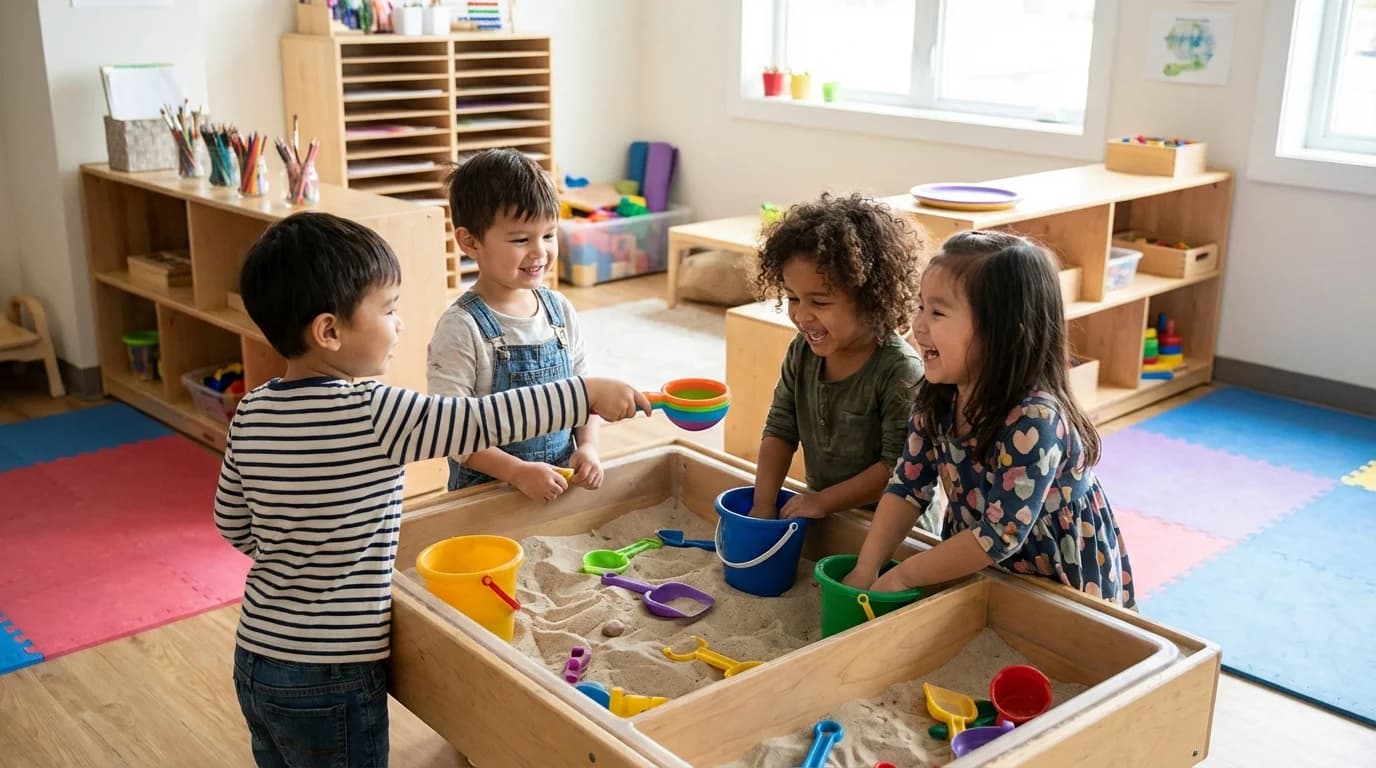
A parent drops off their two-year-old at daycare and, peeking through the window an hour later, sees their child sitting alone at the block table while other children play nearby. The child is not interacting with anyone. Worry sets in: Is something wrong? Is my child antisocial? Should the teacher be making them play with the other children?
This scenario plays out regularly among Flatbush families, and the concern is understandable. But what that parent is actually witnessing is a perfectly healthy, developmentally appropriate stage of play that researchers have studied for nearly a century. At Einstein Daycare, we help families across the 11226 area and throughout Brooklyn understand how play develops, why each stage matters, and how our teachers support children's social growth without forcing interactions that children are not yet ready for.
Parten's Six Stages of Play
In 1932, sociologist Mildred Parten published groundbreaking research based on her observations of young children at play. She identified six stages of social play that children move through as they develop, progressing from solitary activities to increasingly social and cooperative interactions. Nearly a century later, her framework remains one of the most widely used models in early childhood education and is supported by extensive subsequent research on play and child development.
Understanding these stages can fundamentally change how parents interpret what they see their child doing at daycare -- and at home.
Stage 1: Unoccupied Play (Birth to About 3 Months)
In the earliest form of play, infants make seemingly random movements -- kicking their legs, waving their arms, grasping at objects. To adult eyes, this may not look like play at all, but the child is learning to control their body and observe their environment. They are gathering sensory information about the world and beginning to understand cause and effect. When an infant discovers that shaking a rattle produces a sound, they are engaging in a meaningful form of play that lays the foundation for everything that follows.
Stage 2: Solitary Play (Birth to About 2 Years)
During solitary play, a child plays alone and is focused entirely on their own activity. They may be stacking blocks, examining a toy, or scribbling with crayons, with no interest in what other children around them are doing. Solitary play is the dominant form of play for infants and young toddlers, and it remains important even as children grow older. Through solitary play, children develop concentration, independence, and the ability to entertain themselves -- skills that will serve them throughout their lives. The Zero to Three organization emphasizes that solitary play in toddlerhood is not a sign of social difficulty; it is a necessary foundation for later social play.
Stage 3: Onlooker Play (Around 2 Years)
In onlooker play, a child watches other children play without joining in. They may ask questions or make comments about what the other children are doing, but they do not participate directly. This stage is often misinterpreted as shyness or social difficulty, but it is actually an important learning strategy. The child is observing social dynamics, learning the rules of games, and figuring out how interactions work before attempting to join. Think of it as the social equivalent of studying the playbook before stepping onto the field.
Stage 4: Parallel Play (Ages 2 to 3)
This is the stage that most frequently concerns parents, and it is also the stage that is most commonly misunderstood. During parallel play, children play side by side with similar materials but do not directly interact. Two toddlers might sit at the same table, both building with blocks, each constructing their own structure without collaborating or even acknowledging each other's work. They are clearly aware of each other -- they may glance at what the other child is building, or choose the same colored blocks -- but they do not engage in shared play.
Parallel play is not antisocial behavior. It is a crucial developmental stage during which children practice being in proximity to peers, begin to observe and learn from each other, and build comfort with shared spaces. According to the American Academy of Pediatrics, play in all its forms -- including parallel play -- is essential for healthy brain development and helps children practice new social skills in a low-pressure context.
Stage 5: Associative Play (Ages 3 to 4)
Associative play marks a significant shift toward social interaction. Children begin playing with each other -- talking, sharing materials, and engaging in similar activities -- but without organized rules or a shared goal. Two children might both be drawing at the art table, talking about their pictures and sharing crayons, but each is creating their own drawing without coordinating the effort. The distinction from parallel play is the interaction: in associative play, the children are actively engaging with each other, just not yet working toward a common purpose.
This stage is where early friendship skills begin to develop. Children practice turn-taking, learn to negotiate ("Can I use the red crayon when you are done?"), and experience the pleasure of shared social experiences. Our teachers at Einstein Daycare facilitate this stage by providing materials that encourage interaction, seating children together at activity tables, and modeling conversational exchanges.
Stage 6: Cooperative Play (Ages 4 to 5+)
Cooperative play is the most socially complex form of play. Children work together toward a shared goal, assign roles, establish rules, and negotiate throughout the process. Building a block city together, playing house with assigned family roles, or creating a group art project all represent cooperative play. This stage requires and develops sophisticated social skills: communication, compromise, empathy, perspective-taking, and conflict resolution.
The National Association for the Education of Young Children (NAEYC) identifies cooperative play as a crucial context for developing the social-emotional competencies that predict school success. Children who can cooperate effectively in play are better equipped to collaborate in classroom activities, work in groups, and navigate the social complexity of elementary school.
Why These Stages Matter: Age Expectations in Context
One of the most important things parents should understand about Parten's stages is that they are not rigid categories with firm age boundaries. Children do not wake up on their third birthday and suddenly transition from parallel to associative play. The stages overlap, and children may move back and forth between stages depending on the situation, their comfort level, the other children present, and even how they are feeling that day. A four-year-old who typically engages in cooperative play with familiar friends may revert to parallel play when placed in a new group of unfamiliar peers, and this is perfectly normal.
Additionally, earlier stages of play do not become obsolete as children grow. Solitary play remains valuable and necessary throughout childhood -- and adulthood, for that matter. A five-year-old who occasionally chooses to play alone is not regressing; they may be concentrating deeply, processing experiences, or simply enjoying independent exploration. The goal is not to eliminate earlier play stages but to expand a child's repertoire to include increasingly social forms of play as they develop the cognitive and emotional skills to sustain them.
Why Forced Sharing Does Not Work
One of the most deeply held beliefs among parents and even some caregivers is that children should be made to share immediately and unconditionally. A child is playing with a toy, another child wants it, and an adult intervenes: "You need to share. Give the toy to your friend." This approach, while well-intentioned, often backfires -- and research in early childhood education explains why.
True sharing requires empathy: the ability to understand another person's feelings and voluntarily choose to set aside one's own desires. Empathy develops gradually through the preschool years and is not fully mature until well into elementary school. When we force a two-year-old to hand over a toy, we are not teaching sharing. We are teaching compliance -- and often generating resentment that makes genuine sharing less likely in the future.
The NAEYC's principles of child development emphasize that effective teaching meets children where they are developmentally. At Einstein Daycare, instead of forcing immediate sharing, our teachers use strategies that align with children's developmental capacity. For toddlers in parallel play, we ensure that there are enough materials for everyone so that sharing conflicts are minimized. For children in associative play, we introduce turn-taking: "You can use the truck for two more minutes, and then it will be Maria's turn." For children in cooperative play, we help them negotiate: "Both of you want to be the doctor. How can you solve this problem?"
This approach does not mean that children never learn to share. On the contrary, children who are supported through developmentally appropriate strategies develop more genuine generosity and stronger social skills than children who are simply commanded to hand over their possessions. They learn to share because they want to, not because they are forced to.
How Teachers Facilitate Social Play Development
At Einstein Daycare, our teachers play an active but carefully calibrated role in supporting children's progression through the stages of play. This is one of the key strengths of our Creative Curriculum approach, which provides a structured framework for teacher facilitation that respects each child's developmental stage.
For children in solitary play, teachers provide rich materials and stay nearby, offering comfort and security. They narrate what the child is doing ("You stacked three blocks. You are building a tall tower!"), which supports language development without disrupting the child's concentration.
For children in parallel play, teachers set up the environment to encourage proximity. They place materials at shared tables, create cozy spaces where two or three children can play near each other, and gently draw children's attention to what peers are doing: "Look, Marcus is building with blocks too. He is making a road."
For children in associative play, teachers model social language ("May I join your game?"), help children express their needs and feelings verbally, and facilitate problem-solving when conflicts arise. They also create opportunities for shared experiences, such as group art projects or cooperative sensory activities like those described in our article on sensory play benefits.
For children in cooperative play, teachers take a step back but remain available. They provide props and materials that support complex play scenarios, ask questions that extend play narratives ("Where is the fire truck going? Is anyone in the building?"), and intervene only when conflicts cannot be resolved by the children themselves.
Play Develops Empathy
Perhaps the most profound outcome of the progression through play stages is the development of empathy -- the ability to understand and share the feelings of another person. Empathy is not an innate trait that children either possess or lack. It is a skill that develops gradually through social experience, and play is its primary classroom.
During dramatic play, children practice taking on another person's perspective. A child pretending to be a parent, a doctor, or a firefighter must imagine how that person thinks, feels, and behaves. During cooperative play, children learn that their actions affect others -- that grabbing a toy makes a friend sad, that including someone makes them happy, that compromising feels better than fighting. The AAP highlights that through play, children build important life skills including managing emotions, learning rules and expectations, and developing the ability to see things from someone else's perspective.
These are not abstract skills. They are the foundation of every healthy relationship a child will have for the rest of their life. And they develop not through lectures or worksheets but through the daily, messy, joyful experience of learning to play with other human beings.
What Parents Can Do
Understanding the stages of play gives parents a valuable lens for interpreting their child's social behavior. Here are some practical ways to support your child's play development at home:
Provide unstructured play time every day. Resist the urge to schedule every moment. Children need open-ended time to explore, imagine, and interact at their own pace. Arrange playdates with one or two children rather than large groups, especially for toddlers and young preschoolers, as smaller groups are less overwhelming and more conducive to meaningful interaction. Follow your child's lead rather than directing their play. If they are engaged in parallel play, let them be -- do not insist that they "play with" the other child. Model social skills naturally by narrating your own social interactions: "I am going to share my umbrella with Mrs. Johnson because it is raining and she forgot hers."
Our article on art and school readiness explores how creative activities in particular create natural opportunities for children to practice associative and cooperative play as they share materials, discuss their work, and collaborate on projects.
The journey from solitary play to cooperative play is one of the most important developmental progressions of early childhood. It is the journey from "me" to "we," from self-focus to social awareness, from independence to interdependence. At Einstein Daycare in Flatbush, we honor every stage of this journey, providing the environment, materials, and expert facilitation that help each child develop the social skills and empathy they will carry with them far beyond our classrooms. Our teachers, guided by the Teaching Strategies GOLD assessment system, observe and document each child's social development, ensuring that every child receives the support they need to grow at their own pace.
Watch how our teachers skillfully facilitate social play development. Schedule a tour of Einstein Daycare at 900 Lenox Rd, Brooklyn, NY 11203 to see our play-based learning environment in action. Request a tour online or call us at (718) 618-7330.