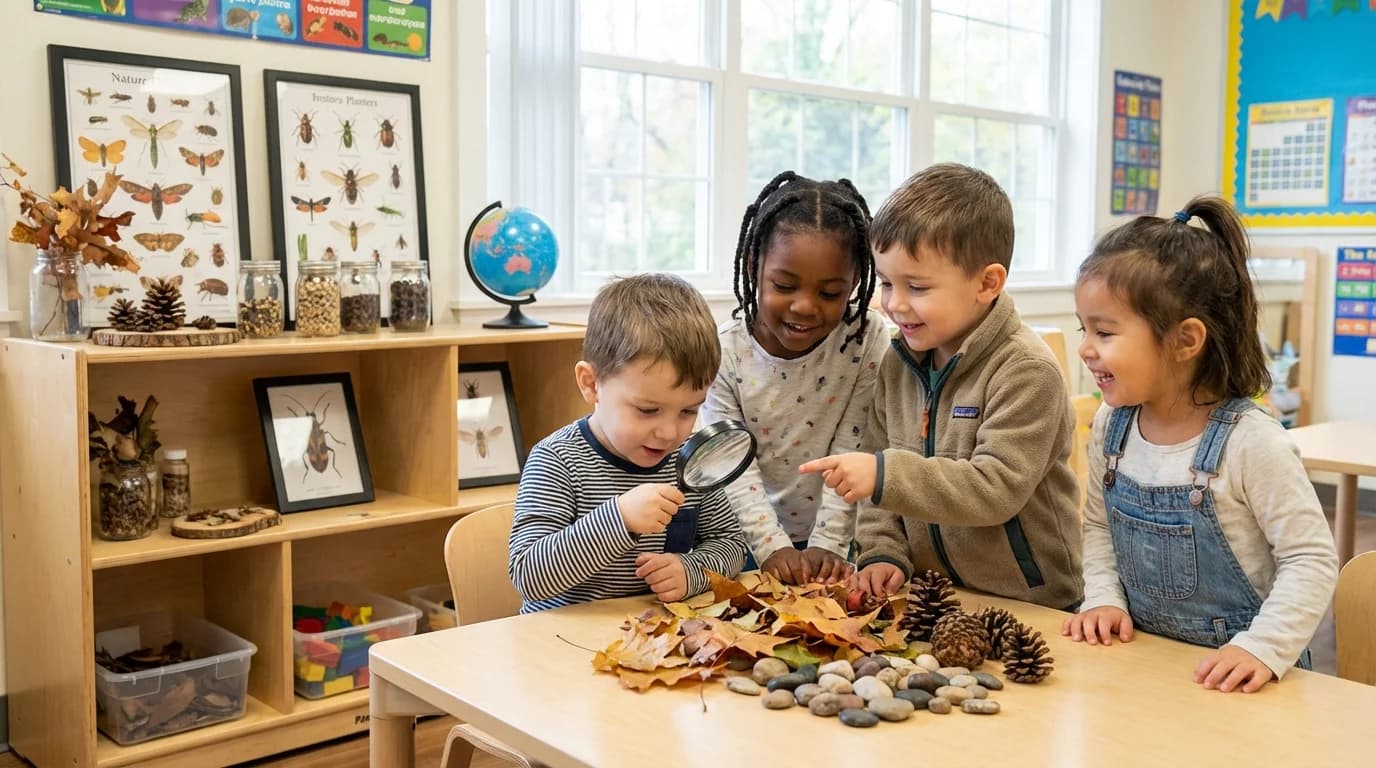
Watch a three-year-old crouch beside a puddle after a rainstorm, poking at the water with a stick, watching the ripples fan outward, and you are watching a scientist at work. Young children arrive in our classrooms already equipped with the most important tool any researcher can possess: unbridled curiosity. They ask "why" dozens of times each day. They test what happens when they drop a block from different heights. They notice that the caterpillar on the playground fence has more legs than the ladybug on the leaf. This instinct to observe, question, and experiment is the foundation of all scientific thinking, and when early childhood educators nurture it deliberately, they lay groundwork that supports academic success for years to come.
At Einstein Daycare in East Flatbush, Brooklyn, science exploration is not a weekly add-on or a special event. It is woven into the daily rhythm of every classroom, from the infant room where babies explore texture boards to the preschool room where four-year-olds record weather observations on a class chart. Our approach draws on the Creative Curriculum framework from Teaching Strategies, which designates a dedicated Discovery Area as one of the core interest areas in every preschool classroom. In that area, children encounter magnifying glasses, balance scales, magnets, collected natural objects, and simple tools that invite them to investigate the world on their own terms.
Why Science Matters in the Preschool Years
The argument for early science education is both intuitive and well-supported by research. The National Science Teachers Association (NSTA) position statement on early childhood science education, endorsed by the National Association for the Education of Young Children, affirms that children have the capacity to engage in scientific practices and develop understanding at a conceptual level from a very young age. The statement emphasizes that young children need multiple, varied opportunities to engage in science exploration and discovery, and that everyday play is itself a form of science learning.
This matters because the preschool years represent a period of extraordinary brain growth. According to Zero to Three, more than one million new neural connections form every second in the first years of life. When children engage in hands-on science activities, they are not simply playing. They are building the neural pathways that support logical thinking, problem-solving, vocabulary development, and the ability to categorize and compare information. These are the same cognitive skills that will serve them in kindergarten math, reading comprehension, and beyond.
The Head Start Early Learning Outcomes Framework identifies Scientific Reasoning as a distinct domain for preschool-age children, recognizing that skills like observation, prediction, and experimentation deserve focused attention alongside literacy and mathematics. When we invest in science exploration at the preschool level, we are not getting ahead of the curriculum. We are meeting children exactly where their development demands.
The Discovery Area: A Classroom Laboratory
In the Creative Curriculum model that guides our classrooms at Einstein Daycare, the Discovery Area is a carefully prepared space where children can investigate scientific concepts through self-directed exploration. Unlike a traditional science table where a teacher sets up a single demonstration, the Discovery Area is stocked with open-ended materials that children can use in multiple ways across multiple days. You can read more about how this framework shapes our entire program in our post on what Creative Curriculum means for East Flatbush families.
A well-equipped Discovery Area might include magnifying glasses and hand lenses for close observation, a balance scale with objects of varying weight, magnets of different shapes and sizes paired with a collection of metallic and non-metallic items, containers for water exploration, small potted plants at different growth stages, a class pet such as a fish or hermit crab, and collections of natural objects like pinecones, shells, rocks, and feathers organized for sorting and comparison. According to the Creative Curriculum for Preschool guide from Teaching Strategies, children learn in the Discovery Area to use their senses to gain information about the environment, develop vocabulary to compare and classify objects, observe cause and effect, and make predictions about what will happen next.
The teacher's role is not to deliver a lecture but to observe, ask open-ended questions, and extend children's thinking. When a child notices that the magnet sticks to the metal shelf but not to the wooden block, a skilled teacher might say, "You found something interesting. What else in our classroom do you think the magnet will stick to?" This kind of interaction aligns with what the Harvard Center on the Developing Child calls serve-and-return exchanges, the responsive back-and-forth interactions that build brain architecture and support cognitive growth.
Age-Appropriate Science Activities That Build Real Understanding
Parents sometimes wonder what science looks like for a child who cannot yet read or write. The answer is that preschool science looks like joyful, purposeful play. Here are some of the activities that form the backbone of science exploration at Einstein Daycare.
Sink and Float Experiments
Few activities captivate preschoolers as reliably as a basin of water and a collection of objects. Children predict whether each item will sink or float, test their hypothesis, and sort the objects into two groups based on the result. Along the way, they encounter concepts related to density, buoyancy, and material properties, though we use child-friendly language rather than technical terminology. The activity also builds vocabulary as children describe objects as heavy, light, smooth, bumpy, hollow, or solid.
Magnet Exploration
Magnets are endlessly fascinating to young children because the force is invisible yet undeniable. Children explore which materials are attracted to magnets and which are not, discovering that magnetism is a property of certain metals rather than of all objects. Over time, they can experiment with magnet strength, polarity, and the ability of magnets to work through thin barriers like paper or fabric.
Plant Growth and Life Cycles
Growing plants from seeds gives children a front-row seat to the life cycle. They observe germination, measure growth with non-standard units like counting blocks, and learn that plants need water, light, and soil. This activity naturally connects to discussions about food, nutrition, and the environment. At Einstein Daycare, our outdoor play area allows children to tend small garden containers and observe insects and pollinators that visit the plants.
Weather Observation
A daily weather chart is one of the simplest yet most effective science routines in a preschool classroom. Children observe the sky, describe the weather using specific vocabulary, and record their observations using pictures or symbols. Over weeks and months, they begin to notice patterns: it rains more in spring, days get longer in summer, leaves change color in autumn. This is foundational data collection and pattern recognition, skills that the Next Generation Science Standards identify as essential for kindergarten learners.
Magnifying Glass Investigations
Giving a child a magnifying glass transforms an ordinary walk into a scientific expedition. Suddenly, the texture of a leaf becomes a landscape. The surface of a rock reveals sparkly minerals. An ant's body shows distinct segments. Magnifying glasses teach children to look closely, a skill that translates directly to the careful observation required in later scientific study and even in learning to read, where children must distinguish between similar-looking letters.
The STEM Connection: More Than a Buzzword
STEM, the integration of science, technology, engineering, and mathematics, has become a prominent term in education discussions. For preschoolers, STEM is not about coding apps or robotics kits. It is about the natural integration of these disciplines through hands-on exploration. When a child builds a ramp and tests how far a ball rolls depending on the ramp's height, that child is simultaneously engaging in physics (science), measurement (mathematics), and design (engineering). When children use a simple balance scale to determine which rock is heavier, they are practicing both scientific inquiry and mathematical comparison.
Our approach at Einstein Daycare ensures that STEM learning connects naturally to other developmental domains. Science activities build vocabulary and narrative skills as children describe what they observe and predict what will happen. They support social-emotional development as children collaborate, share materials, and respect differing ideas. And they develop fine motor skills as children manipulate small objects, pour water, and use tools like tweezers and droppers. For more on how hands-on learning builds STEM skills in our classrooms, see our post on block play and STEM learning in preschool.
Nature Exploration in Brooklyn: Science Beyond the Classroom
Brooklyn offers remarkable opportunities for nature-based science learning, and at Einstein Daycare we take advantage of our local environment to extend classroom discoveries into the real world. The neighborhoods surrounding East Flatbush provide green spaces, street trees, community gardens, and seasonal changes that serve as an outdoor laboratory for young scientists.
Neighborhood walks become science excursions when teachers guide children to notice the shapes of different leaves, listen for bird calls, observe puddles after rain, or feel the difference between sun-warmed pavement and shaded sidewalk. These experiences ground abstract concepts in tangible reality. A child who has watched ice melt on the playground in winter and puddles evaporate in summer has an embodied understanding of states of matter that no worksheet could provide.
Brooklyn is also home to extraordinary institutions that support nature-based learning. The Brooklyn Botanic Garden's children and family programs offer hands-on experiences with planting, composting, and exploring garden ecosystems. For families seeking additional nature exploration, Prospect Park provides meadows, forests, and a lake where children can observe wildlife, collect natural specimens, and experience the changing seasons in a setting that feels far removed from the urban streets just beyond its borders.
How Parents Can Support Science Learning at Home
Science exploration does not require expensive equipment or specialized knowledge. Parents can support their child's scientific thinking through everyday interactions. Cooking together introduces measurement, temperature changes, and chemical reactions. Bath time can become an experiment with objects that sink and float. A walk to the grocery store can prompt conversations about where food comes from and how plants grow.
The most powerful thing a parent can do is model curiosity. When you wonder aloud, "I notice the moon looks different tonight than it did last week. Why do you think that is?" you are teaching your child that asking questions is valuable and that not knowing the answer is the beginning of learning, not the end of it. The NAEYC recommends that parents and educators promote science learning by following children's interests, asking open-ended questions, and providing time and materials for extended exploration rather than rushing toward a predetermined conclusion.
At Einstein Daycare, we share regular updates with families about the science investigations underway in our classrooms, along with suggestions for extending those explorations at home. When a child is studying worms at school and then discovers one in the garden at home, the learning becomes deeper, more personal, and more lasting. You can learn more about our approach to sensory-rich exploration in our post on the benefits of sensory play in early childhood.
Assessment Through Observation, Not Testing
At Einstein Daycare, we assess children's scientific learning not through quizzes or worksheets but through careful, ongoing observation using Teaching Strategies GOLD, an observational assessment system that tracks children's development across multiple domains including science and technology. Teachers document children's questions, their approaches to solving problems, their ability to make predictions and test them, and their growing vocabulary for describing the natural world. This documentation informs our planning, helping us provide experiences that meet each child exactly where they are and nudge them toward the next level of understanding.
This approach reflects a fundamental principle of early childhood science education: the process matters more than the product. We care less about whether a child can recite the names of the planets and more about whether that child can observe carefully, ask a question, try something, and reflect on what happened. Those process skills are the real gift of early science education, and they serve children well regardless of whether they grow up to become scientists, artists, teachers, or entrepreneurs.
Building a Foundation for Lifelong Learning
When we provide rich science experiences for preschoolers, we are doing more than preparing them for kindergarten science standards. We are nurturing a disposition toward inquiry, a habit of looking at the world with curiosity and care, that shapes how children approach all learning. The child who learns in preschool that questions are welcome, that mistakes are informative, and that the natural world is endlessly interesting carries those beliefs into elementary school, high school, and adult life.
At Einstein Daycare, we are proud to offer East Flatbush families a learning environment where science exploration is a daily adventure, not an occasional event. Our classrooms are designed to spark wonder, and our teachers are trained to fan that spark into sustained, joyful inquiry.
See Science in Action at Einstein Daycare
Curious about how our Discovery Area and science exploration activities support your child's learning and development? We invite East Flatbush families to schedule a visit and see our classrooms in person. Request a tour online or call us directly at (718) 618-7330. We would love to show you how we nurture your child's inner scientist every day at 900 Lenox Rd, Brooklyn, NY 11203.