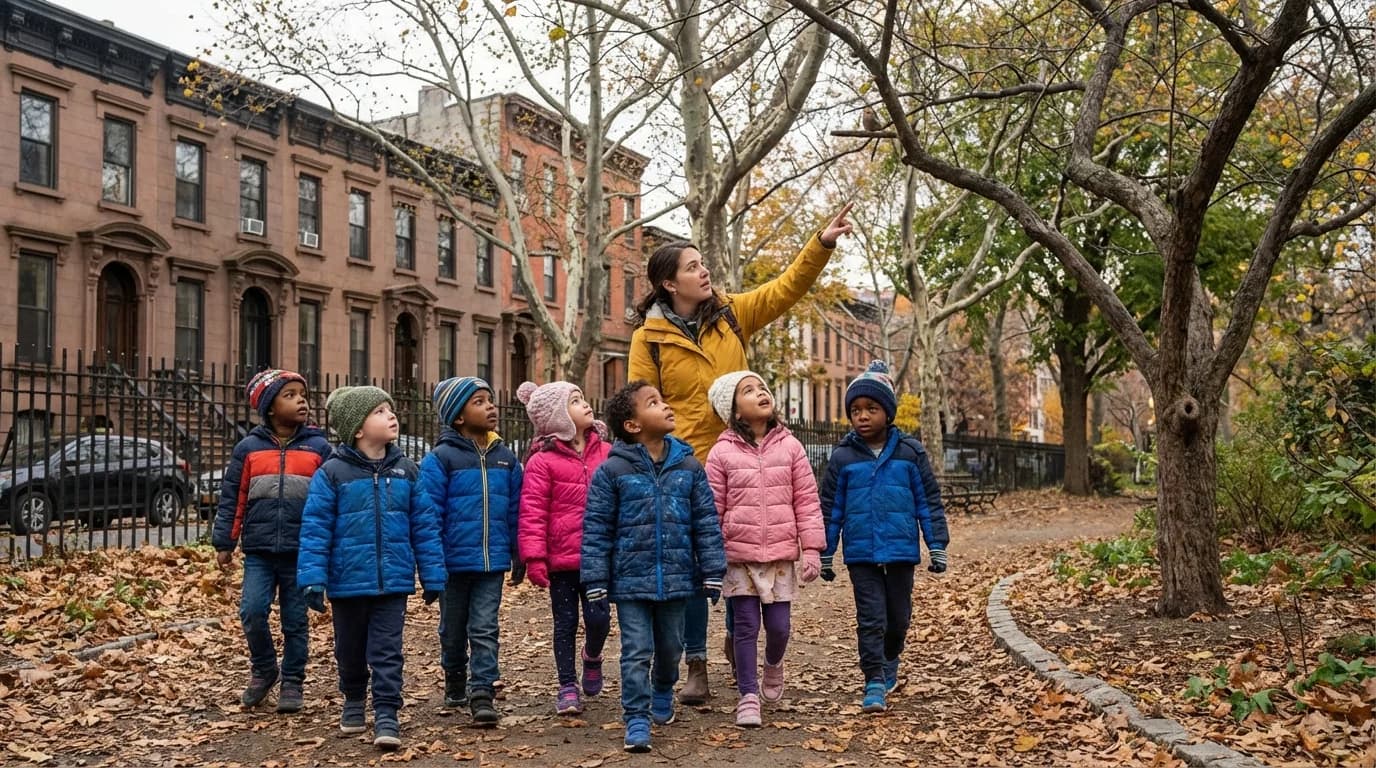
A line of preschoolers walking down a Brooklyn sidewalk, holding a rope and wearing bright safety vests, might look like a simple outing. But if you could hear the conversation happening in that line, you would hear something extraordinary. "Look, that leaf is different from this one." "Why is that puddle rainbow-colored?" "I see three birds on that fence." "The clouds look like they are running." These children are not just walking. They are conducting field research, and their classroom is the neighborhood itself.
At Einstein Daycare in Prospect Lefferts Gardens and the surrounding Brooklyn communities, nature walks and neighborhood explorations are an integral part of our educational programming. Far from being filler activities or simple exercise breaks, these outings are carefully planned learning adventures that build skills across every developmental domain. For families in PLG, the 11225 zip code, and across Brooklyn, understanding how we transform walks into learning can illuminate the depth of what quality early childhood education looks like beyond the classroom walls.
Every Walk Is a Science Expedition
The natural world is the original science laboratory, and even in an urban environment like Brooklyn, it is remarkably accessible. On any given nature walk, our children might observe ants carrying food along a crack in the sidewalk (biology and animal behavior), notice how shadows change direction depending on the time of day (earth science), watch a puddle evaporate over the course of a warm morning (states of matter), compare the bark textures of different street trees (botany and classification), listen to and identify different bird calls (ecology and auditory discrimination), or feel how the air temperature changes from sun to shade (meteorology).
Research from the Children and Nature Network demonstrates that young children engage in higher quality play and learning in natural settings compared to indoor environments, with greater cognitive engagement, more creative thinking, and longer periods of sustained attention. These findings reinforce what our teachers observe every day: children are more curious, more verbal, and more deeply engaged during outdoor explorations than during almost any indoor activity.
Our teachers prepare for nature walks with specific observation goals in mind, guided by The Creative Curriculum framework. If the class is studying trees, the walk might focus on noticing differences between tree species, collecting fallen leaves, and sketching bark patterns. If they are exploring weather, the walk becomes an opportunity to feel the wind, observe cloud formations, and predict whether it might rain. This intentional approach transforms a walk around the block into a genuine scientific investigation.
What Teachers Observe: Insects, Plants, Weather, and Signs
Our educators are trained to see learning opportunities everywhere, and they help children develop the same observational skills. On a single walk, teachers might guide children to observe how ants move in lines and carry objects many times their own size (biology), compare the shapes and sizes of leaves from different street trees (classification), notice how the air temperature shifts from sun to shade (meteorology), and watch squirrels gather food while discussing where they store it (animal behavior).
Plants and seasonal changes offer another layer of observation. Children notice which plants are flowering and which have set seed, observe how grass pushes through cracks in concrete, and collect fallen leaves and seed pods to examine back in the classroom. Weather becomes tangible when children feel the wind on their skin, discuss cloud types, and predict whether it might rain.
Environmental print is equally rich. Teachers point out street signs, store names, and building numbers, giving children authentic practice with letter and number recognition. Children notice patterns in signage, read addresses, and compare numbers, building early literacy and numeracy skills in real-world contexts.
Nature Journals: Where Observation Meets Literacy
One of the most powerful tools in our nature walk program is the nature journal. After each walk, children return to the classroom and record their observations through drawing, dictation, and (for older preschoolers) early writing. These journals serve multiple developmental purposes simultaneously.
These journals serve multiple purposes at once. Children practice forming letters and dictating observations, building the connection between spoken and written language. They develop the scientific habit of documentation, comparing entries from different walks to notice patterns and seasonal changes. And they strengthen drawing skills through observational sketching, learning to translate three-dimensional observations into two-dimensional representations.
The NAEYC supports outdoor learning as a natural context for literacy development, noting that nature-based experiences provide rich content for children's writing, storytelling, and vocabulary growth. For more about how creative activities like nature journaling support school readiness, see our post on art and creative activities for school readiness.
Math on the Move
Nature walks are full of mathematical opportunities. Counting is embedded throughout every walk: "How many fire hydrants did we pass?" "Let's count the steps from the corner to our school." Pattern recognition flourishes as children notice repeating designs in brick walls, iron fences, and leaf arrangements. Measurement and comparison come naturally: "Is that tree taller than our school?" "Which rock is heavier?"
Sorting and classification happen organically when children collect natural materials, grouping leaves by shape, stones by color, or sticks by length. These mathematical concepts embedded in real-world experience align with what the NAEYC describes as developmentally appropriate math instruction for young children.
Social-Emotional Learning on the Trail
Nature walks provide a unique context for social-emotional development. Walking as a group requires children to stay together, follow safety rules, manage impulses, share discoveries with friends, and practice patience. The American Academy of Pediatrics has documented that outdoor play and nature exposure support children's emotional regulation and reduce stress and anxiety.
Our walks also build a sense of community and place. Children learn street names, recognize landmarks, and wave to neighbors, developing a sense of belonging that is foundational to healthy social-emotional growth. As we explore in our post on outdoor play and kindergarten readiness, the social skills children build through outdoor group experiences are among the strongest predictors of school success.
Prospect Park: Brooklyn's Outdoor Classroom
Prospect Park is one of Brooklyn's greatest educational resources, and its proximity to our communities makes it an invaluable extension of our classroom. The park offers diverse ecosystems within a manageable space: woodlands, meadows, a lake, streams, and cultivated gardens.
The Donald and Barbara Zucker Natural Exploration Area, voted one of the Best of New York by New York Magazine, was designed specifically to encourage children's unstructured nature play using natural materials found within the park. Prospect Park's nature-focused play spaces demonstrate what research has long shown: that children's most creative and cognitively rich play happens when they interact with natural materials rather than manufactured equipment.
When our classes visit the park, children observe waterfowl on the lake, explore wooded trails, discover wildflowers, find insects under logs, and experience seasonal changes that are more dramatic in a forested setting than on a city street.
Wingate Park: Nature Close to Home
Not every nature walk needs to be a major excursion. Wingate Park, located right in our neighborhood, provides nearly six acres of green space for shorter explorations. The consistency of visiting a nearby park regularly allows children to track seasonal changes over time, building understanding of natural cycles and strengthening their connection to their immediate environment.
The Brooklyn Botanic Garden: Where Nature Meets Education
The Brooklyn Botanic Garden's Discovery Garden is another remarkable resource for Brooklyn families. This immersive landscape was created specifically for young visitors, featuring meadows of native grasses, woodland areas with raised boardwalks, and marsh habitats. The Garden's programs for kids and families offer guided exploration with real science tools and opportunities to plant, harvest, and care for living things.
Research on Nature and Attention
One of the most compelling reasons to prioritize nature experiences for young children is the documented impact on attention and focus. A growing body of research demonstrates that time spent in natural settings improves children's ability to concentrate, reduces symptoms of attention difficulties, and supports overall cognitive functioning.
The Children and Nature Network's research summaries document that nature play positively impacts children's health and development, with the strongest evidence in physical activity and cognitive development. A longitudinal study of children in daycare centers found that as daily outdoor hours increased, inattention and hyperactivity symptoms decreased.
For children in urban Brooklyn, where screen time can dominate daily life, regular nature experiences provide a critical counterbalance. The sensory richness of natural environments engages children's attention in a fundamentally different way than indoor activities.
For more on why movement and outdoor activity are central to our program, read our post about why movement and music matter in preschool.
How Teachers Plan a Learning Walk
A nature walk at Einstein Daycare is not improvised. Before each walk, teachers identify a focus topic connected to current classroom studies, prepare observation clipboards with guiding questions, review safety procedures with children, and pack supplies like magnifying glasses, collection bags, and nature journals.
During the walk, teachers model curiosity by wondering aloud, ask open-ended questions ("What does that bark feel like?" "What sounds do you hear right now?"), and facilitate peer conversation. Afterward, children record observations in their journals, collected materials join the classroom science area, and new questions become the basis for future investigations.
This before-during-after structure ensures that nature walks connect to the broader curriculum and that learning extends well beyond the walk itself. Using Teaching Strategies GOLD, our assessment tool, teachers document the developmental milestones children demonstrate during these outdoor experiences, from scientific reasoning and language skills to social cooperation and physical coordination.
Bringing Nature Learning Home
You do not need a teaching degree to turn a walk with your child into a learning adventure. Ask open-ended questions like "What do you notice about that tree?" Follow your child's interests: if they stop to watch ants, stop with them. Bring a small notebook for sketching, collect natural items to explore at home, and visit the same spot at different seasons to observe change.
The key is to slow down. What adults walk past without noticing is endlessly fascinating to a young child, and honoring that fascination is one of the most important things you can do to support your child's development as a learner.
The Whole Neighborhood Is Our Classroom
At Einstein Daycare, we believe that learning does not stop at our front door. The streets of Brooklyn, the parks, the gardens, the changing sky: all of it is curriculum. A child who learns to watch a caterpillar with patience and wonder is a child who will bring that same focused attention to reading, mathematics, and every subject they encounter.
Experience how Einstein Daycare brings learning to life indoors and outdoors. Visit us at 900 Lenox Rd, Brooklyn, NY 11203, and see how our Creative Curriculum program transforms everyday experiences into extraordinary learning. Schedule a tour online or call (718) 618-7330 today.