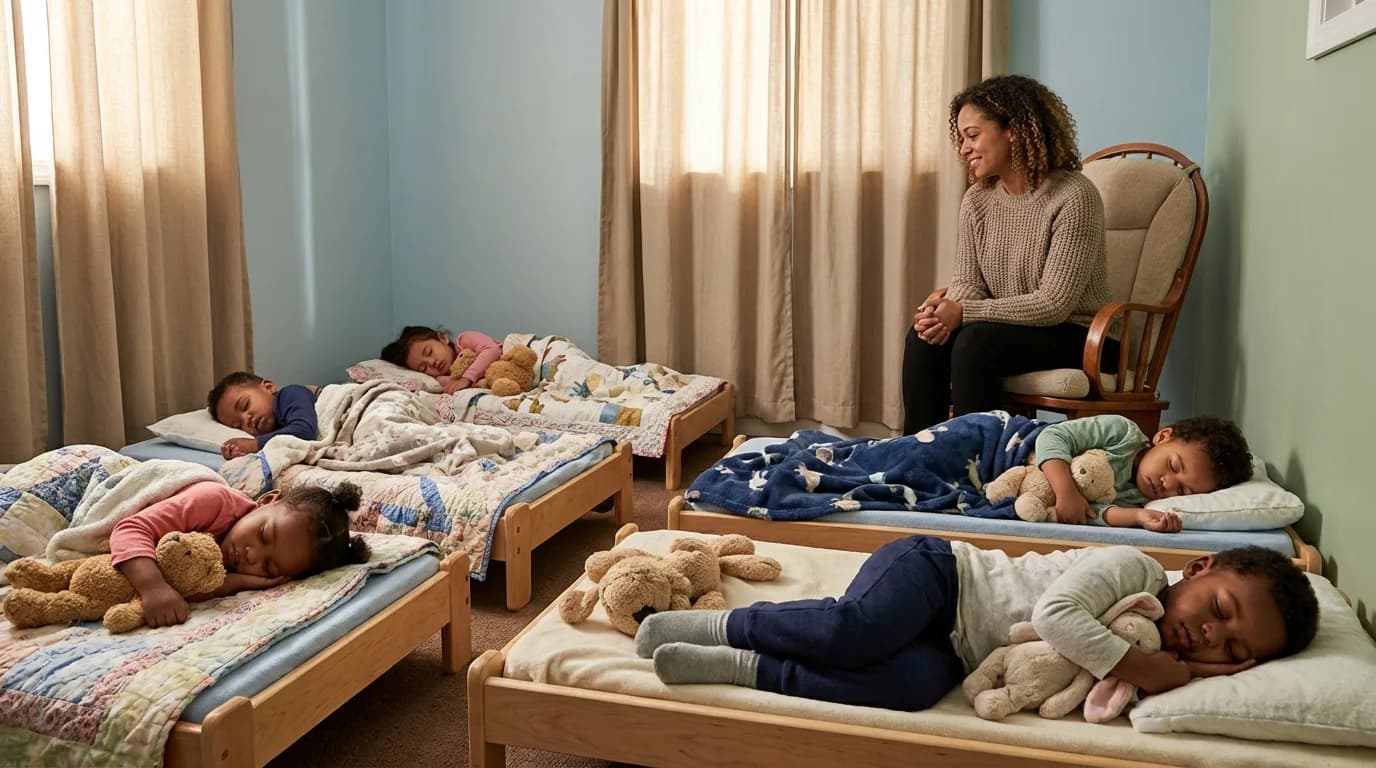
Your toddler's daily report says "nap: 1 hour 45 minutes" and you move on to the art project photo. But that hour and forty-five minutes may have been the most productive learning period of the entire day. Not despite the fact that your child was asleep, but because of it.
Parents tend to think of naptime as a break from learning. A pause between the morning circle time and the afternoon art center. The neuroscience says the opposite. Sleep is when the brain takes everything it absorbed during the morning, sorts through it, strengthens the important connections, and discards the noise. Without that process, much of what your child learned before lunch would fade by pickup time.
If your child attends daycare in Flatbush, Brooklyn or anywhere in the 11226 zip code, naptime is built into the schedule for a reason. Here is what the research says about why that rest period matters, what a good daycare nap routine looks like, and how to handle the common concerns parents raise about sleep at daycare.
The Science: What Happens in a Child's Brain During a Nap
In 2013, researchers at the University of Massachusetts Amherst published a landmark study in the Proceedings of the National Academy of Sciences that changed how early childhood educators think about naps. The study, led by Rebecca Spencer, tested preschool-aged children on a visual-spatial memory task, similar to a matching game. Children performed the task in the morning, then either napped or stayed awake during their usual nap window.
The results were striking. Children who napped retained 10% more of the information they had learned compared to children who stayed awake during the same period. When the researchers tested the children again the next morning, after a full night of sleep, the nap group still outperformed the no-nap group. A single night of sleep did not make up for the missed nap. The memory consolidation that happens during a daytime nap is not redundant with nighttime sleep. It does something different.
Spencer's team also measured brain activity during naps using polysomnography and found increased sleep spindle density, which are bursts of neural activity associated with memory consolidation, during the naps of children who showed the strongest recall. The napping brain is not idle. It is actively processing and filing information.
A follow-up study from the same lab, published in 2020, confirmed that the benefits extend beyond rote memory. Naps support what researchers call "generalization," the ability to apply what you learned in one context to a new situation. A child who learns that mixing red and yellow paint makes orange during the morning art session is more likely to predict that mixing red and blue will create a new color if they nap after the lesson. The nap helps the brain move from memorizing a specific fact to understanding a pattern.
This matters for every part of the daycare day. The social rules practiced during morning free play, the vocabulary introduced during story time, the counting patterns explored at the math center: all of it benefits from the consolidation that happens during rest.
How Much Sleep Do Young Children Actually Need?
The American Academy of Pediatrics endorses the sleep guidelines published by the American Academy of Sleep Medicine. Here is what they recommend for total sleep in a 24-hour period, including naps:
- Infants 4 to 12 months: 12 to 16 hours
- Toddlers 1 to 2 years: 11 to 14 hours
- Preschoolers 3 to 5 years: 10 to 13 hours
For toddlers, that typically means one nap of 1.5 to 3 hours during the day plus 10 to 12 hours overnight. For preschoolers, naps tend to shorten, and some children begin dropping their nap between ages 3 and 5. But "some" is not "most." The majority of three-year-olds still need a daytime nap. Many four-year-olds do too.
Children who consistently get less sleep than these ranges show measurable effects. The AAP links insufficient sleep in early childhood to problems with attention, behavior, emotional regulation, and learning. A 2017 review in the journal Sleep Medicine Reviews found that short sleep duration in preschoolers was associated with higher BMI, poorer emotional regulation, and lower cognitive performance. These are not subtle effects. They show up on standardized assessments.
The takeaway for parents: if your child's daycare schedule includes a nap period, it is not wasted time. It is part of the developmental program, whether anyone calls it that or not.
What a Good Daycare Nap Routine Looks Like
Not all rest time is created equal. A well-run nap routine at a daycare in Brooklyn should include consistent elements that help children transition from active play to rest. Here is what to look for.
A consistent schedule. Nap happens at the same time every day. The brain's circadian rhythm responds to predictability. When a child's body learns that rest follows lunch, the transition becomes smoother over time. At Einstein Daycare, the daily schedule follows a predictable rhythm that children can anticipate, which reduces resistance at nap time and supports the kind of structured daily routine research shows toddlers need.
A calm transition period. Good programs do not go from high-energy outdoor play directly to cots. There is a wind-down period: a quiet story, soft music, dimmed lights. This transition activates the parasympathetic nervous system and signals to the child's body that it is time to rest. Teachers who rush this step often find themselves spending more time settling children who were not given adequate time to shift gears.
A safe sleep environment. In New York City, Article 47 of the NYC Health Code sets specific requirements for rest time in licensed group childcare programs. Cots must be spaced appropriately, each child gets their own bedding, and the sleep area must be supervised at all times. Infants under 12 months follow separate safe sleep standards aligned with AAP guidelines: firm sleep surface, placed on their back, no loose blankets, pillows, or soft objects in the crib. These are not suggestions. They are conditions of licensure, and the NYC Department of Health inspects for compliance. If you want to understand how licensing and health and safety standards work at Brooklyn daycares, we have covered that in detail.
Individual flexibility. Not every child falls asleep during nap time, and a good program does not force it. Children who do not sleep are typically expected to rest quietly on their cots with a book or soft toy. The goal is physical rest and a break from stimulation, even if full sleep does not happen. Teachers who understand child development know that pressuring a child to sleep creates anxiety around rest, which makes future naps harder.
A gentle wake-up. Abruptly waking a room full of toddlers is a recipe for tears and disorientation. Strong programs allow children to wake naturally when possible and keep the post-nap transition slow: lights come up gradually, children are given time to sit and orient before moving into afternoon activities.
How Einstein Daycare Handles Rest Time
At Einstein Daycare on Lenox Road in Flatbush, naptime follows the same structure every day. After lunch and a brief wind-down period with quiet music or a read-aloud, children settle onto individual cots in a dimmed, calm space. Teachers remain in the room throughout the rest period, supervising and available for any child who needs reassurance.
For infants and young toddlers, our staff follows strict safe sleep practices aligned with both AAP recommendations and NYC Article 47 requirements. Cribs meet federal safety standards, infants are placed on their backs, and sleep surfaces are free of loose items.
Our Creative Curriculum framework recognizes rest as an integral part of the daily schedule, not an interruption of it. The curriculum's daily structure includes a balance of active and quiet periods designed to match the natural energy rhythms of young children. Teaching Strategies GOLD, the assessment tool paired with Creative Curriculum, tracks physical development milestones that include self-regulation and the ability to manage daily transitions, including settling for rest.
Children who do not fall asleep during the rest period are welcome to look at books or rest quietly. No child is punished or shamed for not sleeping. The goal is restoration, and that can happen without full sleep for children who are transitioning out of naps.
What to Do If Your Child Will Not Nap at Daycare
This is one of the most common concerns parents in Flatbush raise, and it comes in two versions: "My child naps fine at home but refuses at daycare" and "My child naps at daycare but then won't sleep at bedtime."
If your child resists napping at daycare: The most likely cause is the adjustment period. A child who is used to napping in their own crib, in a dark room, possibly while being rocked or held, is being asked to sleep on a cot in a room with fifteen other children. That is a significant environmental shift. For most children, this resolves within two to four weeks as they acclimate to the new routine. If your child is new to daycare, our guide on preparing your child for their first week addresses sleep adjustment alongside other transitions.
Strategies that help: send a small comfort item from home (a familiar blanket or lovey, if the program allows it), keep the home nap routine as consistent as possible on weekends, and avoid expressing anxiety about naptime in front of your child. Children are remarkably attuned to parental worry, and a casual "I heard you rested at school today, that's nice" carries less weight than you might think, but a panicked "Did you nap? You HAVE to nap!" creates pressure that works against sleep.
If your child naps at daycare but then fights bedtime: This usually means the daycare nap is pushing into the window needed for sleep pressure to build before bedtime. Sleep pressure is the biological drive to sleep that accumulates during waking hours. If a child naps until 3:00 p.m. and bedtime is 7:30 p.m., there may not be enough awake time for adequate sleep pressure.
The fix is usually adjusting bedtime slightly later rather than eliminating the nap. The AAP does not recommend cutting naps for preschoolers who still show signs of needing them: irritability in the late afternoon, falling asleep in the car on short rides, difficulty concentrating after lunch. These are signals that the nap is still serving a physiological purpose.
Talk to your child's teachers about the timing and duration of naps if bedtime is becoming a consistent struggle. Most programs can make minor adjustments, like waking a child after a set period rather than letting them sleep until they wake naturally.
When Children Transition Away from Naps
The transition from napping to not napping is not a single event. It is a gradual process that typically unfolds between ages 3 and 5. According to the National Sleep Foundation, about 94% of three-year-olds still nap, but by age five, that number drops to about 25%. The transition is biologically driven and varies significantly from child to child.
Signs that your child may be ready to drop the nap include: consistently taking 30 minutes or more to fall asleep at nap time, not showing signs of tiredness in the afternoon, and maintaining stable mood and behavior without a nap. If your child still crashes by 4:00 p.m. without a nap, they are not ready. Their body is telling you it still needs that midday reset.
During the transition period, many children alternate. They nap some days and skip other days. This is normal and not a sign of a problem. Daycares that require all children to sleep, rather than rest, during naptime can make this transition harder. A program that allows quiet rest for non-sleepers while still providing the opportunity to sleep gives children space to follow their own developmental timeline.
Spencer's research at UMass Amherst directly addressed whether naps become unnecessary at a certain age. Her team found that children who had fully transitioned away from naps showed no memory benefit from being asked to nap. But children who were still "habitual nappers," those whose bodies still prompted a midday sleep, showed significant learning deficits when their nap was skipped. The conclusion: let the child's biology lead. Do not force naps on children who no longer need them, and do not eliminate naps for children who still do.
Aligning Daycare Nap Schedules with Home Bedtimes
One of the biggest sources of friction for Brooklyn families is the disconnect between the daycare nap schedule and the home bedtime routine. Here is a practical framework for making them work together.
The AAP recommends that preschoolers get 10 to 13 hours of total sleep per day. If your child naps for 1.5 hours at daycare and needs 11 total hours, they need about 9.5 hours of nighttime sleep. If they wake at 6:30 a.m. for daycare, bedtime should be around 9:00 p.m. If you would prefer a 7:30 p.m. bedtime, you may need to coordinate with the daycare on nap length.
Most programs in Flatbush and across Brooklyn schedule nap time after lunch, roughly from 12:30 or 1:00 p.m. to 2:30 or 3:00 p.m. That window works well for the majority of children. If your child's nap extends past 3:00 p.m. and bedtime is suffering, ask the teachers to wake your child at the 90-minute mark. That preserves the sleep cycle benefit (one full sleep cycle for a preschooler is approximately 60 to 90 minutes) while leaving enough awake time before bed.
Consistency between daycare days and weekends matters. If your child naps at 1:00 p.m. at daycare Monday through Friday, try to keep a similar rest time on weekends, even if they do not always sleep. The circadian rhythm benefits from regularity. A child who naps at 1:00 p.m. on weekdays and 4:00 p.m. on weekends is fighting a constantly shifting internal clock.
Common Parent Concerns About Naptime at Daycare
"Is the nap room safe?" Licensed daycares in New York City are inspected by the Department of Health and Mental Hygiene, and safe sleep practices are a specific area of review. Cot spacing, supervision during rest, and infant sleep positioning are all covered under Article 47. Ask to see the nap area during your tour. A program that hesitates to show you where children sleep is a program you should question. For more on what NYC licensing requires, our guide to NYC daycare licensing covers the details.
"My child is too old for naps." Maybe. But the research suggests parents often assume this earlier than the biology supports. If your child is under five and showing afternoon irritability, difficulty focusing, or emotional meltdowns in the late afternoon, they likely still benefit from a nap, even a short one. The Spencer lab's work shows that habitual nappers who are denied naps perform measurably worse on learning tasks.
"Won't napping at daycare ruin nighttime sleep?" It depends entirely on timing and duration. A 90-minute nap ending by 2:30 p.m. rarely disrupts bedtime for children who wake at 6:00 or 7:00 a.m. A two-and-a-half-hour nap ending at 3:30 p.m. might. The solution is calibration, not elimination. Work with your child's teachers to find the right balance.
"The nap room seems too bright or too noisy." Raise this with the director. Good programs actively manage the nap environment: shades or curtains to reduce light, a white noise machine or soft music to mask outside sounds, and a clear expectation that the space is calm. If the nap room shares a wall with the gym or outdoor play area and nothing is done to buffer the noise, that is a facility management issue worth raising.
"My child comes home overtired even though they napped." This can happen when a child is sleeping during the nap period but not reaching restorative deep sleep. Shallow naps, often caused by noise, light, or anxiety, do not provide the same memory consolidation benefits as deeper sleep. If your child consistently seems unrested despite napping, it is worth discussing the nap environment and your child's behavior during rest time with the lead teacher.
Rest Is Part of the Curriculum
There is a reason that well-designed early childhood programs treat naptime with the same intentionality as circle time or outdoor play. Sleep is not a gap in the schedule. It is the period when the brain processes and strengthens everything it absorbed during the active hours. Skip it, and a meaningful portion of the day's learning fades.
The University of Massachusetts research, the AAP sleep guidelines, and the developmental science tracked by tools like Teaching Strategies GOLD all point to the same conclusion: young children who get adequate daytime rest learn more, regulate their emotions better, and show stronger cognitive development than those who do not.
For families in Flatbush, Brooklyn navigating the 11226 zip code and nearby neighborhoods along the B41 bus line or within reach of the Church Avenue stop on the B/Q, choosing a daycare that takes rest seriously is choosing a daycare that understands how learning works. The next time you read "nap: 1 hour 45 minutes" on the daily report, know that your child's brain was doing some of its most important work of the day.