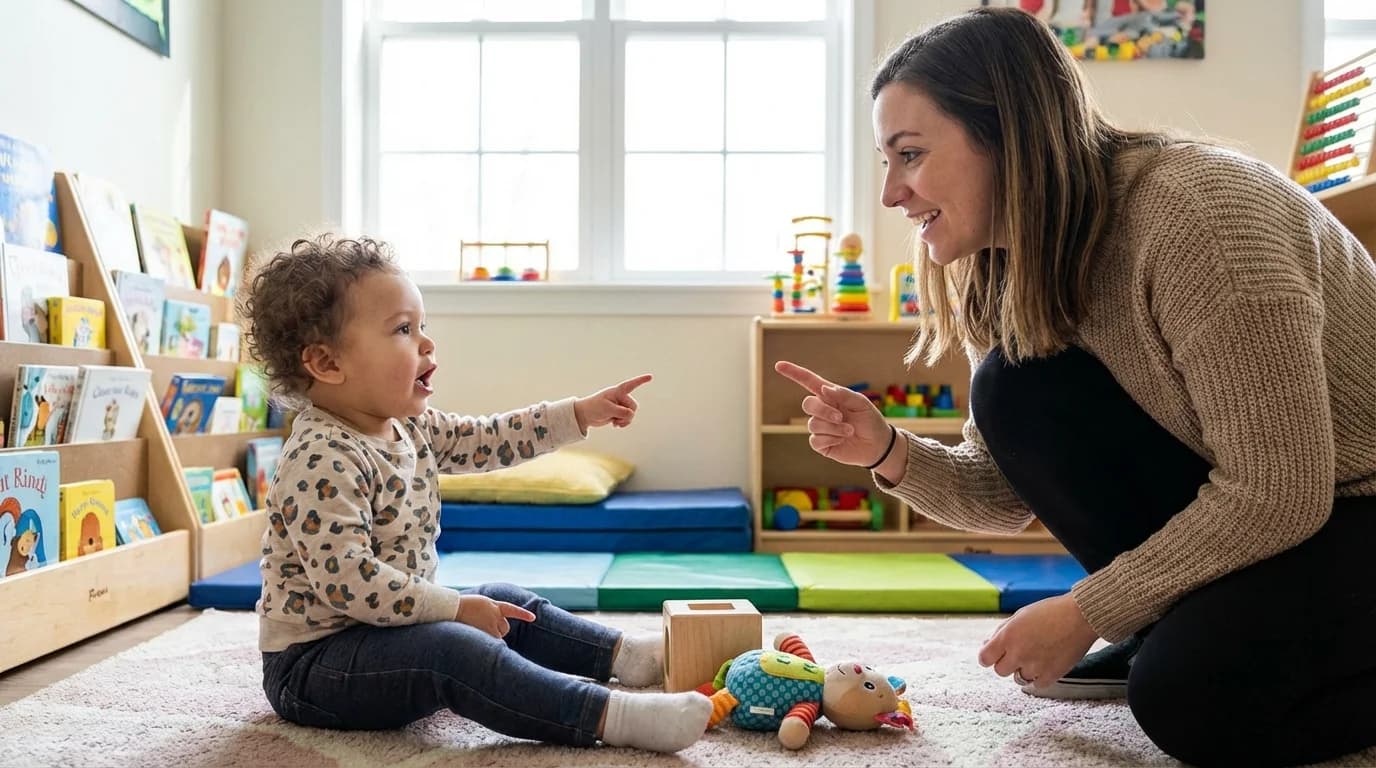
Few areas of child development generate as much parental pride -- and anxiety -- as language. The first word is celebrated and recorded. By age two, many parents find themselves quietly comparing their child's vocabulary to that of peers at the playground or in their Crown Heights playgroup. By three, questions begin to surface: Should she be speaking in full sentences by now? Is it normal that he still mixes up pronouns? Why does she talk nonstop at home but barely speak at daycare?
At Einstein Daycare, we work with families across Crown Heights, the 11213 area, and greater Brooklyn who have questions about their child's language development. Understanding what is typical at each age -- and recognizing the wide range of normal variation -- can help parents feel more confident and know when genuine concern is warranted.
Understanding Language: Receptive vs. Expressive
Before exploring specific milestones, it is important to understand that language development has two distinct dimensions. Receptive language refers to what a child understands -- their ability to comprehend words, follow directions, and process the language they hear. Expressive language refers to what a child produces -- the words they say, the sentences they form, and their ability to communicate their thoughts and needs.
According to the American Speech-Language-Hearing Association (ASHA), receptive language consistently develops ahead of expressive language. A twelve-month-old who says only one or two words may understand fifty or more. A two-year-old who speaks in two-word phrases may comprehend complex sentences with multiple steps. This gap between understanding and production is entirely normal and can sometimes mislead parents who focus only on the words their child says while overlooking the rich comprehension happening beneath the surface.
At Einstein Daycare, our teachers are trained to observe both receptive and expressive language. When a toddler follows a multi-step instruction like "get your cup and bring it to the table," that is a meaningful receptive language milestone, even if the child's spoken vocabulary is still limited.
Language Milestones: Ages 1 to 4
The ASHA communication milestones and the CDC's developmental milestones provide evidence-based timelines for what most children can do at each age. Remember that these represent the age by which approximately 75 percent of children demonstrate a particular skill. Some children reach milestones earlier, others later, and both can be within the range of typical development.
12 to 18 Months
Most children say their first recognizable word around twelve months, though some begin earlier and others a bit later. By eighteen months, many toddlers have a vocabulary of approximately ten to twenty words, though some may have more and others fewer. Receptive language at this stage is far richer: children can typically follow simple one-step directions ("give me the ball"), point to familiar objects or body parts when named, and understand "no." They may not say the words "shoe" and "dog" yet, but they look at those objects when you name them, demonstrating comprehension.
At this age, children also communicate extensively through gestures -- pointing, waving, shaking their head, and reaching. These gestures are not a substitute for words but an important bridge to verbal communication. The American Academy of Pediatrics notes that gesture use is actually a positive predictor of later language development.
18 to 24 Months
This period is often called the "language explosion." Many toddlers go from saying a handful of words to fifty or more within just a few months. By twenty-four months, most children are combining two words into simple phrases: "more milk," "daddy go," "big truck." They can follow two-step instructions ("pick up the block and put it in the box"), point to pictures in books when asked, and understand simple questions.
This is also the age when the variability among children becomes most apparent. Some two-year-olds are speaking in short sentences while others are still at the two-word phrase stage. The AAP reminds parents that there is tremendous variance in the age at which children begin to produce recognizable speech, and that this variability alone does not indicate a problem.
2 to 3 Years
Two-year-olds begin using three-word phrases and short sentences. They start using pronouns (I, me, you), though errors are common and normal ("me want cookie" instead of "I want a cookie"). They can follow more complex instructions and begin asking simple questions. Vocabulary grows rapidly, often reaching 200 to 300 words or more by age three. Strangers can typically understand about 50 to 75 percent of what a two-to-three-year-old says, with familiar adults understanding more.
This age also brings the emergence of early grammar. Children begin adding "-ing" to verbs (running, eating), using plurals (dogs, shoes), and experimenting with past tense, often with charming errors like "I goed" or "she runned." These mistakes are actually evidence of sophisticated language learning -- the child has internalized a grammatical rule and is applying it, even in cases where English has irregular forms.
3 to 4 Years
Three-year-olds speak in sentences of four to six words and can carry on simple conversations. They can tell short stories, describe recent experiences, and ask "why" and "how" questions with increasing frequency. Their speech is clear enough that strangers can understand most of what they say. By four, children use more complex sentences, understand concepts like "same" and "different," follow multi-step directions, and can retell a familiar story with some accuracy. The AAP's milestone guide for 3- to 4-year-olds notes that by this age, children should be able to say their first name, understand the concept of counting, and engage in fantasy play.
How a Language-Rich Daycare Environment Supports Development
Research consistently shows that the quantity and quality of language exposure in early childhood is one of the strongest predictors of later language ability, reading comprehension, and academic success. At Einstein Daycare, we create what early childhood educators call a "language-rich environment" -- a setting where children are immersed in meaningful conversation, storytelling, songs, and vocabulary throughout the day.
Our teachers narrate activities as they happen ("You are pouring the water into the blue cup"), ask open-ended questions ("What do you think will happen if we add more blocks?"), and expand on children's language ("You said 'big truck.' Yes, that is a very big red fire truck"). This technique, sometimes called "serve and return" interaction, helps children build vocabulary, learn sentence structure, and develop conversational skills in a natural, engaging context.
Our approach through The Creative Curriculum intentionally integrates language development into every learning center. In the dramatic play area, children practice conversational exchanges as they role-play. In the book corner, teachers read aloud and encourage discussion about stories. At the art table, children describe their creations and learn new descriptive vocabulary. Our focus on early literacy and reading readiness ensures that language development is woven into the fabric of every day.
Bilingual and Multilingual Language Development
Crown Heights and the surrounding Brooklyn neighborhoods are among the most linguistically diverse communities in the world. Many families at Einstein Daycare speak Haitian Creole, Spanish, Yiddish, Russian, Chinese, or other languages at home while their children learn English at daycare. This bilingual or multilingual development is a tremendous cognitive advantage, but it also generates questions and, sometimes, unnecessary worry.
The American Academy of Pediatrics addresses several persistent myths about bilingual language development. One of the most common is the belief that exposure to two languages causes language delays. Research does not support this. Bilingual children reach language milestones -- babbling, first words, first phrases -- on the same timeline as monolingual children. They may have a smaller vocabulary in each individual language compared to a monolingual peer, but their total vocabulary across both languages is typically equal to or greater than that of monolingual children.
Another common concern is code-switching -- when a child mixes words from two languages in a single sentence. This is not a sign of confusion. It is a sophisticated linguistic skill that demonstrates the child's ability to draw on both language systems to communicate effectively. By age three, most bilingual children can distinguish between their languages and adjust based on whom they are speaking with. For a deeper exploration of this topic, we encourage families to read our article on supporting bilingual children at daycare.
When Language Development Warrants Evaluation
While the range of typical language development is wide, there are certain patterns that merit professional evaluation. ASHA recommends that parents consider seeking an evaluation if their child shows any of the following patterns:
By 12 months: not babbling, not using gestures like pointing or waving, not responding to their name. By 18 months: not using at least a few single words, not understanding simple instructions. By 24 months: not combining two words into phrases, using fewer than 50 words, not following simple two-step instructions. By 36 months: speech is largely unintelligible to unfamiliar listeners, not using three-word sentences, not able to follow two-step instructions without gestures.
It is important to note that meeting most milestones while missing one does not necessarily indicate a problem. But if a child is not meeting several milestones, is not progressing, or appears to be losing previously acquired skills, an evaluation is warranted.
NYC Early Intervention and Evaluation Resources
For children under three years of age, New York City's Early Intervention Program provides free developmental evaluations and, when appropriate, free therapeutic services including speech-language therapy. The program is available to all families regardless of income or immigration status. Families can make a referral by calling 311 and asking for Early Intervention.
For children aged three to five, the New York City Department of Education's Committee on Preschool Special Education (CPSE) provides evaluations and services. Parents can request an evaluation by contacting their local CPSE office directly.
At Einstein Daycare, we support families through this process. Our teachers observe language development closely using Teaching Strategies GOLD assessments, and we share detailed observations with families and, with parental consent, with evaluating professionals. Early identification and support for language delays produces significantly better outcomes than waiting, so we encourage families to seek evaluation whenever they have concerns rather than adopting a "wait and see" approach.
Supporting Language Development at Home
The most effective language support happens through natural, daily interactions. Talk to your child throughout the day, narrating your activities as you cook, shop, or walk through the neighborhood. Read together every day, even if it is just for five or ten minutes. Ask questions that require more than a yes-or-no answer: "What happened at the park today?" rather than "Did you have fun at the park?" Resist the urge to correct grammar directly. Instead, model the correct form: when your child says "I goed to the store," respond with "You went to the store? What did you buy?"
The Zero to Three organization emphasizes that responsive, back-and-forth conversation is the single most powerful driver of language development in young children. This means that a five-minute engaged conversation with your toddler is more valuable for language growth than an hour of passive exposure to television or other audio.
Language development between ages one and four is one of the most remarkable transformations in all of human development. From a baby's first babbled syllable to a four-year-old's detailed account of their day, the journey is astonishing. At Einstein Daycare, serving families throughout Crown Heights, East Flatbush, and the broader Brooklyn community, we are privileged to be part of this journey every day, providing the language-rich environment and expert attention that help every child find their voice.
Learn how our language-rich environment supports your child's communication development. Schedule a tour of Einstein Daycare at 900 Lenox Rd, Brooklyn, NY 11203 to see our classrooms in action. Request a tour online or call us at (718) 618-7330.