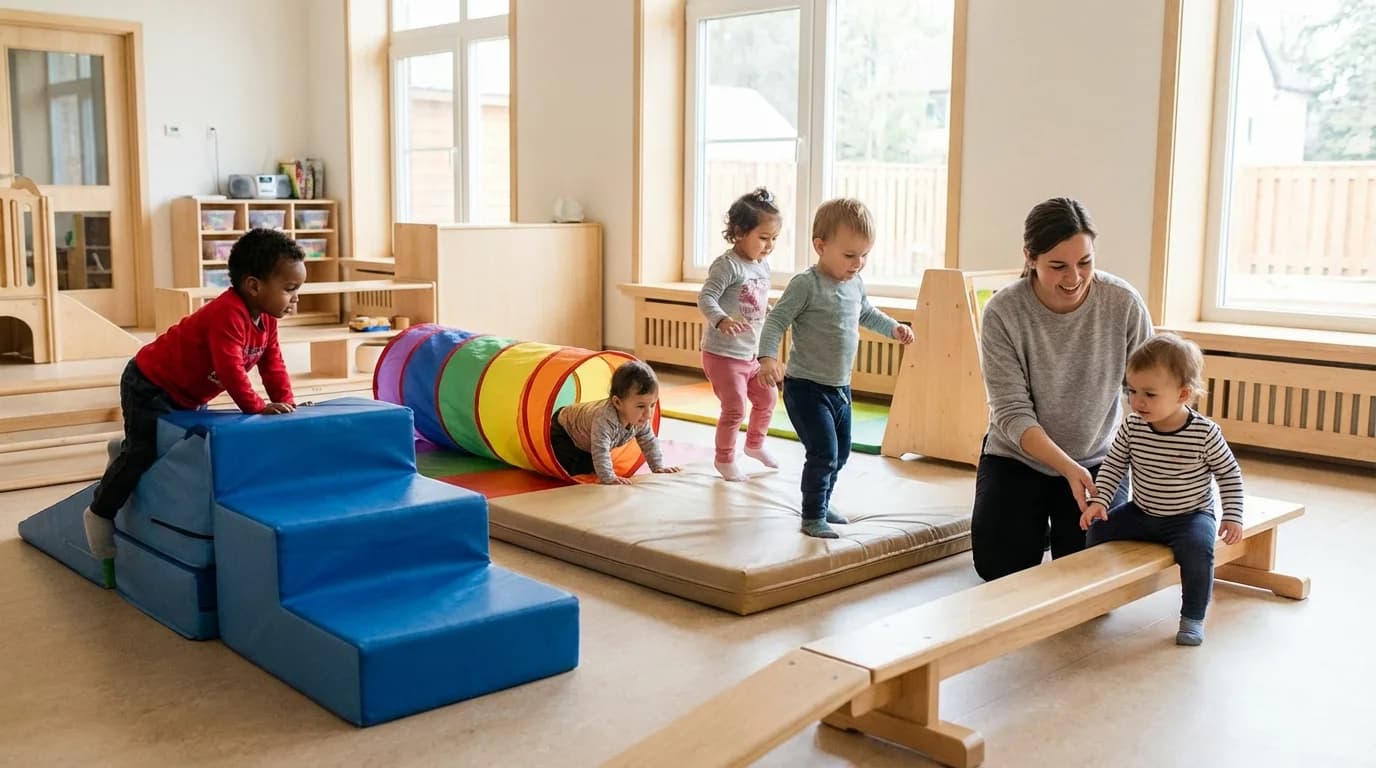
Watching your child take their first steps is one of parenting's great milestones. But gross motor development, the ability to use large muscle groups for movements like crawling, walking, running, jumping, and climbing, encompasses so much more than that iconic first step. From the moment your baby lifts their head during tummy time to the day your preschooler pedals a tricycle around the block in Canarsie, gross motor skills are developing continuously, and they are connected to nearly every other area of your child's growth.
For Brooklyn parents, understanding gross motor milestones serves two important purposes. First, it helps you appreciate and support your child's physical development at every stage. Second, it helps you recognize when development may be delayed so you can access resources, like NYC's excellent Early Intervention Program, as early as possible. This guide walks you through what to expect from birth to age five, how quality daycare programs support gross motor development, and what to do if you have concerns.
What Are Gross Motor Skills and Why Do They Matter?
Gross motor skills involve the large muscles of the body, including those in the arms, legs, torso, and feet. They are the foundation for nearly everything your child does physically: sitting, standing, walking, running, jumping, throwing, catching, climbing, and dancing. But their importance extends far beyond physical activity.
According to Zero to Three's research on physical development and learning, gross motor development is deeply connected to cognitive development, social-emotional growth, and even language acquisition. A child who can move confidently through space is better able to explore their environment, interact with peers, and engage in the kinds of play that build thinking skills.
The National Association for the Education of Young Children (NAEYC) emphasizes that motor development is not a separate domain to be addressed in isolation. It is woven into every aspect of early childhood learning. When a toddler builds a block tower, they are using gross motor stability to sit upright, fine motor control to place each block, cognitive skills to plan the structure, and social skills if they are building with a friend.
Gross Motor Milestones by Age: The CDC Timeline
The CDC's "Learn the Signs. Act Early." program provides evidence-based developmental milestones that represent what 75 percent or more of children can do by a given age. Here is a focused look at the gross motor milestones from birth through age five.
Birth to 4 Months
- Lifts head when lying on stomach (tummy time)
- Pushes up on arms when lying on stomach
- Moves both arms and both legs
- Opens hands briefly
At this stage, tummy time is critical. The American Academy of Pediatrics recommends supervised tummy time from the very first days of life, starting with short periods and gradually increasing as your baby builds strength. This foundational work builds the neck, shoulder, and core muscles that support every subsequent milestone.
6 to 9 Months
- Rolls from stomach to back and back to stomach
- Sits without support
- Pushes up to a crawling position
- Begins to pull to standing position
12 Months
- Pulls up to stand and cruises along furniture
- May take first independent steps
- Sits down without help
The CDC's one-year milestone checklist notes that the range for first steps is wide. Some babies walk at nine months; others do not walk independently until 15 or 16 months. Both are within normal range.
18 Months
- Walks independently
- Begins to run
- Climbs on and off furniture without help
- Walks up steps with help
- Carries toys while walking
2 Years
- Kicks a ball
- Begins to run
- Walks up a few stairs with or without help
- Climbs on and off furniture easily
According to the CDC's two-year milestone checklist, this is an age of growing physical confidence. Two-year-olds are movers, and their energy can feel relentless to parents. But all that movement is essential developmental work.
3 Years
- Runs well without falling frequently
- Pedals a tricycle
- Climbs stairs with alternating feet
- Jumps with both feet off the ground
4 Years
- Hops on one foot
- Catches a large ball most of the time
- Pours liquid, cuts with supervision, and mashes own food
- Walks up and down stairs independently, alternating feet
The CDC's four-year milestone page shows significant refinement in coordination and balance at this age. Four-year-olds are developing the physical skills they will need for kindergarten activities, from sitting at a desk to participating in physical education.
5 Years
- Stands on one foot for ten seconds or longer
- Hops and skips
- Can do somersaults
- Swings and climbs on playground equipment
- May be able to skip
How Quality Daycare Supports Gross Motor Development
A quality daycare program does not just provide a safe place for your child to be while you work. It actively supports gross motor development through intentional programming, thoughtful environments, and trained educators who understand the connection between movement and learning.
Structured Outdoor Play
Daily outdoor time is essential for gross motor development, and the AAP recommends that toddlers get at least three hours of physical activity daily, which includes both structured and unstructured movement. At Einstein Daycare, outdoor play is a non-negotiable part of every day, weather permitting. Our outdoor space includes age-appropriate climbing structures, open areas for running, and materials for activities like ball play, obstacle courses, and group games.
Outdoor play offers something indoor spaces cannot: uneven terrain, natural obstacles, and open-ended physical challenges that require children to adapt their movements. Walking on grass versus concrete, climbing over a log, or navigating a gentle slope all build proprioception, the body's sense of where it is in space, which is foundational to gross motor competence. We explore these benefits in depth in our article about outdoor play and kindergarten readiness.
Yoga and Mindful Movement
One of the unique features of our program at Einstein Daycare is our yoga program for young children. Yoga builds core strength, balance, coordination, and body awareness, all of which are critical components of gross motor development. The NAEYC highlights that yoga for young children combines slow, intentional breathing with adapted poses that strengthen muscles and improve flexibility while also supporting self-regulation and focus.
Poses like tree pose build single-leg balance. Downward dog strengthens shoulders and core. Cobra builds back extension. And the practice of holding a pose, even briefly, develops the body awareness and motor planning skills that children need for more complex physical tasks.
Music and Dance
Our music program is another vehicle for gross motor development. Dancing, marching, clapping to a beat, and playing simple percussion instruments all require coordination, rhythm, and whole-body movement. Research shows that rhythmic activities help children develop bilateral coordination, the ability to use both sides of the body together, which is essential for later skills like running, skipping, and even writing.
Obstacle Courses and Movement Activities
Our teachers regularly set up indoor and outdoor obstacle courses tailored to each age group's developmental level. For toddlers, this might mean crawling through a tunnel, stepping over pool noodles, and tossing a beanbag into a basket. For preschoolers, courses become more complex: hopping on one foot, balancing on a beam, crawling under a table, and catching a ball. These activities build strength, coordination, motor planning, and sequencing skills in a playful context.
Centers-Based Learning and Movement
Even in the classroom, gross motor development happens throughout the day. Our centers-based environment, aligned with the Creative Curriculum framework, includes a gross motor center with materials for climbing, balancing, and active play. The block center requires children to reach, lift, stack, and carry, all gross motor activities. The dramatic play area involves whole-body movement as children act out roles. As we discuss in our article on block play and STEM learning, even something as simple as building with blocks involves significant physical coordination alongside cognitive development.
The Movement-Cognition Connection
One of the most important findings in early childhood development research is the strong link between physical movement and cognitive growth. This is not just correlation. Movement physically changes the developing brain.
According to Zero to Three's research on movement and early development, physical activity increases blood flow to the brain, supports the growth of new neural connections, and strengthens the cerebellum, a brain region involved in both motor coordination and cognitive functions like attention, language processing, and problem-solving.
Here is what this means practically:
- Children who move more learn more. Studies consistently find that children with strong gross motor skills perform better on cognitive tasks, including language and math assessments.
- Movement supports self-regulation. The physical control required to balance, climb, or throw a ball translates into better impulse control and emotional regulation. A child who can control their body is developing the neural pathways needed to control their behavior.
- Active play builds executive function. Games like "Red Light, Green Light" or "Simon Says" require children to listen, process instructions, inhibit impulses, and execute physical responses, all core executive function skills that predict school success.
- Spatial awareness from movement supports math. Children who navigate space through climbing, running, and building develop spatial reasoning skills that are directly linked to mathematical thinking.
This is why at Einstein Daycare, rest and activity work hand in hand. Our article on how naptime supports learning explores the other side of this equation, how adequate rest allows the brain to consolidate the physical and cognitive learning that happens during active play.
When to Be Concerned: Recognizing Delays
It is important to remember that developmental milestones are guidelines, not deadlines. Children develop at different rates, and there is a wide range of normal. A baby who walks at ten months is not "ahead" of a baby who walks at fourteen months. Both are within the expected range.
However, there are signs that may indicate a gross motor delay that warrants further evaluation:
- Your child is consistently not meeting milestones for their age by the CDC timeline
- Your child has lost skills they previously had (regression)
- Your child has significant asymmetry in their movement, such as consistently using only one hand or favoring one leg
- Your child seems unusually stiff or unusually floppy in their movements
- Your child avoids physical activity or seems fearful of movement that peers enjoy
- Your child falls much more frequently than peers of the same age
The CDC's free Milestone Tracker app is an excellent tool for keeping track of your child's development. It provides illustrated checklists, tips, and the ability to share your tracking information with your child's pediatrician.
NYC Early Intervention: A Free Resource for Brooklyn Families
If you have concerns about your child's gross motor development, or any area of development, and your child is under three years old, New York City offers one of the best Early Intervention programs in the country.
The NYC Early Intervention Program provides free evaluation and services for infants and toddlers with suspected or confirmed developmental delays. Here is what Canarsie and Brooklyn parents need to know:
- It is completely free. Services are provided at no cost to families, regardless of income, immigration status, or insurance coverage.
- Anyone can make a referral. You do not need a doctor's order. Parents, grandparents, daycare providers, or anyone who suspects a delay can call 311 and ask for the Early Intervention Program to initiate an evaluation.
- Evaluation is comprehensive. A team of specialists will assess your child across all developmental domains, not just the area of concern.
- Services come to you. If your child qualifies, services like physical therapy, occupational therapy, and developmental instruction can be provided in your home, at your child's daycare, or in a center-based setting.
- Early is better. Research overwhelmingly shows that early intervention leads to better outcomes. If you are wondering whether to wait and see or to call, call. There is no downside to an evaluation, and the upside can be significant.
For children ages three through five who may have developmental delays, the NYC Department of Health provides transition resources to connect families with the Committee on Preschool Special Education (CPSE) for continued evaluation and services through the Department of Education.
Supporting Gross Motor Development at Home
You do not need special equipment or a gym to support your child's gross motor development at home and around your Canarsie neighborhood. Here are practical, free ways to encourage movement every day.
For Babies (0 to 12 Months)
- Provide plenty of supervised tummy time on a clean floor or blanket
- Place interesting toys just out of reach to encourage reaching and rolling
- Let your baby practice sitting with support, gradually reducing the support
- Provide safe surfaces and furniture for pulling up
For Toddlers (1 to 3 Years)
- Visit Canarsie Park or Seaview Park regularly for outdoor play on varied terrain
- Play ball games: rolling, throwing, kicking, and eventually catching
- Dance to music at home, encouraging jumping, spinning, and marching
- Create simple indoor obstacle courses using couch cushions, pillows, and blankets
- Walk to the store instead of driving when possible, letting your toddler walk or push a small cart
For Preschoolers (3 to 5 Years)
- Practice hopping, skipping, and galloping on sidewalks and in parks
- Ride tricycles or balance bikes along the paths at Canarsie Park
- Play "follow the leader" with different movement patterns
- Practice catching and throwing with balls of different sizes
- Try simple yoga poses together at home (tree pose, warrior pose, downward dog)
- Visit local playgrounds with climbing structures appropriate for their age
Brooklyn Parks and Spaces for Gross Motor Play
Canarsie and surrounding Brooklyn neighborhoods offer excellent free spaces for active play. Here are some favorites among local families:
- Canarsie Park: Large open spaces, playground equipment, and nature paths
- Paerdegat Park: Play structures and open fields for running and ball play
- Seaview Park: Varied terrain and open spaces perfect for toddler exploration
- Fresh Creek Nature Preserve: Nature trails that offer uneven terrain for developing balance and coordination
Regular visits to these spaces give your child varied physical challenges that indoor environments cannot replicate. The combination of structured movement at daycare and unstructured outdoor play on weekends creates a comprehensive approach to gross motor development.
The Bottom Line
Gross motor development is not just about physical milestones. It is the foundation for learning, social connection, emotional regulation, and lifelong health. By understanding the milestone timeline, choosing a daycare that prioritizes physical development, and creating opportunities for movement at home and in your community, you are giving your child the strong physical foundation they need to thrive.
And if you ever have concerns about your child's development, do not wait. Brooklyn families have access to excellent resources, from your pediatrician to the NYC Early Intervention Program, and seeking support early is always the right call.
Active Bodies, Active Minds at Einstein Daycare
At Einstein Daycare, gross motor development is woven into every part of our day, from structured yoga sessions and music-and-movement activities to outdoor play and our centers-based classroom environment. We use the Teaching Strategies GOLD assessment system to track every child's physical development and share progress with families. Visit us at 900 Lenox Rd to see how we help Brooklyn children build strong bodies and strong minds.
Schedule a Tour or call us at (718) 618-7330.