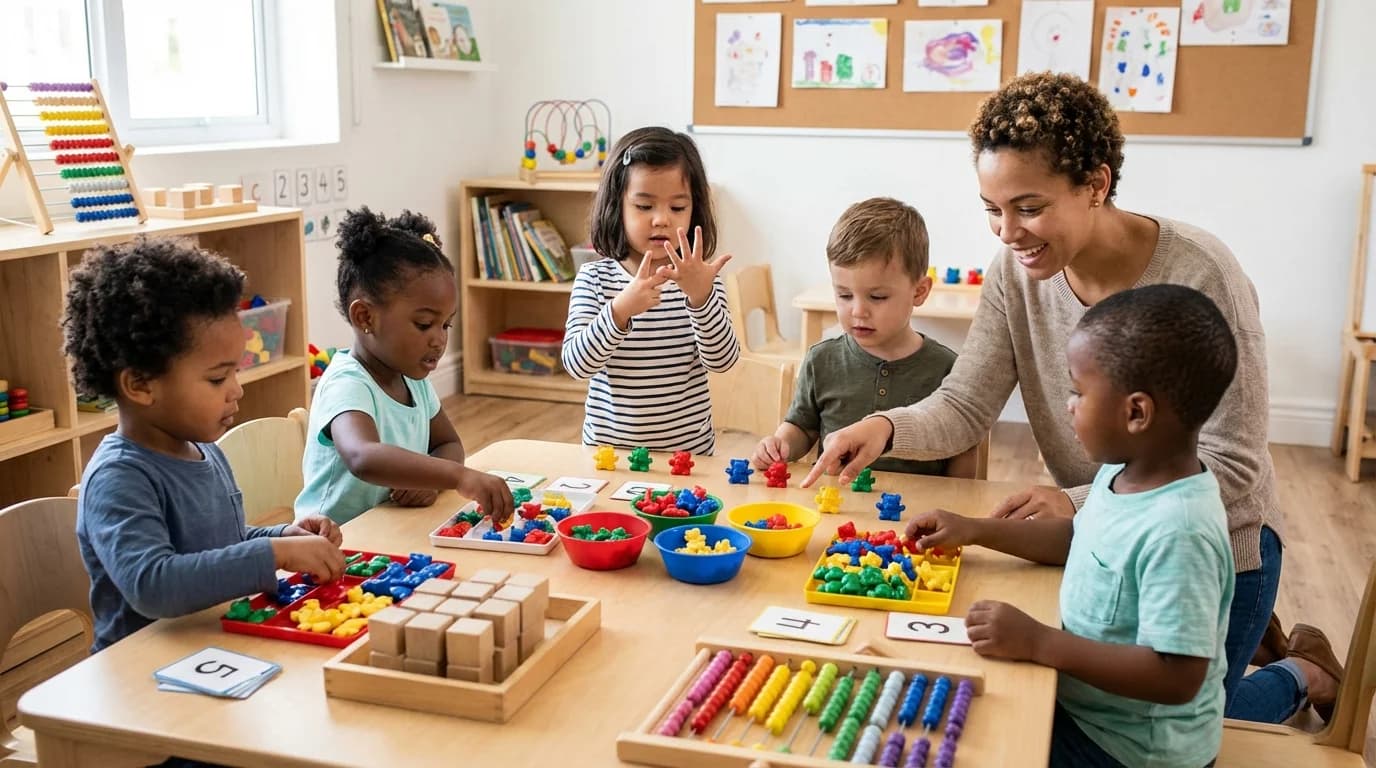
When most parents think about what their child learns at daycare, math is rarely the first thing that comes to mind. Images of story time, outdoor play, and art projects tend to dominate the picture. Yet some of the most important mathematical learning of a child's entire life is happening during the daycare and preschool years, woven so seamlessly into daily routines and play that it often goes unnoticed. Counting the steps on the way to the playground, sorting crayons back into their containers by color, noticing that the pattern on a friend's shirt goes red-blue-red-blue: these are not random moments of childhood curiosity. They are the building blocks of mathematical thinking, and research tells us they matter enormously.
For families in Flatbush, Ditmas Park, and the surrounding 11210 neighborhoods of Brooklyn, understanding the math learning happening at daycare can deepen appreciation for the early childhood years and help parents reinforce these concepts at home. At Einstein Daycare, located at 900 Lenox Rd in Brooklyn, mathematics is not a separate subject taught in isolation. It is integrated into every part of the day through our Creative Curriculum framework, which uses intentional, play-based strategies to develop the mathematical thinking that children will carry with them into kindergarten and beyond.
Why Early Math Matters More Than You Think
One of the most significant findings in educational research over the past two decades is that early math skills are the single strongest predictor of later academic achievement, outperforming even early reading skills. A landmark study that followed four-year-olds through elementary school found that preschool math knowledge, specifically in areas like counting, quantity comparison, and pattern recognition, predicted mathematics achievement in fifth grade. Even more remarkably, the NAEYC reports that a longitudinal study found children's understanding of math concepts at school entry were the strongest predictors of overall achievement, even stronger than literacy skills.
This finding has profound implications for how we think about early childhood education. It means that the counting, sorting, and pattern-making activities happening in your child's daycare classroom are not just enrichment. They are foundational experiences that set the trajectory for academic success across all subjects. The Zero to Three organization emphasizes that math skills are built through daily routines and informal activities, and that these experiences give children a critical jumpstart on the formal math instruction they will encounter in school.
Core Math Concepts at Daycare
Counting and Number Sense
Number sense, the intuitive understanding of what numbers mean and how they relate to each other, is the cornerstone of all mathematical learning. At daycare, number sense develops through countless daily interactions. Children count how many friends are at the table, how many crackers are on their plate, how many blocks they stacked before the tower fell. They begin to understand that the last number they say when counting a group of objects tells them how many there are, a concept mathematicians call cardinality.
Zero to Three notes that learning starts in the early years through everyday "math play" and by hearing and using math language. At Einstein Daycare, teachers are intentional about using math language throughout the day, asking questions like "How many cups do we need?" or "Do we have enough napkins for everyone?" These are not quiz questions. They are genuine invitations to think mathematically in a context that matters to the child.
Counting errors are normal and expected in the early years. A toddler might skip numbers, count an object twice, or say numbers out of order. These errors are part of the learning process, and skilled teachers respond by gently modeling correct counting without making the child feel they have failed. The Zero to Three Math4Littles program emphasizes that the goal is having fun, and adults should avoid making a big deal about mistakes, simply providing the correct information and moving on.
Sorting and Classification
Sorting is one of the earliest and most natural mathematical activities for young children. Long before they understand numbers, children begin to notice similarities and differences among objects and group them accordingly. At daycare, sorting happens everywhere: putting red blocks in one bin and blue blocks in another, separating large buttons from small buttons, grouping animal figures by type, or organizing leaves collected on a nature walk by shape.
Sorting is more than an organizational skill. It is the foundation of logical thinking. When a child decides that two objects belong together and a third one does not, they are making a classification judgment that requires observation, comparison, and reasoning. These are the same cognitive processes that underlie more advanced mathematical concepts like data analysis and algebra. Our article on block play and STEM learning explores how hands-on activities like these contribute to mathematical and scientific thinking.
Patterns and Algebraic Thinking
Patterns are the language of mathematics. The ability to recognize, extend, and create patterns is a precursor to algebraic thinking, and it begins developing in the toddler and preschool years. At daycare, children encounter patterns in songs and chants, in the daily schedule, in art activities where they alternate colors or shapes, and in movement games where they clap-stomp-clap-stomp.
The NAEYC emphasizes that making math meaningful for young children involves connecting mathematical concepts to their everyday experiences. Pattern work does this naturally. When a child strings beads in an AB pattern (red-blue-red-blue), they are not just making a pretty necklace. They are learning to identify a rule, predict what comes next, and verify their prediction, the same cycle of hypothesis and testing that drives all scientific and mathematical inquiry.
Shapes and Spatial Reasoning
Geometry begins long before children learn the formal names for shapes. It starts with exploring the physical world: noticing that a ball rolls but a block does not, that a puzzle piece fits only one way, that the door is a rectangle and the clock is a circle. At Einstein Daycare, shape learning is embedded in block play, art activities, outdoor exploration, and classroom conversations.
Spatial reasoning, the ability to visualize and mentally manipulate shapes and spaces, is increasingly recognized as a critical mathematical skill. Children develop spatial reasoning when they build with blocks, complete puzzles, draw, and navigate their environment. The Teaching Strategies GOLD assessment system includes specific objectives for spatial relationships and shapes (Objective 21), tracking children's growing ability to explore and describe spatial relationships and geometric forms. This allows our teachers to ensure that every child receives the support and challenge they need in this area.
Measurement and Comparison
Young children are natural comparers. They want to know who has more, whose tower is taller, whether the play dough snake is longer than the table. These observations are the beginnings of measurement, a mathematical domain that connects directly to science, engineering, and everyday problem-solving.
At daycare, measurement concepts develop through hands-on experiences: filling and emptying containers at the water table to explore volume, comparing the lengths of two jump ropes, discovering that three small blocks are as tall as one big block. Children learn measurement vocabulary like more, less, longer, shorter, heavier, lighter, and full and empty, and they begin to use nonstandard units (like their own footsteps) to measure distances. These concrete experiences create the conceptual foundation for the standard measurement systems they will learn in elementary school.
How Creative Curriculum Integrates Math
At Einstein Daycare, our use of the Creative Curriculum for Preschool provides a research-based framework for integrating mathematics into every part of the day. The curriculum emphasizes that young children need daily opportunities to manipulate, draw, compare, describe, sort, and explore mathematics concepts in a variety of ways, with the physical environment and materials being vital to concept development.
The Creative Curriculum approach to math includes both child-initiated exploration and teacher-directed activities. During free play, children naturally engage with mathematical concepts as they build, sort, count, and create patterns. During small-group and large-group times, teachers introduce specific mathematical concepts through playful, engaging activities that build on children's interests and developmental levels. The Teaching Strategies research confirms that skill development in this framework is sequential and scaffolded, with skills building on each other over time.
What makes this approach particularly effective is that mathematics is not isolated as a separate "lesson." Instead, math concepts arise naturally during block time, meal preparation, outdoor play, art activities, music, and transitions. When a teacher asks children to figure out how many more cups they need at snack time, or invites them to compare the length of shadows on the playground, they are creating authentic mathematical experiences that feel meaningful to children rather than abstract. To learn more about how this curriculum works in practice, see our article on what Creative Curriculum looks like at Einstein Daycare.
Teaching Strategies GOLD and Math Assessment
Tracking mathematical development is essential to ensuring that every child is making progress and receiving appropriate support. Einstein Daycare uses the Teaching Strategies GOLD assessment system, which includes twelve mathematics items across key objectives including number concepts and operations (Objective 20), spatial relationships and shapes (Objective 21), and classification skills (Objective 13).
GOLD uses color-coded progressions that guide teachers toward selecting and adapting activities to support each child's individual development. Teachers collect ongoing evidence of children's mathematical thinking through observation, work samples, and documented conversations, then use this information to inform instruction and communicate with families. This means that when your child's teacher tells you at a parent conference that your child is working on one-to-one correspondence or beginning to recognize patterns, that assessment is based on systematic observation and aligned with research-based developmental expectations.
Math Is Everywhere: Daily Opportunities at Daycare
One of the most important messages for Brooklyn parents is that math at daycare is not about worksheets, flashcards, or rote memorization. The NAEYC stresses that playful math equals engaged learning, and that children who have access to playful math activities in their early education settings thrive as they discover math concepts through age-appropriate experiences.
Here are just a few of the ways math shows up naturally throughout a day at Einstein Daycare.
During arrival, children count how many friends are in the classroom and compare that to how many chairs they need. At snack time, they practice one-to-one correspondence by passing out napkins so each person gets exactly one. During block play, they explore geometry, measurement, balance, and spatial reasoning. During outdoor time, they count jumps, compare heights, and notice shapes in the environment. At circle time, they clap rhythmic patterns, count the days of the week, and sort objects by attribute. During cleanup, they classify materials by type and return them to labeled shelves. Each of these moments is a genuine mathematical experience embedded in a context that makes sense to children.
How Parents Can Support Early Math at Home
Research from Zero to Three shows that the more young toddlers are exposed to mathematical language by their parents, the better their vocabulary and some of their early math skills in preschool. This means that one of the most powerful things Flatbush and Brooklyn parents can do is simply talk about math during everyday moments.
Count steps as you walk up to your apartment. Ask your child to help set the table by figuring out how many forks are needed. Sort laundry together by color. Notice patterns on the sidewalk or in fabric at the store. Compare sizes at the grocery store by asking which apple is bigger. Measure ingredients together when cooking. Play board games that involve counting, like Chutes and Ladders. These are not "math lessons." They are natural conversations that build the mathematical language and concepts your child needs.
It is equally important to maintain a positive attitude about math. Research suggests that math anxiety can be transmitted from parents to children, even at very young ages. If you catch yourself saying "I was never good at math," consider reframing: "Math is something we can all learn, and it is fun to figure things out." Your child is watching and absorbing your attitude toward mathematics just as they absorb your attitude toward reading.
Preparing for Kindergarten Through Mathematical Play
When it comes to kindergarten readiness, the mathematical skills developed at daycare play a critical role. Children who enter kindergarten with a strong foundation in counting, number sense, spatial reasoning, patterns, and measurement are better prepared for the math curriculum they will encounter. But the benefits extend beyond mathematics itself. The NAEYC points out that early math experiences help build a strong foundation that prepares children for success across all academic areas. For a broader look at how play-based learning connects to school readiness, see our article on pre-K readiness through play-based learning.
The logical thinking, problem-solving abilities, and persistence that children develop through mathematical play transfer to every area of learning. A child who has learned to try different approaches when a block tower keeps falling is developing the same resilience they will need when a reading passage is difficult. A child who can identify and extend a pattern is exercising the same analytical thinking they will use in science.
At Einstein Daycare, we are committed to providing the rich, play-based mathematical experiences that research shows make a lasting difference. Our combination of the Creative Curriculum framework, Teaching Strategies GOLD assessment, and intentional teacher practices ensures that every child in our care develops the mathematical foundation they need to thrive, not just in kindergarten, but throughout their educational journey.
Discover How We Build Mathematical Thinkers at Einstein Daycare
From counting games to pattern play to block building, every day at Einstein Daycare is filled with meaningful mathematical learning. Schedule a tour at 900 Lenox Rd, Brooklyn, NY 11203 to see how we prepare children for kindergarten and beyond.
Schedule a Tour Online or call us at (718) 618-7330.