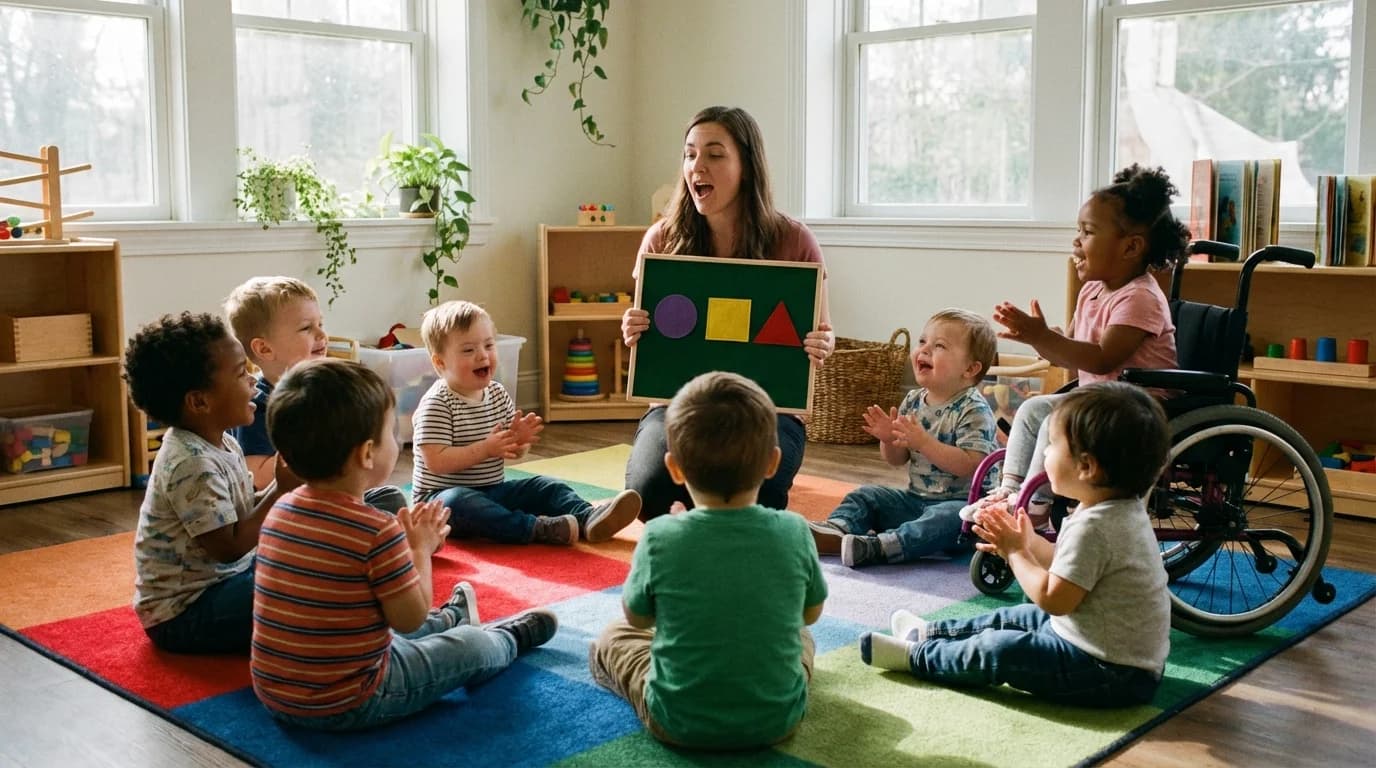
If you have ever picked up your child from preschool and asked, "What did you do today?" only to receive the enthusiastic but vague answer, "We did circle time!" you are not alone. Circle time is one of the most recognizable rituals in early childhood education, and for good reason. It is often the part of the day children remember most fondly, the time when the whole class gathers together to sing, share stories, discuss the day, and build the sense of community that makes a classroom feel like a second home.
But circle time is far more than a pleasant tradition. When implemented thoughtfully, it is a carefully structured learning experience that supports language development, social-emotional growth, cognitive skills, and the classroom behaviors that children will need when they enter kindergarten. When implemented poorly, it can become a frustrating exercise in crowd control that benefits no one. Understanding the difference matters for parents and educators alike.
At Einstein Daycare in Flatbush, Brooklyn, circle time is a daily cornerstone of our program, designed according to Creative Curriculum's large-group time guidelines from Teaching Strategies. This post explores what happens during effective circle time, how long it should last for different ages, what research tells us about its benefits, and how this seemingly simple routine helps prepare children for the academic and social expectations of elementary school.
What Happens During Circle Time
Circle time, sometimes called morning meeting, group time, or large-group time, is a period when the entire class gathers in a designated area, typically sitting on a rug or carpet in a circular or semicircular arrangement. The circular seating is intentional: it allows every child to see every other child and the teacher, creating a sense of equality and inclusion that other seating arrangements do not provide.
While specific activities vary by classroom and curriculum, most circle times include a combination of the following elements.
Greeting and Community Building
Circle time often begins with a greeting ritual. Children may say good morning to each other by name, sing a welcome song, or participate in a brief check-in where they share how they are feeling using words, pictures, or gestures. This greeting serves a developmental purpose beyond politeness: it helps children feel seen, valued, and connected to their classroom community. According to NAEYC's guidance on circle time and small groups, circle time is the ideal setting for establishing a classroom community as teachers and children take time to greet one another and reinforce social customs.
Calendar and Weather
Many preschool circle times include a calendar routine where children identify the day of the week, the date, and the month. Weather observation often accompanies this, with a child looking out the window or stepping outside to report on conditions, then updating a classroom weather chart. These routines build math concepts like sequencing, counting, and pattern recognition, along with science skills like observation and data recording. Over time, children begin to notice patterns in the weather that connect to their growing understanding of seasons.
Songs and Movement
Music is a staple of circle time, and its inclusion is backed by substantial research. Songs with hand motions like "The Itsy Bitsy Spider" or "Head, Shoulders, Knees, and Toes" develop phonological awareness, vocabulary, memory, and coordination simultaneously. Movement songs give children a chance to use their bodies, which is especially important for young children whose attention spans are refreshed by physical activity. At Einstein Daycare, our music enrichment program extends beyond circle time, but the songs and fingerplays introduced during group time become favorites that children carry through their day and bring home to share with families.
Read-Alouds and Storytelling
Shared reading is one of the most valuable activities in any preschool classroom, and circle time provides an ideal context for it. When a teacher reads a picture book to the whole group, children develop listening comprehension, vocabulary, narrative understanding, and the ability to make predictions and connections. Skilled teachers do not simply read the words on the page. They pause to ask questions: "What do you think will happen next? How do you think the character feels? Has something like this ever happened to you?" These interactive read-aloud techniques transform passive listening into active cognitive engagement.
Discussion and Sharing
Circle time often includes a period for children to share news, ask questions, or discuss a topic introduced by the teacher. This might be a conversation about an upcoming field trip, a classroom problem that needs solving, or an observation a child made on the playground. These discussions build oral language skills, teach children to listen to others, and provide practice with the turn-taking that is essential for later academic participation. For children who are quieter or more reserved, skilled teachers find gentle ways to include them without putting them on the spot.
Introduction to the Day's Activities
In many Creative Curriculum classrooms, circle time serves as a bridge between large-group gathering and the free-choice period that follows. Teachers may introduce new materials that have been added to an interest area, describe a special activity available that day, or ask children to make a plan for where they would like to start their exploration. This planning process, simple as it seems, develops executive function skills like decision-making, self-regulation, and goal-setting.
How Long Should Circle Time Last?
This is one of the most important and most frequently misunderstood aspects of circle time. Young children have limited attention spans for seated, teacher-directed activities, and exceeding those limits transforms circle time from a positive experience into a struggle. NAEYC guidance on circle time duration recommends keeping group time short and developmentally appropriate, emphasizing that young children should spend most of their time exploring materials and playing with other children rather than sitting in teacher-led activities.
Research-informed guidelines suggest the following approximate durations:
Two-year-olds: 5 to 8 minutes. At this age, circle time should be very brief and highly interactive, with lots of movement and music. Many experts recommend that circle time for twos be optional, allowing children to join or leave as they choose.
Three-year-olds: 8 to 12 minutes. Three-year-olds can sustain attention for slightly longer, but activities should change frequently within that window. A greeting song, a short book, and a movement activity might be the entire agenda.
Four- and five-year-olds: 12 to 20 minutes. Older preschoolers can handle longer circle times, particularly when activities are engaging and interactive. Even at this age, however, teachers should watch for signs of restlessness and be willing to end early rather than push through a losing battle.
At Einstein Daycare, our teachers are trained to read the room. If children are engaged and participating, circle time continues. If attention is waning, the teacher transitions to the next part of the day rather than insisting that everyone sit still. This responsiveness is itself a form of quality teaching, one that respects children's developmental needs and builds trust between teachers and children.
Creative Curriculum Large-Group Time
The Creative Curriculum for Preschool frames circle time as "large-group time" and provides specific guidance for making it purposeful and engaging. Within this framework, large-group time is not a separate activity bolted onto the day but an integrated component of the curriculum's study-based approach.
When a class is engaged in a study of, for example, trees, large-group time might include reading a book about different kinds of trees, singing a song about leaves, discussing what children observed on their nature walk, or introducing a new material in the Discovery Area related to the study. This integration means that circle time reinforces and extends the learning happening throughout the rest of the day, rather than existing in isolation.
Creative Curriculum also emphasizes the importance of planning large-group time with specific learning objectives in mind. A teacher does not simply choose a book at random. She selects one that connects to the current study, addresses a specific developmental objective, or responds to something children have expressed interest in. This intentionality distinguishes high-quality circle time from time-filling routine. For more about how Creative Curriculum shapes the full day at our program, visit our post on a typical day at daycare in Brooklyn.
Effective Versus Ineffective Circle Time
Not all circle times are created equal, and parents and educators benefit from understanding what separates effective group time from the kind that frustrates everyone involved.
Signs of Effective Circle Time
In an effective circle time, children are actively participating rather than passively sitting. The teacher makes eye contact with children, uses their names, and responds to their contributions with genuine interest. Activities are varied and include movement breaks. The teacher adjusts the pace and content based on children's responses. The atmosphere is warm and joyful, not rigid or controlling. Children who need to move can do so without being shamed. The content connects to children's lives, interests, and current classroom studies.
Effective circle time also builds on what the Harvard Center on the Developing Child identifies as serve-and-return interactions. When a child offers a comment or question during group discussion and the teacher responds thoughtfully, builds on the child's idea, and invites further thinking, both children's brains and the classroom community are strengthened.
Signs of Ineffective Circle Time
Ineffective circle time is characterized by excessive duration, with children expected to sit still for thirty minutes or more. The teacher does most of the talking while children listen passively. Activities are repetitive and disconnected from children's interests. Children who struggle to sit still are repeatedly corrected or removed. The primary focus is on compliance rather than engagement. The same routine is followed every day without variation or responsiveness to the group.
Research supports what experienced educators already know: when circle time becomes a battle of wills between a teacher demanding stillness and children whose bodies need to move, learning stops. The NAEYC position statement on Developmentally Appropriate Practice emphasizes that effective early childhood programs balance adult-directed and child-initiated activities, and that educators need to balance activities that require attentive behavior with time for more active movement.
How Circle Time Prepares Children for Kindergarten
For families in Flatbush and across Brooklyn, kindergarten readiness is a significant concern, and circle time plays a surprisingly important role in preparing children for the expectations of elementary school. The skills practiced during daily group time map directly onto the behaviors and competencies that kindergarten teachers identify as essential for school success.
Listening comprehension. In kindergarten, children are expected to listen to instructions, follow multi-step directions, and understand stories read aloud. Circle time provides daily practice with all of these skills in a supportive, low-pressure environment.
Turn-taking and group participation. Kindergarten classrooms involve regular whole-group discussions, partner sharing, and collaborative activities. Children who have practiced raising their hand, waiting for their turn to speak, and listening to classmates during circle time transition more smoothly into these academic routines.
Self-regulation. The ability to manage one's body and attention in a group setting is one of the strongest predictors of kindergarten success, often more predictive than academic skills like letter recognition. Circle time, when appropriately structured, gives children graduated practice with self-regulation in a context where expectations are clear and support is available. According to the CDC's developmental milestones for four-year-olds, children at this age are developing the ability to follow rules, take turns, and engage in cooperative play, all of which are reinforced during well-structured circle time.
Vocabulary and oral language. The rich language environment of circle time, including songs, stories, discussions, and new vocabulary introduced in context, builds the oral language foundation that supports reading comprehension in kindergarten and beyond. Children who enter kindergarten with strong vocabularies and the ability to express their ideas in sentences have a significant advantage in literacy development.
Foundational academic concepts. Calendar routines introduce counting, sequencing, and pattern recognition. Weather observation builds scientific thinking. Read-alouds develop story structure awareness and print concepts. Songs build phonological awareness. These are not isolated skills but integrated learning experiences that prepare children for formal academic instruction. For more on how outdoor experiences complement these classroom routines, see our post on outdoor play and kindergarten readiness.
Circle Time for Different Ages at Einstein Daycare
Because children's developmental needs vary significantly between ages two and five, circle time looks different in each of our classrooms at Einstein Daycare.
In our toddler classroom, group time is brief and almost entirely musical. Children gather on the rug for a few favorite songs with hand motions, perhaps a very short board book with large pictures, and a transition song that signals it is time to move to the next activity. The entire experience lasts five to eight minutes, and children are free to participate from the edges of the group if sitting in the circle does not work for them that day.
In our twos classroom, circle time expands slightly to include a simple greeting, a song or two, a short read-aloud, and a movement activity. Teachers use props like puppets, felt board pieces, or scarves to maintain interest. The duration is approximately eight to ten minutes, and teachers remain flexible, ready to shorten or extend based on the group's energy and engagement.
In our preschool classroom, circle time is the most structured, incorporating all the elements described earlier: greeting, calendar and weather, read-aloud, discussion, and introduction to the day's activities. Even here, however, the emphasis is on engagement rather than endurance. Our teachers plan circle time with the same intentionality they bring to every other part of the curriculum, selecting activities that connect to current studies and address specific learning objectives.
What Parents Can Do at Home
The skills children build during circle time can be reinforced at home through simple, everyday interactions. Reading together each evening builds the same listening comprehension and vocabulary that read-alouds develop at school. Singing songs in the car or during bath time reinforces phonological awareness and memory. Having regular family conversations at mealtimes, where everyone takes turns sharing something about their day, mirrors the discussion and turn-taking practiced during group time.
Parents can also support their child's circle time experience by talking about it positively. When your child mentions a song they learned or a book the teacher read, showing genuine interest and asking follow-up questions reinforces the message that what happens at school matters and that learning is something your family values. The Zero to Three organization emphasizes that responsive, back-and-forth interactions between children and caring adults are among the most powerful drivers of healthy brain development, whether those interactions happen at home or at school.
For more ideas on how daily routines support learning, explore our post on how to choose a daycare in Brooklyn, which includes guidance on evaluating classroom routines and daily schedules during your search.
A Small Ritual With Large Impact
Circle time may occupy only fifteen minutes of a preschooler's day, but its impact extends far beyond that brief window. It is where children learn that they belong to a community. It is where they discover that their words matter and that listening to others is worthwhile. It is where songs become memory tools, stories become windows into other lives, and the simple act of sitting together becomes practice for the collaborative learning they will do for the rest of their educational lives.
At Einstein Daycare, we treat circle time with the seriousness it deserves: not as filler, not as crowd control, but as one of the most valuable learning opportunities in our day. Our teachers plan it carefully, deliver it warmly, and adjust it constantly to meet the needs of the real, individual children sitting in front of them. That commitment to intentional, responsive teaching is what makes circle time at our program not just a routine but a foundation for lifelong learning.
See Circle Time in Action at Einstein Daycare
Want to experience the warmth and intentionality of our daily routines for yourself? Flatbush families are invited to schedule a classroom visit and see how circle time, free play, and every part of our day supports your child's growth. Request a tour online or call us at (718) 618-7330. Einstein Daycare is located at 900 Lenox Rd, Brooklyn, NY 11203, serving families throughout Flatbush, Crown Heights, East Flatbush, and surrounding Brooklyn neighborhoods.