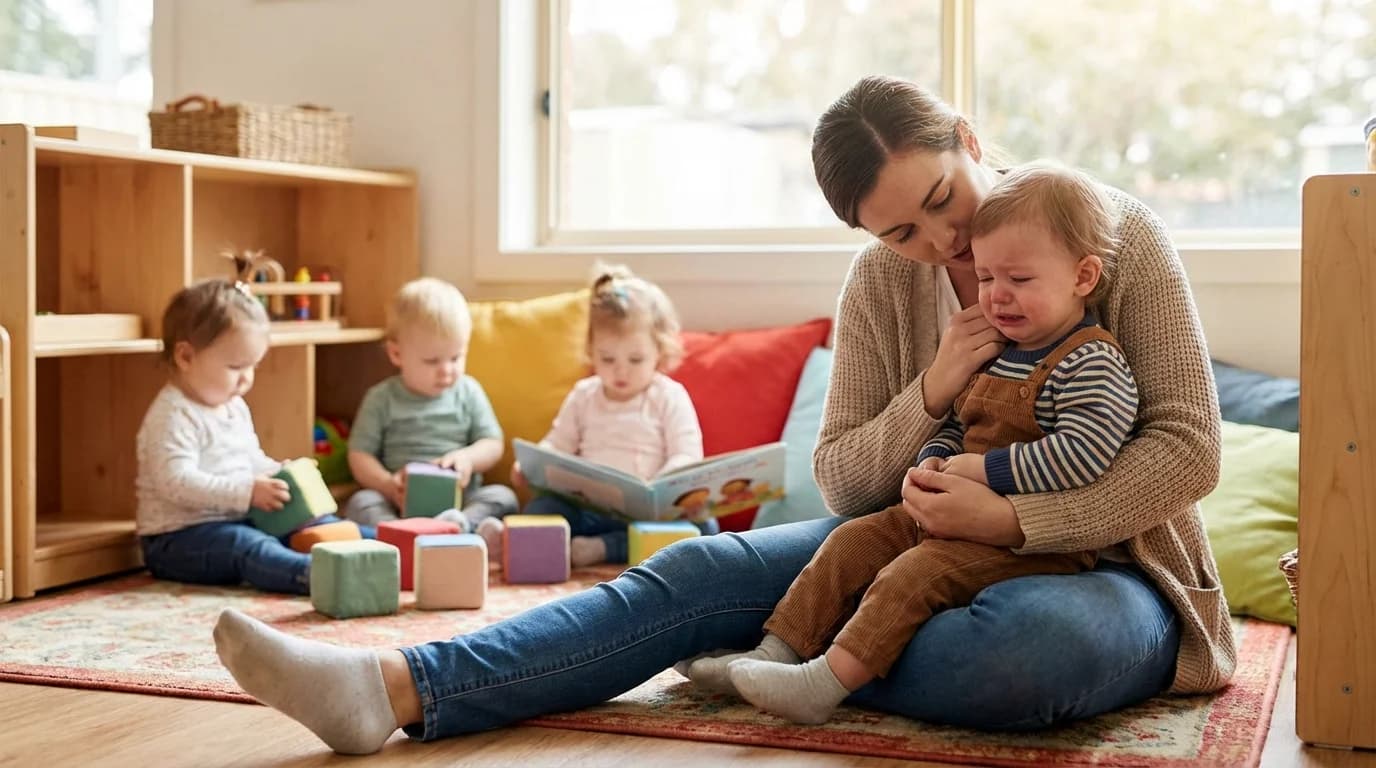
If you have ever watched a toddler go from joyful laughter to a full-body meltdown in the span of thirty seconds, you have witnessed firsthand what researchers call the developing capacity for emotional regulation. For young children, feelings arrive with an intensity that can be overwhelming, not because something is wrong with them, but because the parts of the brain responsible for managing emotions are still under construction. Learning to understand, express, and regulate those big feelings is one of the most important developmental tasks of early childhood, and it is one of the areas where a quality daycare environment can make a profound difference.
For families in Prospect Lefferts Gardens, Crown Heights, and the broader 11225 area of Brooklyn, understanding how daycare supports emotional development can help parents make sense of the emotional ups and downs that are a normal part of their child's growth. At Einstein Daycare, located at 900 Lenox Rd in Brooklyn, we approach emotional regulation not as something to be corrected, but as a skill to be taught, practiced, and supported with the same intentionality we bring to literacy or mathematics.
Understanding Emotional Regulation in Young Children
Emotional regulation refers to a person's ability to recognize their emotions, understand what those emotions mean, and manage how they express and respond to those feelings. For adults, this might look like taking a deep breath before responding to a frustrating email. For a three-year-old, this same process is extraordinarily difficult because the prefrontal cortex, the brain region responsible for impulse control and rational decision-making, will not be fully developed until their mid-twenties.
According to Zero to Three, children do not develop meaningful self-control until approximately three and a half to four years of age, and even then, they still need significant help managing their emotions and impulses. This is not a failure of parenting or teaching. It is a reflection of brain development. The Harvard Center on the Developing Child explains that executive function and self-regulation skills, which include the ability to manage emotions, develop through experience and practice in supportive environments. No one is born with these skills, but everyone is born with the potential to develop them.
Understanding this developmental reality is liberating for parents and teachers alike. It means that a child's tantrum is not a sign of poor behavior. It is a signal that they need help building a skill they have not yet mastered.
What Emotional Regulation Looks Like at Different Ages
Infants (Birth to 12 Months)
Infants have virtually no capacity for self-regulation. They depend entirely on caregivers to help them manage distress. When a baby cries and a caregiver responds with warmth, feeding, rocking, or a soothing voice, the baby's nervous system begins to calm. This responsive pattern, which the Harvard Center on the Developing Child calls serve and return, is the foundation upon which all later emotional regulation is built. More than one million neural connections form every second in the first years of life, and the quality of these early interactions shapes the brain's architecture for managing stress and emotion.
Toddlers (12 to 36 Months)
Toddlers begin to develop an awareness of their own emotions and the emotions of others, but they lack the tools to manage what they feel. This is the age of big reactions, as frustration over a broken cracker or a toy taken by a peer can feel genuinely catastrophic. The American Academy of Pediatrics notes that this period is characterized by rapid emotional development alongside limited verbal ability, which means children often express their feelings through behavior rather than words.
Preschoolers (3 to 5 Years)
By the preschool years, children are developing a richer emotional vocabulary and beginning to use simple strategies to manage their feelings. The AAP describes preschoolers as especially sensitive to the feelings of others, noting that they enjoy making people happy and show sympathy and concern when they see others are hurt or sad. However, they still move freely between fantasy and reality and can become overwhelmed by strong emotions. This is the stage where intentional teaching of emotional regulation strategies begins to have the most impact.
How Daycare Supports Emotional Regulation
Co-Regulation: The Foundation of Emotional Learning
Zero to Three defines co-regulation as what a caregiver does with a child to help them feel safe, calm, and understood. It is the essential first step before any child can begin to self-regulate. Strong co-regulation in early childhood is directly connected to how well a child develops coping strategies, emotional awareness, and resilience over time.
In a daycare setting, co-regulation looks like a teacher sitting at eye level with a crying child, using a calm voice and steady presence. It looks like a caregiver placing a gentle hand on a frustrated toddler's back and breathing slowly, allowing their own regulated nervous system to help calm the child's activated one. The NAEYC emphasizes that teachers can use a calm voice and gentle touch to comfort young children, and that slowing your own breathing helps them return to a regulated state.
At Einstein Daycare, our teachers are trained in co-regulation techniques that prioritize connection before correction. We understand that a child cannot learn from a conversation about behavior while they are still in a state of emotional overwhelm. Regulation always comes first.
Naming and Labeling Emotions
One of the most powerful tools for emotional regulation is surprisingly simple: giving feelings a name. When a teacher says, "You look frustrated because Maya took the block you were using," they are doing several things at once. They are validating the child's experience, teaching emotional vocabulary, and modeling the connection between events and feelings.
Research consistently shows that the ability to label emotions is a critical step toward managing them. When children have words for what they feel, they can begin to communicate their needs verbally rather than through hitting, crying, or withdrawing. The NAEYC recommends strategies that help children understand and manage emotions, noting that naming feelings is a foundational practice that supports emotional intelligence throughout life. Our approach at Einstein Daycare aligns closely with the work we do around social-emotional development across all of our classrooms.
Calm-Down Corners and Safe Spaces
Many quality daycare programs, including Einstein Daycare, incorporate designated calm-down areas within each classroom. These are not punishment spaces or "time-out" chairs. They are intentionally designed corners with soft seating, sensory tools like stress balls or textured fabrics, visual emotion charts, and sometimes books about feelings. The purpose is to give children a place to go when they need help returning to a regulated state.
The NAEYC notes that providing access to sensory experiences, such as textured toys, sand and water play, art experiences, and music, can be calming and regulating for children. A calm-down corner equipped with these kinds of materials gives children both a physical space and a set of tools they can use when feelings become overwhelming.
Breathing Techniques and Body-Based Strategies
Teaching young children to use their bodies as tools for emotional regulation is remarkably effective. Simple breathing exercises, such as "smell the flower, blow out the candle" or "balloon breathing" where children imagine inflating a balloon in their belly, give children concrete, physical actions they can take when they feel upset.
Research published in the National Institutes of Health found that yoga interventions for young children resulted in measurable improvements in self-regulation and emotion regulation, particularly for children from economically diverse backgrounds. At Einstein Daycare, our dedicated yoga program gives children regular practice with breathing techniques, body awareness, and mindful movement, all of which translate directly into improved emotional regulation throughout the day. You can learn more about our approach in our article on why movement and music matter in preschool.
The RULER Approach to Emotional Intelligence
One of the most well-researched frameworks for teaching emotional regulation in educational settings is the RULER approach, developed at the Yale Center for Emotional Intelligence. RULER stands for five learnable skills of emotional intelligence: Recognizing, Understanding, Labeling, Expressing, and Regulating emotion.
The RULER framework includes tools like the Mood Meter, which helps children identify the full range of their emotions, and the Meta-Moment, which teaches children to pause and respond with their "best self" in mind when experiencing strong emotions. Research shows that RULER implementation improves academic outcomes, reduces bullying, and enriches school climate. While RULER is primarily designed for school-age children, its core principles, particularly around recognizing and labeling emotions, inform best practices in early childhood settings as well.
At Einstein Daycare, we draw on these evidence-based principles by integrating emotion recognition into daily conversations, using visual tools like feeling charts, and creating classroom cultures where all emotions are accepted and children are supported in learning healthy ways to express them.
The Role of Yoga in Emotional Regulation
Einstein Daycare's yoga program is not simply a physical activity. It is a carefully integrated component of our emotional regulation curriculum. A systematic review published by the National Institutes of Health found that yoga and mindfulness are promising practices for addressing social-emotional development among preschool-aged children, with multiple studies reporting improvements in regulatory skills including behavioral self-regulation and executive function.
During yoga sessions, children practice deep breathing, learn to notice how their body feels, and develop awareness of the connection between physical sensations and emotions. A child who has practiced "belly breathing" during yoga can draw on that skill when they feel angry on the playground. A child who has learned to notice tension in their shoulders during a stretching exercise can begin to recognize the physical signs of frustration before it escalates into a meltdown.
What Parents Can Expect and How to Help at Home
Emotional regulation is not a skill that develops overnight. Parents of children in the Prospect Lefferts Gardens and Crown Heights neighborhoods should expect the process to be gradual, nonlinear, and sometimes messy. A child who managed a disappointment beautifully on Monday may have a complete meltdown over a similar situation on Wednesday. This is normal. Fatigue, hunger, illness, and transitions all affect a child's emotional capacity.
The American Academy of Pediatrics advises that emotion coaching starts with noticing your child's feelings, helping name those emotions, acknowledging how they feel, and then addressing the underlying need. They also note that children often use sensory activities or body movement to channel their feelings, such as jumping, getting a hug, or listening to music.
Here are some ways Brooklyn families can reinforce emotional regulation at home. Practice naming your own emotions out loud, as modeling is one of the most powerful teaching tools. Say things like, "I feel frustrated that we are stuck in traffic, so I am going to take three deep breaths." Create a small calm-down area at home with a few comforting objects. Read books about feelings together, and talk about the characters' emotions. Most importantly, validate your child's feelings before trying to fix the situation. A simple "I can see you are really upset" goes further than "stop crying" ever will.
The Long-Term Impact of Early Emotional Learning
The emotional regulation skills children develop in their daycare years have consequences that extend far beyond early childhood. Children who learn to manage their emotions effectively are better equipped for academic success, healthier peer relationships, and greater overall well-being throughout their lives. The Harvard Center on the Developing Child emphasizes that executive function skills, which include emotional regulation, are more important for school readiness than the specific content knowledge a child has learned.
At Einstein Daycare, we see the evidence of this every day. Children who arrive unable to express their frustration without hitting gradually learn to use words. Children who once fell apart at every transition learn to breathe, wait, and move on. These changes do not happen because children are told to behave differently. They happen because children are given the tools, the practice, and the supportive relationships they need to grow. Our Teaching Strategies GOLD assessment system tracks each child's social-emotional development, ensuring that our teachers can provide targeted support and that families can see their child's progress over time.
Supporting Your Child's Emotional Growth at Einstein Daycare
Our teachers are trained in co-regulation, emotional coaching, and evidence-based strategies that help children learn to manage big feelings in healthy ways. Schedule a tour of Einstein Daycare at 900 Lenox Rd, Brooklyn, NY 11203 to see our approach in action.
Schedule a Tour Online or call us at (718) 618-7330.