Choosing a daycare is one of the most consequential decisions a parent makes, and it is also one of the most difficult. You tour a facility, observe a classroom for twenty minutes, and try to determine whether this is the place where your child will be safe, happy, and well-supported for the next several years. But what does quality actually look like in a preschool classroom? How can you tell whether the cheerful decorations on the wall reflect genuinely thoughtful educational practice, or whether they are simply window dressing?
This is exactly the problem that the Early Childhood Environment Rating Scale, Revised Edition, commonly known as ECERS-R, was designed to solve. Developed by researchers at the Frank Porter Graham Child Development Institute at the University of North Carolina, ECERS-R provides a systematic, research-validated method for evaluating the quality of early childhood classrooms serving children ages two and a half through five. It is used in all fifty states and in numerous countries worldwide, and it remains one of the most widely recognized tools for distinguishing between mediocre, adequate, and excellent childcare environments.
At Einstein Daycare in Brooklyn, we use ECERS-R standards as a guiding framework for our classroom environments. We believe that Brooklyn parents, including families in Crown Heights, Flatbush, East Flatbush, and surrounding neighborhoods, deserve to understand what quality measurement means so they can make informed decisions about their children's care. This post explains what ECERS-R evaluates, how scoring works, why it matters for your child's development, and what questions you should ask any daycare you are considering.
What ECERS-R Actually Measures
ECERS-R defines "environment" broadly. It is not simply about whether the classroom has enough toys or whether the paint on the walls is fresh. The scale assesses what researchers call process quality: the full range of experiences a child has in a classroom, including interactions with teachers and peers, access to materials, the structure of the daily schedule, and provisions for health and safety. According to the FPG Child Development Institute's Environment Rating Scales project page, the instrument guides observers to assess the arrangement of indoor and outdoor space, the materials and activities offered, the supervision and interactions that occur, and the schedule of the day including both routines and activities.
The scale consists of 43 items organized into seven subscales. Each subscale addresses a different dimension of classroom quality.
The Seven Subscales of ECERS-R
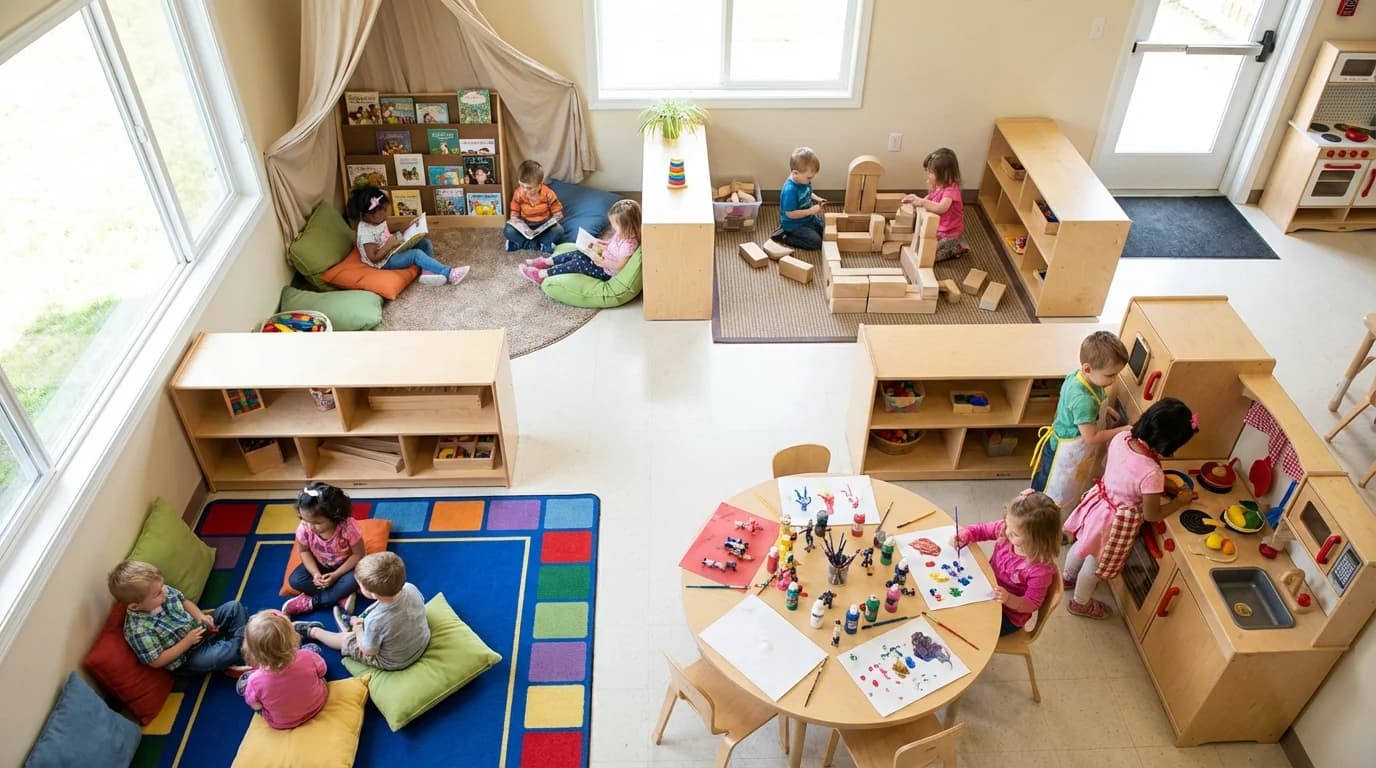
1. Space and Furnishings. This subscale evaluates whether the physical classroom environment supports children's learning and well-being. It examines whether there is adequate indoor space that is well-maintained and arranged for children's use, whether furnishings are child-sized and in good repair, whether there are soft areas for comfort, whether the room arrangement allows for different types of activities, and whether displays are related to current classroom activities and placed at children's eye level. A high-scoring classroom is not necessarily the one with the newest furniture but the one where the space is thoughtfully organized to promote independence, exploration, and comfort.
2. Personal Care Routines. This subscale looks at the quality of daily care routines including greeting and departure, meals and snacks, nap and rest time, toileting and diapering, and health and safety practices. It evaluates whether these routines are handled in ways that are not only sanitary and safe but also warm, unhurried, and respectful of each child's individual needs. In a high-quality classroom, even diaper changes become opportunities for one-on-one interaction and language development.
3. Language-Reasoning. Communication is assessed through this subscale, which examines whether children have frequent opportunities to engage in conversation with teachers and peers, whether books are accessible and used regularly, whether teachers encourage children to communicate their ideas and feelings, and whether reasoning skills are fostered through questions and problem-solving activities. Language-rich environments are among the strongest predictors of later academic success.
4. Activities. This is one of the broadest subscales, evaluating the range and quality of activities available to children. It covers fine motor activities, art, music and movement, blocks, sand and water play, dramatic play, nature and science, math and number activities, and the use of technology. A high score requires not just that these materials exist but that they are accessible, varied, and rotated regularly to maintain children's interest. For more on how specific activity areas support learning, see our post on the benefits of dramatic play in preschool.
5. Interaction. This subscale is often considered the most important because it directly measures the quality of relationships in the classroom. It evaluates supervision of children, the discipline approach used, the quality of staff-child interactions, and the nature of interactions among children. Observers look for warmth, responsiveness, respect, and the absence of harsh or punitive discipline. Research consistently shows that the quality of teacher-child interactions is the single strongest predictor of children's developmental outcomes in childcare settings.
6. Program Structure. This subscale examines how the day is organized, including whether there is a predictable schedule with a balance of active and quiet activities, whether children have substantial periods of free play, whether group time is appropriate in length and content, and whether provisions are made for children with disabilities. A well-structured program gives children both the security of routine and the freedom to explore their interests.
7. Parents and Staff. The final subscale evaluates provisions for the adults in the program, including communication with parents, opportunities for professional development, staff supervision and evaluation, and whether staff have adequate breaks and working conditions. This subscale recognizes a fundamental truth: the quality of care children receive is directly related to the quality of support their caregivers receive.
How ECERS-R Scoring Works
Each of the 43 items on the ECERS-R is scored on a scale of 1 to 7, with specific indicators defined at each level:
1 - Inadequate. Conditions at this level may pose risks to children's health, safety, or development. Basic needs are not consistently met. Materials may be lacking or inappropriate.
3 - Minimal. Basic health and safety needs are met, but the environment provides limited support for learning and development. This is often the minimum standard required for licensing compliance.
5 - Good. The environment actively supports children's development with appropriate materials, positive interactions, and a well-organized program. Most children's needs are met consistently.
7 - Excellent. The environment provides exceptional, individualized support for children's learning and development. Interactions are consistently warm and stimulating. Materials are rich, varied, and accessible. The program reflects deep understanding of child development.
Scores of 2, 4, and 6 represent intermediate levels between these anchors. The total score is an average across all items and subscales. In practice, a program scoring consistently at 5 or above is considered high-quality, while scores below 3 indicate significant concerns.
Why Environment Quality Predicts Child Outcomes
The connection between classroom environment quality and children's developmental outcomes is not theoretical. It is supported by decades of rigorous research. The landmark NICHD Study of Early Child Care and Youth Development, the largest and longest-running study of childcare in the United States, followed more than 1,300 children from birth through age fifteen across ten sites nationwide. The study found that higher quality child care was consistently related to better cognitive, language, and academic outcomes at every age measured, and that these effects persisted into elementary school and beyond.
A systematic review and meta-analysis published in Early Childhood Research Quarterly examined the relationship between ECERS/ECERS-R scores and child outcomes across multiple studies, confirming that environment quality as measured by these scales is associated with children's language development and positive behavioral outcomes. While the effect sizes are modest, the consistency of the findings across diverse populations and settings is striking.
What makes this research particularly relevant for Brooklyn parents is its implication for equity. Children from economically disadvantaged backgrounds show the largest gains from attending high-quality programs. In a city as economically diverse as New York, access to high-quality early childhood environments is not a luxury. It is a matter of educational equity. This is one reason why understanding quality indicators like ECERS-R is especially important for families in Crown Heights, East Flatbush, and neighboring communities.
Licensing Minimum Versus Quality Excellence
One of the most important distinctions parents need to understand is the difference between licensing compliance and genuine quality. In New York City, group childcare programs are regulated under Article 47 of the NYC Health Code, administered by the Department of Health and Mental Hygiene. These regulations set minimum standards for health, safety, staffing ratios, and physical space. Meeting these standards is necessary and important, but licensing requirements represent a floor, not a ceiling. You can learn more about what NYC licensing involves in our parent's guide to NYC daycare licensing.
A program can be fully licensed and still score a 3 on the ECERS-R, meaning it meets minimal quality standards. Conversely, a program that aspires to ECERS-R scores of 5 or above is going far beyond licensing requirements, investing in the quality of interactions, the richness of learning materials, the thoughtfulness of the daily schedule, and the depth of its partnership with families. At Einstein Daycare, we hold ourselves to the higher standard because we believe every child deserves more than the minimum.
The NAEYC's framework for Developmentally Appropriate Practice provides additional guidance that aligns with ECERS-R's vision of quality, emphasizing that effective early childhood programs are built on strong, caring relationships, meaningful curriculum, and responsive teaching that adapts to each child's strengths and needs.
What Einstein Daycare Does Differently
At Einstein Daycare, we use the ECERS-R framework as a continuous improvement tool, not just an evaluation that happens once and is filed away. Here is what that looks like in practice across several of the subscales.
In our physical environment, classrooms are organized into clearly defined interest areas, including blocks, dramatic play, art, library, discovery, and fine motor areas. Materials are stored on low, open shelves where children can access them independently. Displays reflect current classroom projects and include children's actual work, not commercially produced decorations. These design choices directly reflect ECERS-R best practices in the Space and Furnishings subscale and align with the centers-based approach described in our post on Creative Curriculum at Einstein Daycare.
In our interactions, teachers are trained to engage in warm, responsive communication with every child throughout the day. We prioritize what the Harvard Center on the Developing Child describes as serve-and-return interactions, the back-and-forth exchanges between children and attentive adults that build brain architecture. When a toddler points at a bird outside the window, the teacher does not simply nod. She names the bird, describes what it is doing, and asks the child what they notice. These moments are small, but accumulated over days and weeks and months, they shape a child's cognitive and emotional development profoundly.
Our daily schedule balances active and quiet activities, individual and group time, indoor and outdoor play. Children have extended periods of free choice time when they can explore interest areas at their own pace, which the ECERS-R Program Structure subscale identifies as essential for high-quality programs.
Questions Brooklyn Parents Should Ask Any Daycare
Armed with an understanding of ECERS-R, you are better positioned to evaluate any childcare program you visit. Here are questions that get beyond surface appearances and into the substance of quality.
About the environment: How are your classrooms organized? Can children access materials independently? How often do you rotate materials and activities? Are learning areas clearly defined?
About interactions: What is your approach to discipline? How do teachers respond when a child is upset? What does a typical teacher-child conversation look like during free play?
About the program: What does a typical day look like? How much time do children spend in free play versus teacher-directed activities? How do you accommodate children with different interests and developmental levels?
About assessment: How do you track children's learning and development? Do you use a formal assessment tool? How do you share progress with families? At Einstein Daycare, we use Teaching Strategies GOLD, which allows our teachers to document children's growth through authentic observation rather than standardized testing.
About quality improvement: Do you use any quality rating tools or participate in quality improvement programs? What professional development do your teachers receive? How do you ensure consistency across classrooms?
About parent partnership: How do you communicate with families about their child's day? Are parents welcome to visit at any time? How do you incorporate family input into the program?
A program that welcomes these questions and answers them thoughtfully is one that takes quality seriously. A program that seems uncomfortable or dismissive may not have invested in the kind of intentional, evidence-based practice that ECERS-R measures.
Beyond ECERS-R: The Evolving Landscape of Quality Measurement
It is worth noting that the field of early childhood quality measurement continues to evolve. The creators of ECERS-R have since published the ECERS-3, the third edition of the Environment Rating Scale, which refines and updates the instrument based on new research and feedback from the field. The ECERS-3 places greater emphasis on teacher-child interactions and less on the mere presence of materials, reflecting growing evidence that what adults do with children matters more than the physical objects in the room.
Regardless of which specific edition is used, the core principle remains the same: quality in early childhood education is measurable, and it matters deeply for children's outcomes. Parents who understand this principle are empowered to advocate for their children and to choose programs that genuinely support their development.
Quality Is a Choice, Not an Accident
High-quality early childhood environments do not happen by accident. They are the result of deliberate decisions: decisions about how to arrange a classroom, how to train and support teachers, how to structure the day, and how to partner with families. At Einstein Daycare, we make these decisions with intention every day, guided by the research-based standards that ECERS-R represents.
For Crown Heights, Flatbush, and East Flatbush families seeking childcare that goes beyond the basics, we invite you to visit our classrooms and see quality in action. The difference between a minimal environment and an excellent one is visible the moment you walk through the door, and your child will feel it every day they are in our care.
Experience Quality Childcare at Einstein Daycare
We welcome Crown Heights and Brooklyn families to visit our classrooms and see our commitment to quality firsthand. Our teachers are happy to answer your questions about our environment, our curriculum, and our approach to supporting every child's growth. Schedule a tour online or call us at (718) 618-7330. Einstein Daycare is located at 900 Lenox Rd, Brooklyn, NY 11203, and we look forward to meeting your family.