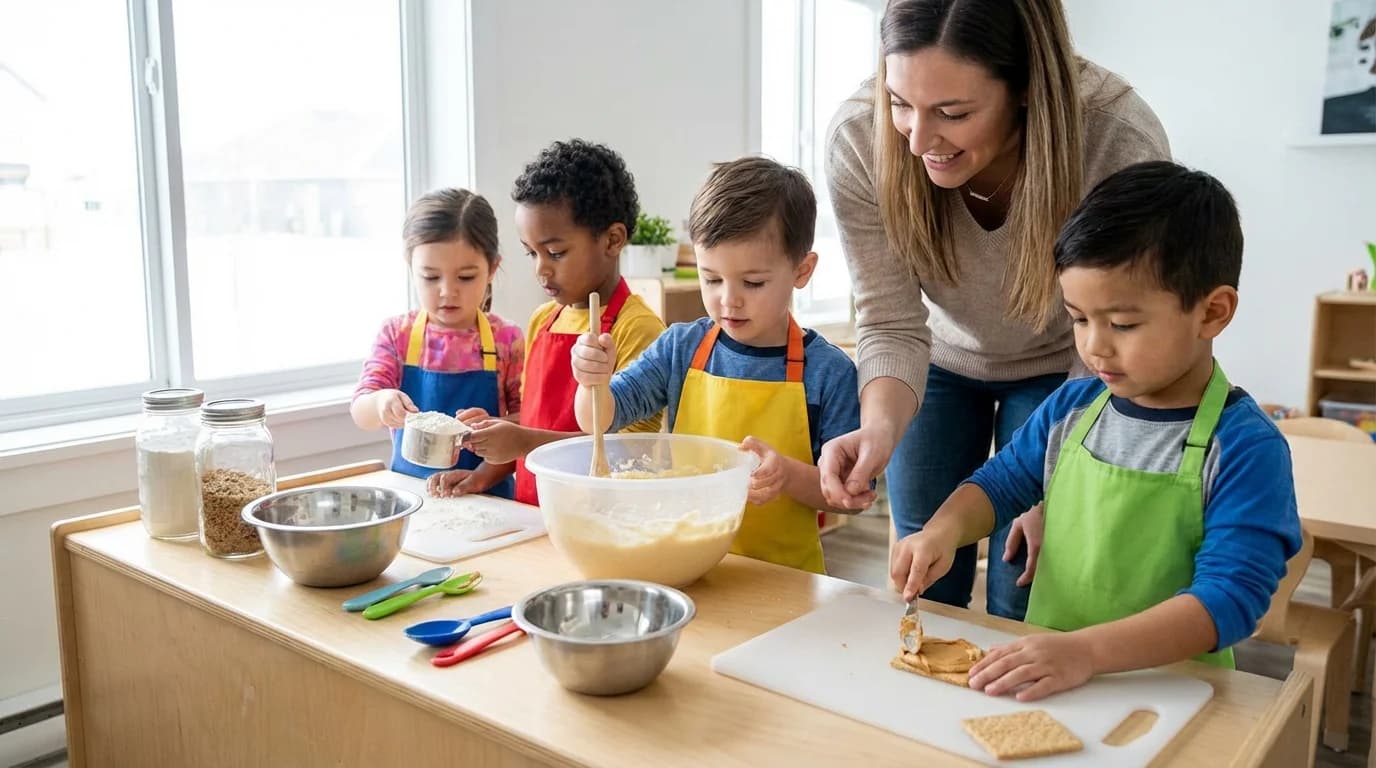
There is no single activity in early childhood education that packs as much learning into one experience as cooking. When a group of preschoolers gathers around a table to make banana muffins, they are not just following a recipe. They are measuring ingredients (math), observing how heat transforms batter into bread (science), reading recipe steps (literacy), taking turns and sharing tools (social skills), and building the confidence that comes from creating something real and useful (life skills).
At Einstein Daycare in East Flatbush, Brooklyn, cooking activities are a regular part of our Creative Curriculum programming. We have seen firsthand how these experiences captivate even the most reluctant learners and create some of the most memorable moments of the school year. For families in the 11203 zip code and surrounding neighborhoods, understanding the depth of learning in preschool cooking can change how you think about what your child does all day.
Math in the Measuring Cup
Cooking is arguably the most natural and effective way to introduce math to young children. There is nothing abstract about it. When a child scoops one cup of flour, they are learning about measurement. When they count three eggs, they are practicing one-to-one correspondence. When they notice that two half-cups fill one whole cup, they are building an intuitive understanding of fractions.
The National Association for the Education of Young Children (NAEYC) highlights baking as a powerful context for math learning, noting that doubling recipes requires multiplying, halving requires dividing, and measuring with half-cups and quarter-teaspoons introduces children to fractions in a meaningful, hands-on way. NAEYC recommends building a habit called "mise en place," or putting everything in order, which teaches children sequencing and organizational skills alongside the math.
At Einstein Daycare, our teachers use cooking activities to reinforce the math concepts children are exploring in other areas of the classroom. When we make trail mix, children practice counting and sorting. When we follow a recipe for playdough, they work with measurement and proportional reasoning. When we make fruit salad, they discuss concepts like "more," "less," "equal," and "enough." The NAEYC emphasizes that embedding math in everyday activities like cooking is one of the most effective strategies for building number sense in young children.
Science You Can Taste
Every cooking activity is a science experiment. When children watch butter melt in a warm pan, they are observing a change of state. When they mix baking soda and vinegar for a recipe and see it fizz, they are witnessing a chemical reaction. When they knead bread dough and watch it rise, they are learning about the biological process of fermentation, even if they do not know the word yet.
These are not obscure scientific concepts. They are the building blocks of scientific literacy: observing changes, identifying cause and effect, making predictions, and testing hypotheses. "What do you think will happen when we put the batter in the oven?" is a genuine scientific question, and preschoolers take it seriously.
Our Creative Curriculum framework encourages teachers to use cooking as an opportunity to model scientific thinking. Teachers narrate what they observe ("The butter is starting to melt. It is changing from solid to liquid."), ask prediction questions ("Do you think the bananas will get softer or harder when we mash them?"), and help children connect cooking observations to broader scientific concepts they encounter in the natural world.
Literacy Through Recipes
Recipes are one of the most functional forms of text that young children encounter. A recipe has a title, a list of ingredients, numbered steps, and a clear purpose. When children follow a recipe, they are practicing reading comprehension in the most practical way possible.
At Einstein Daycare, we create visual recipe charts with pictures alongside words so that pre-readers can follow along independently. Children learn that text carries meaning, that we read from left to right and top to bottom, and that the sequence of steps matters. These are the foundational literacy skills that the NAEYC identifies as essential for kindergarten readiness.
Cooking also builds vocabulary in a way that sticks. Words like "stir," "whisk," "knead," "sprinkle," "measure," "pour," "dissolve," "mixture," and "ingredients" become part of children's working vocabulary because they are connected to actions the children perform themselves. Research consistently shows that vocabulary acquired through hands-on experience is retained more effectively than vocabulary learned through isolated instruction.
Social Skills and Teamwork in the Kitchen
Cooking is inherently collaborative. Children must share ingredients, wait their turn to stir, pass items to their neighbor, and work together toward a shared goal. These experiences build the social-emotional skills that are among the strongest predictors of long-term school success.
The American Academy of Pediatrics has documented that cooperative, hands-on activities like cooking support children's development of executive function skills, including self-regulation, working memory, and flexible thinking. In our cooking activities, children practice waiting for their turn, following multi-step directions, offering help to classmates, and cleaning up together.
Life Skills That Last
In an age when many adults struggle with basic food preparation, introducing children to cooking early builds competence and confidence that lasts a lifetime. Preschoolers who participate in cooking activities develop an understanding of where food comes from, comfort and familiarity with kitchen tools, awareness of basic food safety practices, pride in contributing to a meal, and willingness to try new foods.
That last point is particularly significant. Children who participate in preparing food are more willing to taste the results, even when the dish includes ingredients they might otherwise refuse. As we discuss in our post about nutrition and meals at daycare, building a healthy relationship with food starts early and benefits from hands-on experience.
Food Safety and Allergy Considerations
Parents rightfully want to know how cooking activities are managed safely in a classroom setting. At Einstein Daycare, food safety is paramount. Before any cooking activity begins, every child washes hands thoroughly with soap and water. All cooking surfaces are cleaned and sanitized. Teachers check allergy records and adapt recipes to exclude known allergens. Children use age-appropriate tools, and all cutting is done by adults or with child-safe implements. Hot surfaces and appliances are managed exclusively by adults.
We maintain detailed allergy documentation for every child enrolled, and our staff is trained in allergy awareness and emergency response. The CDC's guidelines for managing food allergies in early care settings inform our policies, which include strict protocols for preventing cross-contamination and ensuring that every child can participate safely in cooking activities.
For cooking projects, we select recipes that can be easily modified to accommodate common allergens. Dairy-free, nut-free, and gluten-free variations are standard considerations in our meal planning. Parents are always informed in advance about upcoming cooking activities and the ingredients involved.
Cultural Food Traditions in a Diverse Brooklyn Classroom
One of the greatest gifts of cooking in a diverse classroom is the opportunity to explore and honor the cultural food traditions that children bring from home. East Flatbush is one of the most culturally rich neighborhoods in the country, and our classrooms reflect that diversity.
Throughout the year, we invite families to share recipes meaningful to their heritage. A grandmother's sorrel drink, a parent's method for making dumplings, a family's special rice and peas: these contributions transform cooking into celebrations of cultural identity. The NAEYC has documented the importance of incorporating knowledge from children's homes and communities into classroom learning, noting that this approach honors families' cultural assets and strengthens the home-school connection.
Our cooking activities have introduced children to plantains from Caribbean families, dumplings from Chinese families, pupusas from Salvadoran families, and many other dishes. This early exposure to cultural diversity through food builds the openness and empathy that serve children throughout their lives.
Cooking and the Creative Curriculum Framework
Within The Creative Curriculum framework, cooking activities connect to virtually every domain of learning. Cognitive development includes understanding cause and effect, sequencing, and problem-solving. Language development includes vocabulary building, following directions, and conversational skills. Physical development includes fine motor practice through stirring, pouring, kneading, and spreading. Social-emotional development includes cooperation, patience, and pride in accomplishment. Math includes measurement, counting, and comparing quantities. Science includes observing changes in matter, making predictions, and exploring properties of materials.
Our teachers use Teaching Strategies GOLD to document children's growth across these domains during cooking activities. A single muffin-making session might generate observation notes about a child's emerging counting skills, their ability to follow two-step directions, their willingness to try a new food, and their use of descriptive language. This kind of multi-domain documentation helps us build a complete picture of each child's development.
For a deeper look at how our curriculum integrates hands-on learning across all classroom areas, visit our post on understanding Creative Curriculum at Einstein Daycare.
Nutrition Awareness From the Start
Cooking activities provide a natural opportunity to talk about nutrition in a way that is positive and age-appropriate. Rather than lecturing children about "good foods" and "bad foods," we help them notice how different foods make their bodies feel, explore where food comes from (farms, gardens, trees, the ground), understand that our bodies need different kinds of food to grow strong, and appreciate the effort that goes into preparing meals.
The USDA's Child and Adult Care Food Program (CACFP) provides nutritional guidelines that shape our overall meal planning, and our cooking activities reinforce these standards by emphasizing whole grains, fresh fruits and vegetables, and balanced nutrition. When children help prepare their own healthy snacks, they develop a relationship with nutritious food that goes beyond what any poster or lesson plan can achieve.
Simple Cooking Activities for Home
You do not need a gourmet kitchen to bring cooking activities home. Here are some simple ideas that work well with preschool-age children: making trail mix by counting and mixing different ingredients, spreading peanut butter or cream cheese on celery or crackers, washing and tearing lettuce for a salad, mashing bananas for banana bread, stirring batter for pancakes, assembling personal pizzas with pre-cut toppings, and making smoothies with fresh fruit and yogurt.
The most important thing is to let your child participate actively. The learning happens in the doing, and the mess is part of the experience.
More Than a Recipe
When your child comes home talking about the soup they made at school, know that they practiced math, explored science, built literacy skills, strengthened social connections, honored cultural traditions, and developed life skills that will serve them far beyond the classroom. At Einstein Daycare, every recipe we make together is an opportunity to grow minds, build community, and nourish both bodies and spirits.
Discover how Einstein Daycare integrates cooking and other hands-on learning into every day. Visit our classrooms at 900 Lenox Rd, Brooklyn, NY 11203, and see our Creative Curriculum in action. Schedule a tour online or call (718) 618-7330 to learn more.